

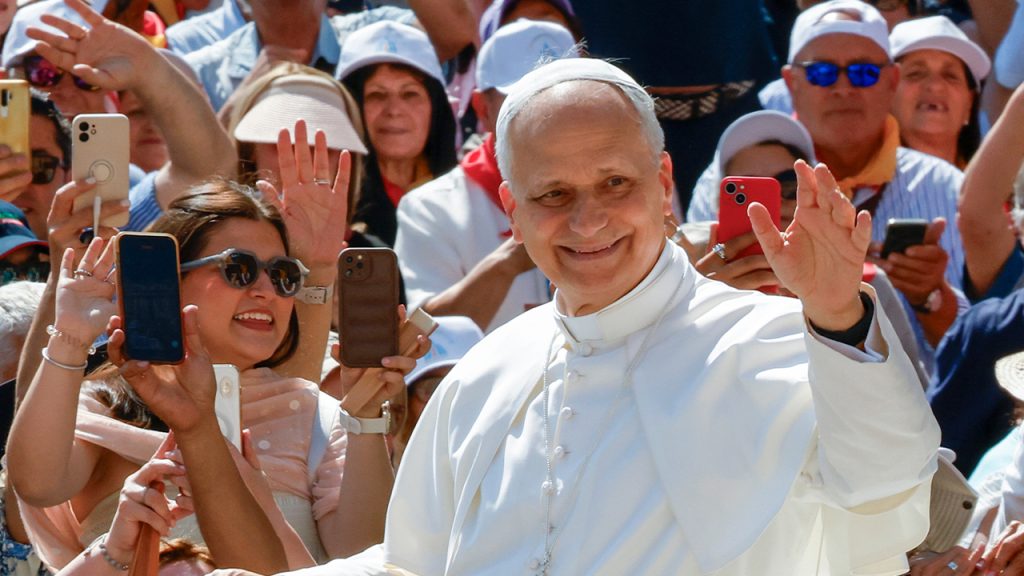
Christopher White had a front-row seat at the Vatican this spring, as the world mourned the death of Pope Francis and witnessed the surprise election of Chicago’s own Robert Prevost, the first U.S.-born pope.
In Pope Leo XIV: Inside the Conclave and the Dawn of a New Papacy, published this month by Loyola Press, White, a former Vatican correspondent for the National Catholic Reporter, gives readers a behind-the-scenes look at the passing of the papal torch.
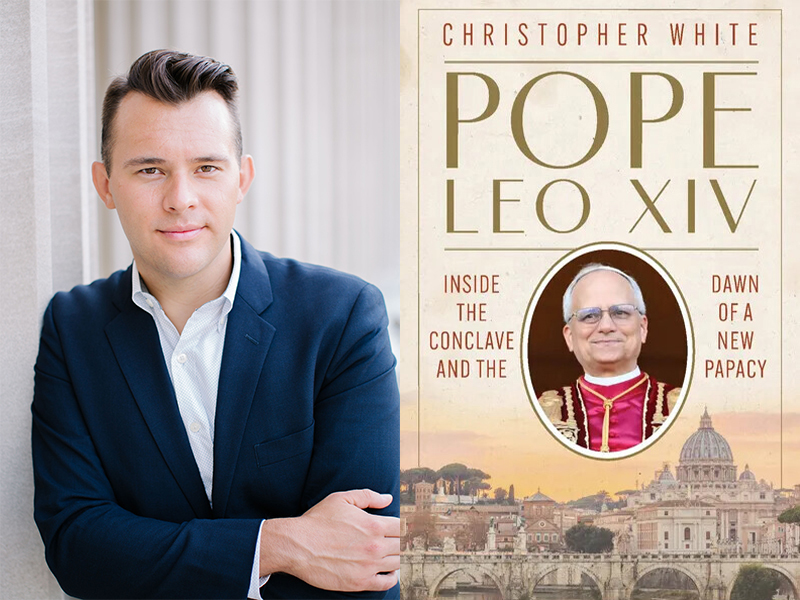
White launched his career in journalism about a decade ago, after earning a master’s degree in ethics and society at Fordham. For the past four years—before taking on a new role at Georgetown University’s Initiative on Catholic Social Thought and Public Life—he lived in Rome and was a frequent member of the press pool that traveled the globe with Pope Francis.
Fordham Magazine spoke with the South Carolina native about the politics of the conclave, Pope Leo’s concerns about AI, and the impact that Pope Francis had on him personally.
I’m intrigued by the experience of being at the Vatican during that period between Francis’ death and the start of the conclave. What was that like?
It’s an extraordinary thing to live through and to try to capture journalistically. On one hand, you’ve just covered a papal funeral, so you see this tremendous outpouring of grief for a figure like Pope Francis, who was much beloved. Then you compound that with tremendous anxiety or hope about the future. The 133 men that were going to the Sistine Chapel were having very intense conversations, both as a part of formal meetings and in their own private dinners and prayer sessions and just coffees and walks and talks.
During that period, certain cardinals said to Prevost, “You may be asked to take on this responsibility.” And I think the weight of that began to settle with him.
RELATED STORY: Fordham Mourns Death of Pope Francis, Reflects on Influence of First Jesuit Pope
You note in the book that you were part of a small contingent of Vatican reporters who thought Prevost had a real chance at being elected. Why were you more bullish on his odds than many others?
I don’t fault anyone for overlooking him or writing him off, because the conventional wisdom for a very long time was that an American would never be pope. But most of his adult life was either in Europe or in Latin America, so I think many cardinals simply stopped thinking about geography when they began to consider his candidacy. He’s a polyglot—he speaks multiple languages. He also had the advantage of being a fairly well-known entity among the cardinals themselves. During his time as the head of the Augustinian order and also prefect of the Dicastery for Bishops, he had interacted with a lot of cardinals from around the world. And that gave him a leg up in a conclave where 80% of the men in that room had never done this before.
You also point out that he had ascended rather quickly within the Vatican hierarchy under Francis.
I think it’s fair to say that Francis had his eyes on Prevost from almost a decade ago. They knew each other before Francis was pope from Prevost’s own ministry in Latin America. Francis brought him to Rome in 2023 to head a very influential Vatican office [the Dicastery for Bishops] in which they were collaborating on some of the pope’s most sensitive and important decisions. He elevated him to the highest rank within the College of Cardinals. Francis did everything he could to further Prevost’s career, and it certainly left him in good standing when it came time for the conclave.

Where do you see Leo continuing the legacy of Francis? And where do you see him being different?
Leo has given every indication that he intends to follow the same path as Pope Francis. He has emphasized what Pope Francis called the need for the church to be more synodal, meaning more participatory, with more of a missionary focus—inviting lay people to have a greater share in the church’s power structures and in thinking about the church’s future.
In terms of where he’s different, he’s a much more cautious personality than Francis. Francis was an extrovert. Leo is an introvert. Francis was a man of big ideas. Leo is a man of particulars and government—he’s a real manager. He was a mathematics major. He’s interested in thinking through how these processes that were started under Francis can be best institutionalized for the church of tomorrow. Some people will see in Leo a less interesting public figure than Francis was, because Francis knew how to use the media spotlight and often acted with great gestures. Leo is someone who has always resisted that. That being said, I think he’s finding his own presence and his own voice in these moments.
What are some of the biggest issues Pope Leo—and the Catholic Church as a whole—will face in the years to come?
The Vatican is facing a severe budget shortfall and its pension fund is woefully underfunded. So Leo is going to have to think through how the Vatican can best preserve and steward its dwindling earthly resources.
I think he is also generally concerned about the Vatican’s overall communication strategy—how it communicates in a digital world to evangelize and to preach the Gospel. He took his name from Leo XIII, who was concerned about the rights of workers and the rise of inequality. He’s certainly concerned about AI, because he sees that as one of the big questions of our day. He seems very interested in having the church shape conversations about what it means to be human and what our relationship with technology should be.
And then lastly, I would say he comes into this papacy with a real priority of peace. He spoke about peace nine times in his very first speech, and we’ve seen him lean heavily into using his platform to push for peace, particularly in ending the wars in Ukraine and Gaza.
RELATED STORY: ‘A Heart for the Poor’: Pope Leo XIV Welcomed with Hope and Joy by Fordham
What about the relationship to U.S. politics? In particular, how do you see him approaching the country’s immigration policies?
I think Pope Leo’s own biography as a second-generation son from a family that migrated to the United States—and from his vantage point in Peru, seeing the reason why people there chose to migrate—has put this at the center of his own life. He sees it directly linked to his ministry because it involves the central question of human dignity, and I think he’s deeply concerned about a U.S. immigration policy that he sees as an affront to human dignity. I think he wants to make sure the Catholic Church is not co-opted into that.
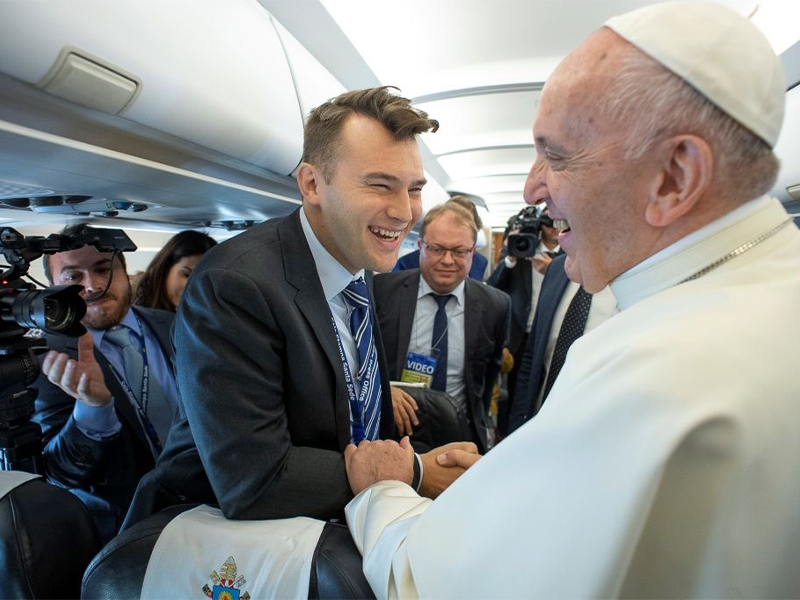
As a Vatican correspondent who lived in Rome and often traveled as part of the press pool, you got a uniquely up-close view of Pope Francis, not only as a leader but as a person. How would you sum up what he was like to be around?
Pope Francis gave tremendous credibility to the Gospel message of caring for “the least of these.” He preached those words, but he also lived them. I couldn’t help but to be moved by it many, many times—to see his remarkable ability to connect with people. He possessed the rare gift of being able to cut through the chaos and find the gesture or the words to speak to particular moments, both globally, but more often than not, just on a very direct and personal level. We saw that most often traveling with him, whether it was in refugee camps or meeting with victims of trafficking or war.
Anytime Francis traveled, on the way, he would come back [to the press area of the plane] and greet journalists individually, and those were just personal encounters. He had a great memory—you could tell him things and he would remember them months or years later. He loved to laugh and really embodied a sense of joy.
Interview conducted, edited, and condensed by Adam Kaufman.
