

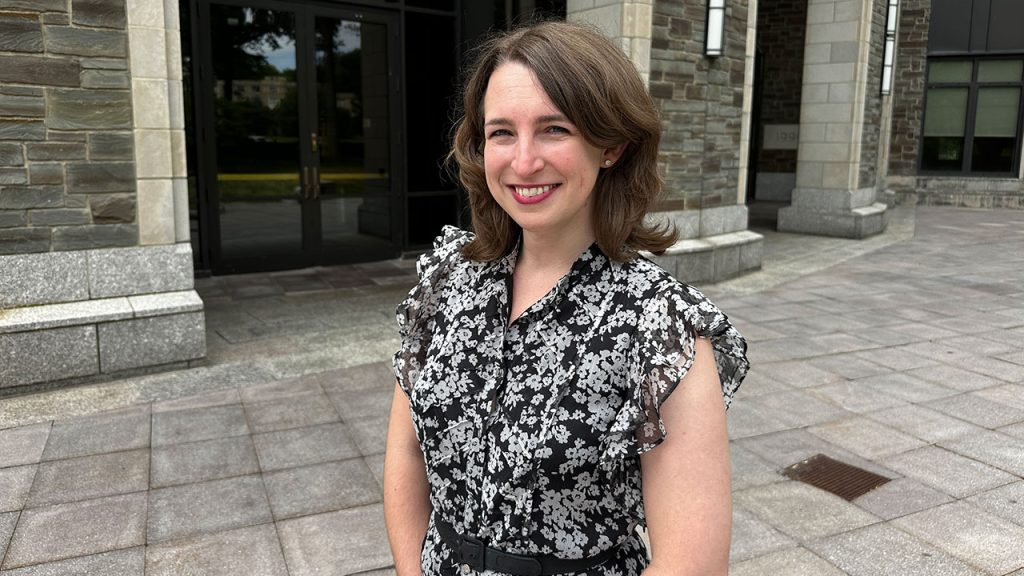
What do you do at Fordham?
I am just starting my second year at Fordham. I’m an associate professor of English and director of the Writing Center at both Rose Hill and Lincoln Center. We have a robust staff of graduate students and professional tutors, and I oversee the ways that they approach conversations about writing.
I’m also a researcher of writing centers, so a lot of times my research informs what we do in our day-to-day work. This fall I am so excited to be teaching a writing center graduate-level seminar, where we’ll get to talk about how writing centers came to exist institutionally. I also teach in the English department’s public and professional writing minor.
Tell me a little about your background.
I’m originally from Reno, Nevada. I still identify very much as a West Coast person. I went to Loyola Marymount University in Los Angeles and I have a big Jesuit tradition in my family, so I was just thrilled to get this offer from Fordham.
I did my master’s at the University of Nevada, Reno, and I received my Ph.D. from Ball State University in Indiana. Prior to coming to Fordham, I worked at the University of Massachusetts Dartmouth as an associate professor of English and communication and the founding director of their Writing and Multiliteracy Center. I’ve been working almost continuously in writing centers since I started as an undergraduate tutor myself.
Why specialize in writing centers?
It’s so rewarding to see someone who may be very uncertain about their writing leave feeling totally different, not just about the assignment, but about their own abilities. And that was always my goal, to make people feel more confident in their abilities. Because writing is hard.
When you come to the writing center, you’re unpacking someone’s entire history with writing, and that can be a really vulnerable place. So the very first thing that I have anybody who wants to be a tutor do is make an appointment with another tutor, so they can be given feedback on their own writing. And a lot of them agree, it is intimidating to have someone look at their writing, but they appreciate the feedback.
We really want the Writing Center to be an open and inclusive and accessible space … where we empower individuals to gain different levels of confidence.
What’s your stance on students using ChatGPT?
I’d much rather read something that is an authentic representation of a student’s perspective, rather than something that is grammatically perfect. But in the Writing Center, we know that there is a range of acceptability of generative AI tools. So we can have conversations about how to use AI within the particular parameters that have been set by a class.
What’s a fun fact about you that most colleagues don’t know?
I am a huge fan of musical theater. And so I am thrilled if someone wants to talk to me about Broadway or musical theater. I was a theater minor in college, and I’ve been so grateful in my first year here to have been able to see quite a few Broadway shows. The play English and the musicals Operation Mincemeat and Pirates! The Penzance Musical are the top three shows I’ve seen this year.
If you see me with headphones on campus, I’m probably listening to a show tune.
Do you have a writing tip for the Fordham community?
I have a revision tip: use Speechify. Fordham has a subscription (just sign up with your Fordham email), and it lets you import a document and then it will read it back to you. I use that for everything—important emails, drafts that I’m submitting to a publication. It is so, so helpful in the final stage of editing. When you have someone else read your writing aloud, you are often much more aware of the way it sounds to another audience.
This interview was edited for length and clarity.
