

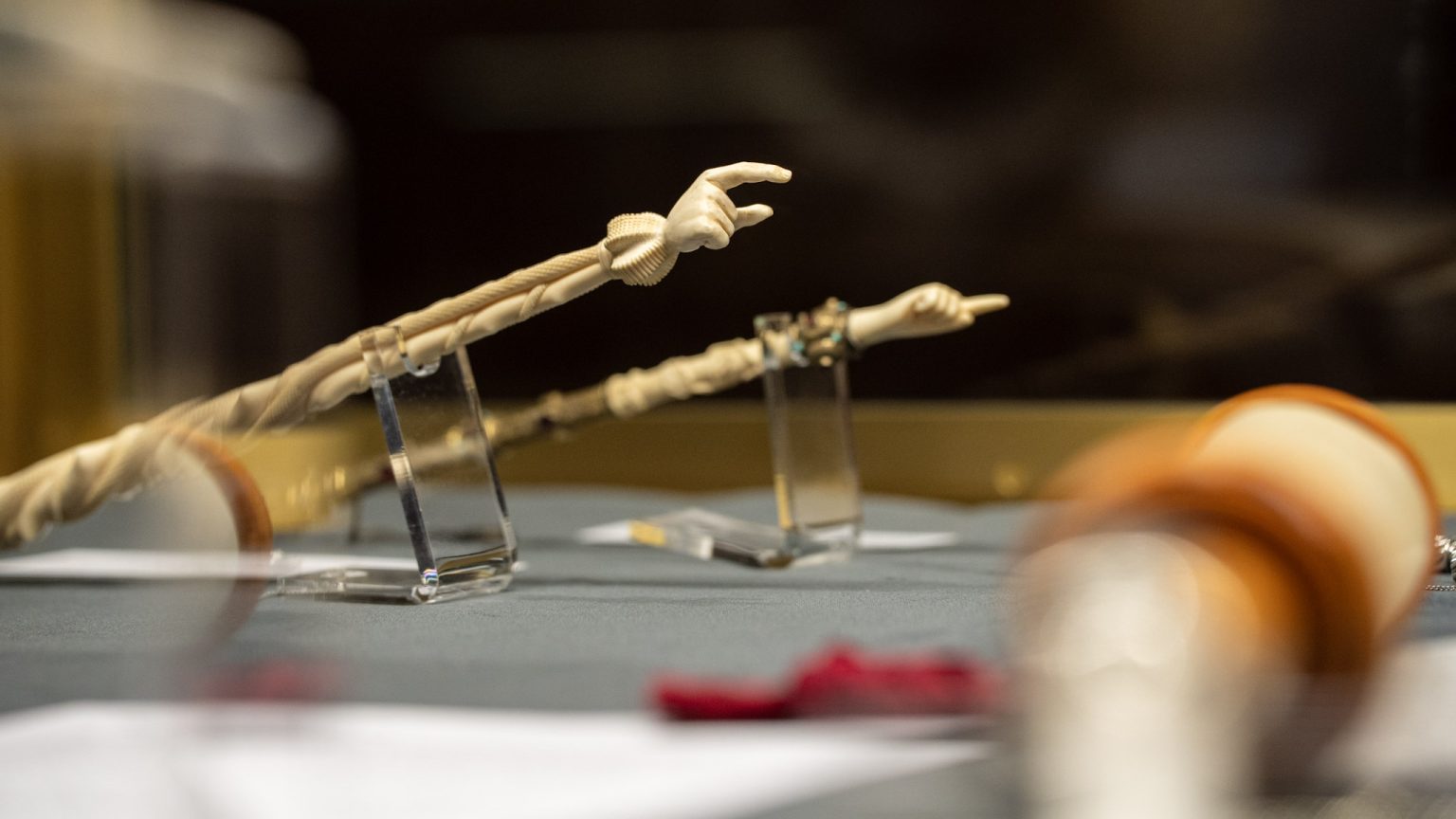
A new exhibit at the Walsh Library highlights the artistry of a special religious object: the Torah pointer.
“Guiding Hands for Sacred Scripts: Torah Pointers, Art, and Contexts” brings together more than 60 Torah pointers, or “yads,” on loan from Clay Barr, a Judaica collector with the largest collection of Torah pointers in the country. The exhibit opened just ahead of the Jewish High Holy Days—a fitting time to showcase these objects that guide readers through the Torah scroll, according to Magda Teter, Shvidler Chair of Judaic studies.
“It’s a beautiful season to highlight yads because of Rosh Hashana and Yom Kippur,” said Teter, a professor of history who co-curated the exhibit. “They serve as objects of connection with the Torah, but they can also be very personal.”
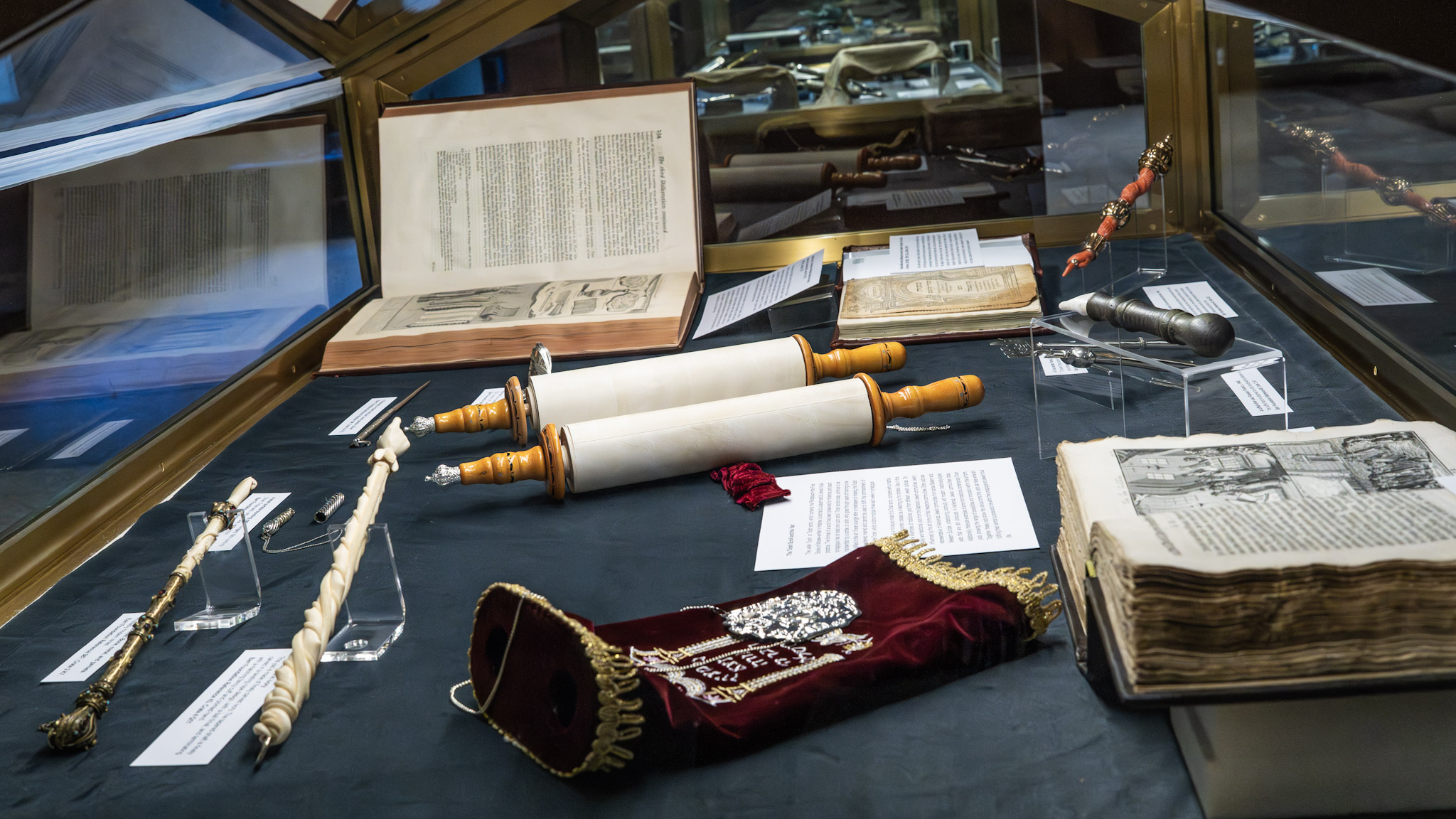
“Guiding Hands” shows yads in context with other objects of Jewish ritual life from Fordham’s own collection. The exhibit is displayed alongside art from 20th-century artists Ben-Zion and Mordechai Rosenstein, on view in the fourth-floor Henry S. Miller Judaica Research Room.
What is a Torah pointer?
In Judaism, there is a prohibition against touching the Torah’s parchment directly. Readers follow along with the text using a yad—Hebrew for “hand”—which often has a sculpted finger on its end.
Yads in the exhibit date from the 17th century to modern times, and come from Jewish communities in Germany, Russia, India, Afghanistan, the United States, and beyond. Their materials are just as diverse, incorporating silver, ivory, glass, wood, gemstones, and even a skateboard.
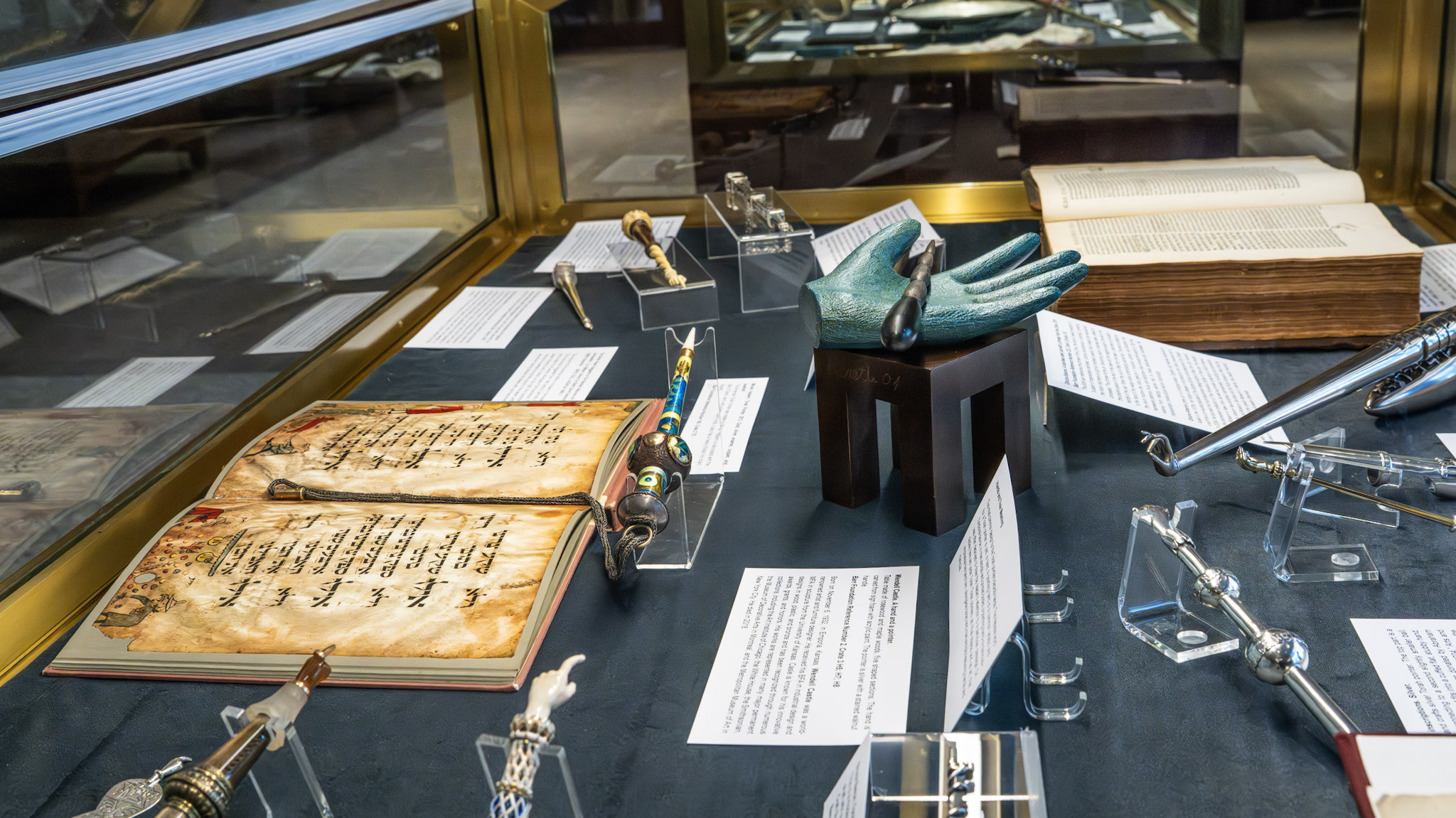
According to Teter, these yads exemplify a concept in Judaism known as Hiddur Mitzvah, or “beautifying the commandment,” which holds that rituals should be performed with aesthetically pleasing objects.
“There are no rules for what a yad has to look like. It could be as simple as a stick,” Teter said. “But because of the idea of beautifying the commandment, they developed into objects of artistry, shaped by the traditions and materials of each community.”
An Undergraduate Co-Curator
Undergraduate student Miriam Krakowski, a history major, helped to curate the exhibit alongside Teter and Amy Levine Kennedy, who teaches in the Communication and Media Studies Department. Krakowski said she was fascinated by the pointers, especially a large yad from early 20th-century Afghanistan, made from gilt-parcel silver with turquoise and coral insets.
Her work on the exhibit was part of a Jewish Studies internship made possible through the Henry S. Miller fund. According to Krakowski, it was a chance to experience what her future may hold.
“I would love to work in Judaica special collections someday, which kind of made this perfect,” said Krakowski. “It’s incredible that Fordham has opportunities for an undergrad to get involved in that way.”
Yads as Memorials
Traditionally, yads were kept in synagogues. Over time, they also became personal items, sometimes given as gifts to mark a bar or bat mitzvah. Some bear inscriptions that commemorate a loved one or a rabbi. A number of the yads in this exhibit honor Holocaust victims, and are displayed separately on the library’s fourth floor, near the Rosenblatt Holocaust Collection.
Barr’s collection is also a memorial; she began collecting pointers more than 30 years ago to honor her late husband, Jay D. A. Barr, who she said was always drawn to depictions of the human hand in art.
“When I was trying to think of how I would memorialize him,” Barr said, “I remembered he had donated two pointers from Sotheby’s to our synagogue, and I thought, ‘A ha! I’ll build a collection of Torah pointers in his memory.’”
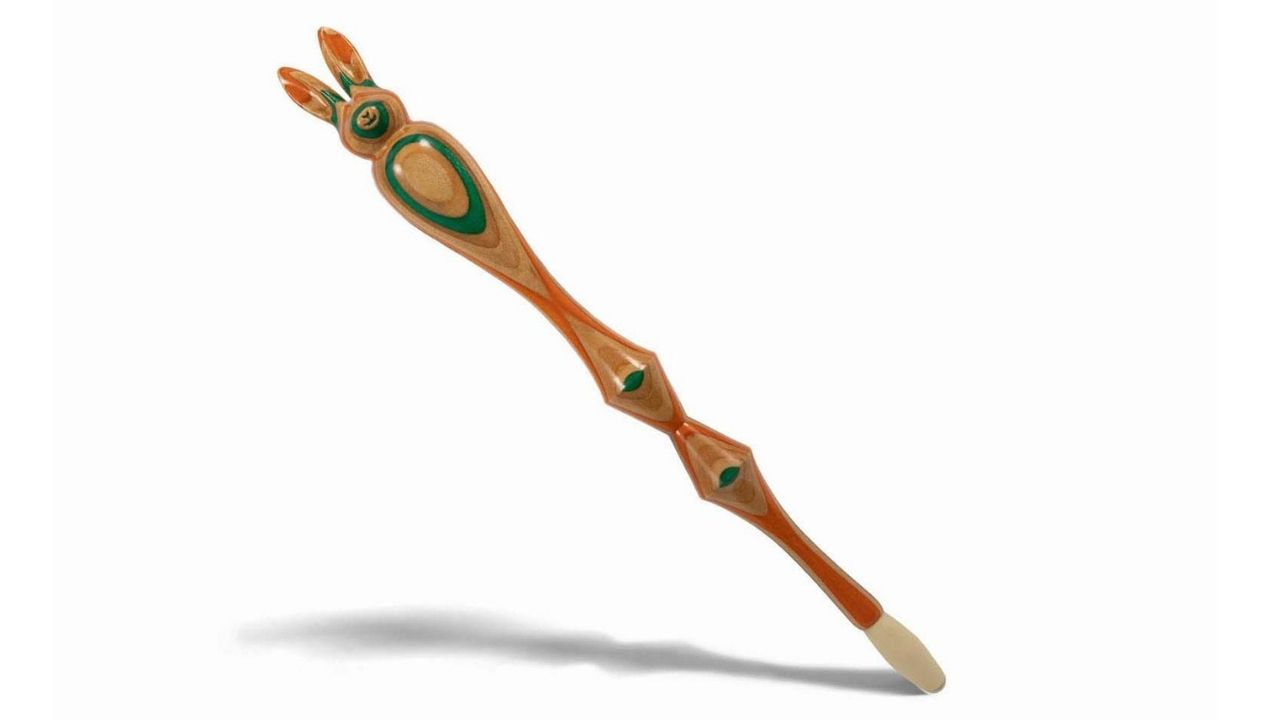
Barr now has more than 200 yads in her collection, including dozens she commissioned from contemporary artists. One rabbit-shaped yad by woodworker Spencer Tinkham was carved from a skateboard once owned by Barr’s grandson. The rabbit shape honors her late husband, whose nickname was “The Bun,” short for bunny.
Now 84, Barr hopes to continue commissioning new Torah pointers and sharing them with the world.
“They’re beautiful objects and I hope a lot of people will come and enjoy them,” she said.
“Guiding Hands for Sacred Scripts: Torah Pointers, Art, and Contexts” is on display through Dec. 18 on the first and fourth floors of the Walsh Library.
