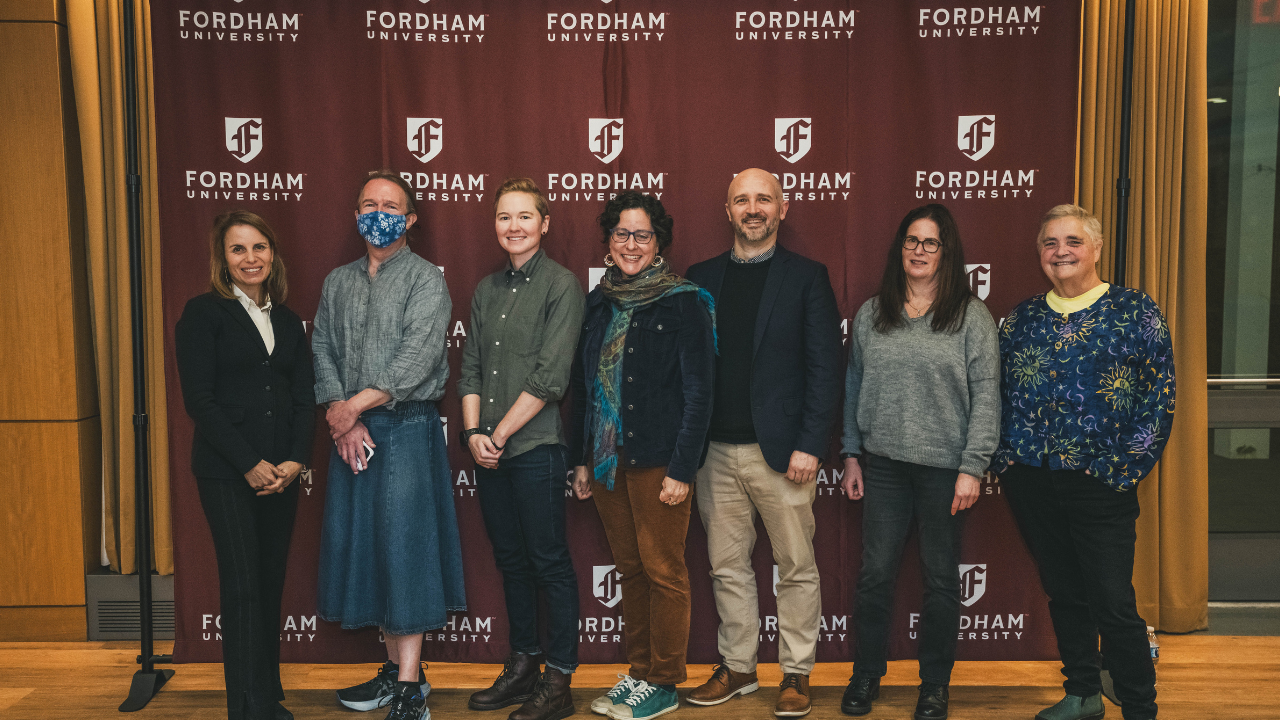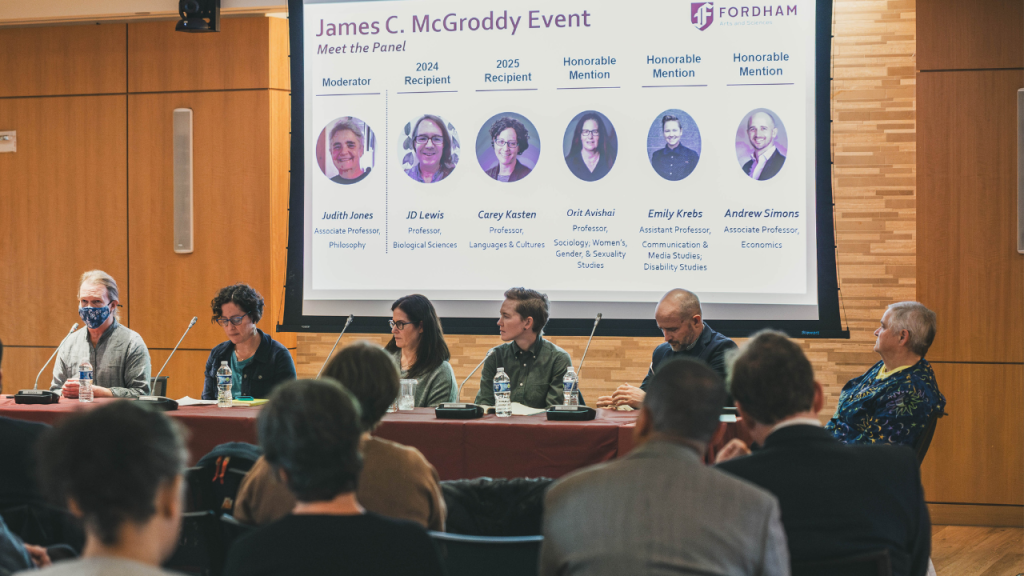
Arts and Sciences faculty members shared insights from their novel teaching practices on Nov. 4 at an event celebrating the honorees of the James C. McGroddy Award for Innovation in Education. The award, which carries a cash prize of $10,000, celebrates educators who prepare students for future challenges and opportunities through innovative pedagogy. Philosophy professor Jude Jones, Ph.D., moderated a panel discussion with five of the honorees.
This year’s winners were Carey Kasten, Ph.D., professor of Spanish, and Leo Guardado, Ph.D., associate professor of theology, who were honored for their joint work on Fordham’s Initiative on Migrants, Migration, and Human Dignity.
Gaining Perspective—and Real Skills
Kasten described the migration initiative as transformative for the students who participate, many of whom visit the U.S.-Mexico border and learn firsthand about accompaniment.
Students in the program also intern at partner organizations, share their experiences on panel discussions, and write for the initiative’s website. These experiences give them “real skills” that can make them feel more confident about the job market, she said.
“Students are anxious in ways that I’ve never seen before,” said Kasten. “Giving them productive steps on how to have a job in this world is helpful.”
Facing Challenging Issues
Also honored at the event were Melissa Labonte, Ph.D., associate professor of political science, and Orit Avishai, Ph.D., professor of sociology, who received an honorable mention and corresponding $1,500 prize for their interdisciplinary capstone class called Taming “Wicked” Problems: Social Science Research and Solutions Lab.
Students are placed into groups and asked to identify a problem in the world that they can improve, rather than solve. Avishai said that through teamwork, research, and talking to those affected, students learn how to “take on, rather than be paralyzed by, these massive, unanswerable questions.”
Building Resilience
JD Lewis, Ph.D., professor of biological sciences, won last year’s McGroddy Award for reimagining the first-year STEM experience in biology. They were honored at this year’s event.
Lewis made the biology curriculum more flexible by spreading the sequence of courses over two years in an effort to increase retention.
The change also allows time for active research, they said, which teaches students that there is no such thing as a failed experiment. “You just didn’t get the answer you expected—and that’s OK,” said Lewis.
Emily Krebs, Ph.D., assistant professor of communication and media studies and director of the Disability Studies program, received an honorable mention this year for their syllabus design and teaching. “Talking to students about my own failures is huge,” said Krebs, who assigned a piece of their own writing that they now see as flawed. “I think modeling that failure, and my willingness to engage with it, is a really powerful tool.”
The last honorable mention recipient this year was economics professor Andrew Simons, Ph.D., who teaches a popular interdisciplinary capstone class, The Ecology and Economics of Food Systems, with biology lecturer Dawn Fariello, Ph.D. Together they give their students direct feedback five to six times during one long writing assignment.
“They have to come talk to us about the assignment, which hopefully makes them a little less likely to use AI,” said Simons. The check-ins also provide students with the critical feedback they need to “bounce back within the same assignment.”
“One of the things we are talking about is, how do we build resilience into students? Out in the world, no one’s going to hold their hand. Their future bosses may not be the nicest people in the world. They need to learn how to bounce back from hard things.”