

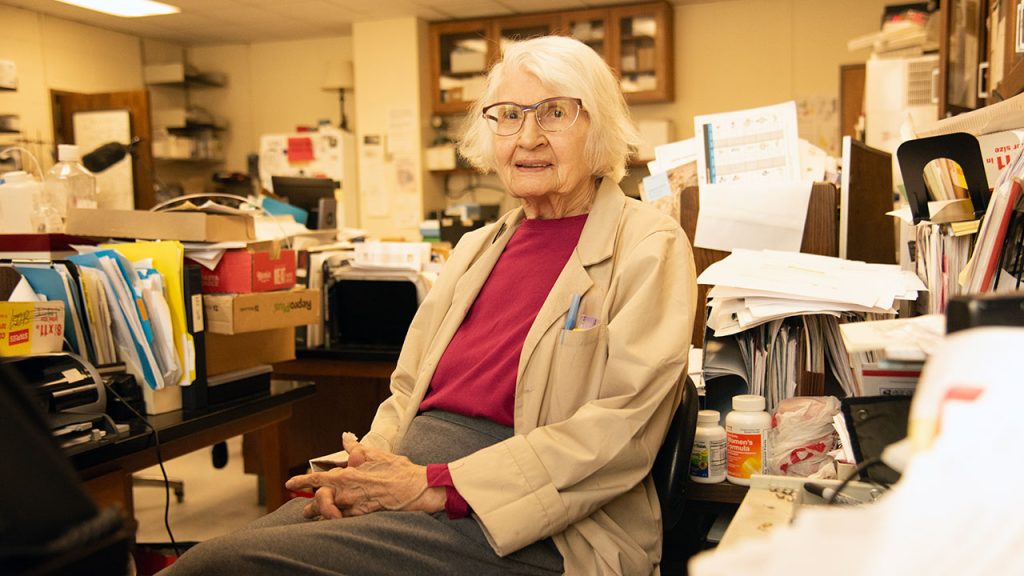
Mary G. Hamilton, Ph.D. chemistry professor emerita, who worked tirelessly in her Fordham lab until the age of 94 and supported countless students in their science research, died at home among her family on Nov. 12. She was 100.
Hamilton was such a fixture in her Lincoln Center lab, it’s still known as “Mary’s room,” said Deborah Luckett, Ph.D., senior biology lecturer.
“When she taught biochemistry lab, she basically taught students everything they needed to know for medical school and graduate school,” Luckett said.
“Her lab at Fordham was her happy place,” said Audrey Gill, Hamilton’s niece. She described her aunt as a philanthropist who made monthly contributions to 35 different organizations, from the ASPCA to the Campaign for Female Education. But Hamilton focused her philanthropy on Fordham above all. “The goal was to hit the million mark,” said Gill of her aunt’s contributions to the University. She reached it this February.
A Patient Teacher and a Patron of Science
Hamilton has been a major supporter of natural sciences student research at Lincoln Center since 2002. Much of her philanthropy has supported summer student research presented at the Mary G. Hamilton Research Symposium, an annual event that was named for her in 2020. Last year alone, Hamilton’s philanthropy helped support 19 research projects by 29 natural sciences students.
Luckett once asked Hamilton why it was so important to support undergraduate research. “She said, ‘If I give it to a student, I know it’s helping a student do something for their future career. I can see they got a feeling of what research is all about.’”
Former student Tatiana Popovitchenko, Ph.D., a postdoctoral researcher at Rutgers and 2012 graduate, trained under Hamilton as a teaching assistant for biochemistry lab. “Dr. Hamilton was very inspirational to me as a woman that just kept plugging away at her research,” said Popovitchenko. “Her patience was remarkable and I am probably a scientist today because of that attitude.”
“She taught me so much,” said 2022 graduate Frances Murray, who now works in sales at a medical devices company. “She was continuing her education every day she was in the lab, which was such an inspiration.”
73 Years in the Sciences
Hamilton, one of four children, was born in Buffalo, New York, on September 9, 1925, to Daniel and Agnes Gill. Her sister Frances recalled that instead of asking for clothes for Christmas as a teenager, Hamilton asked for—and received—a microscope.
Still, her father “thought I was going to go to secretarial school,” Hamilton once told students during a discussion with biology professor Jason Morris, Ph.D.
Instead, she earned a bachelor’s in science from the University of Buffalo in 1947 and later, her doctorate in biochemistry from Cornell University Graduate School of Medical Sciences in 1961. She spent much of her career studying proteins in animal and marine invertebrate tissue, and authored more than 60 publications in science journals.
Renowned biochemist Mary L. Peterman, Ph.D., was Hamilton’s first boss at Sloan Kettering Institute, where she worked for 35 years as a researcher prior to Fordham. She also spent two years in London doing postdoctoral research.
“She never felt held back,” said her niece. “She pursued her goals even at a time when women didn’t do those types of things.”
Redefining Retirement
In 1982, at age 57, Hamilton joined Fordham.
“This was her second career,” said Morris. “She was passionate about research, and I think she really appreciated that she’d found a home in our department.”
Hamilton “retired” from the full-time faculty around 1997, the year that Robert R. Grimes, S.J., became dean of Fordham College at Lincoln Center.
“Little did I realize that Mary had a very different idea of retirement than most people,” said Grimes, now dean emeritus. “It was a rare day she was not in her lab. … And years later when I retired, that retiree was still going strong.”
Retired chemistry lecturer Yevgeniya Alkayeva, Ph.D., remembered Hamilton’s remarkable work ethic. Though spring 2019 was Hamilton’s last semester teaching at Fordham, she continued to come to her lab until the pandemic. “She always arrived before anyone else, and she was the last to leave on the final day before the University closed for COVID.”
Always in Motion
Hamilton’s niece recalls the far-flung Christmas gifts her aunt brought back from her travels—a Japanese kimono, a Middle Eastern headscarf. Some of these mementos came from the business trips she took with her husband of 45 years, Hubert “Hube” Hamilton, who worked as an international salesman for Teflon.
Hamilton also traveled widely to present papers at academic conferences, and to see eclipses, flying as far as Tahiti and Australia for celestial events.
“She was just so alive,” said her colleague Luckett. “Every time I think about her, I just think about her moving around.”
A video by Tom Stoelker screened at the Fordham Women’s Summit, where Hamilton was honored for her philanthropy in 2024, demonstrates Hamilton’s mobility well into her 90s. From her Union City, New Jersey, home, she rode two buses and a ferry to get to campus.
Celebrating a Century
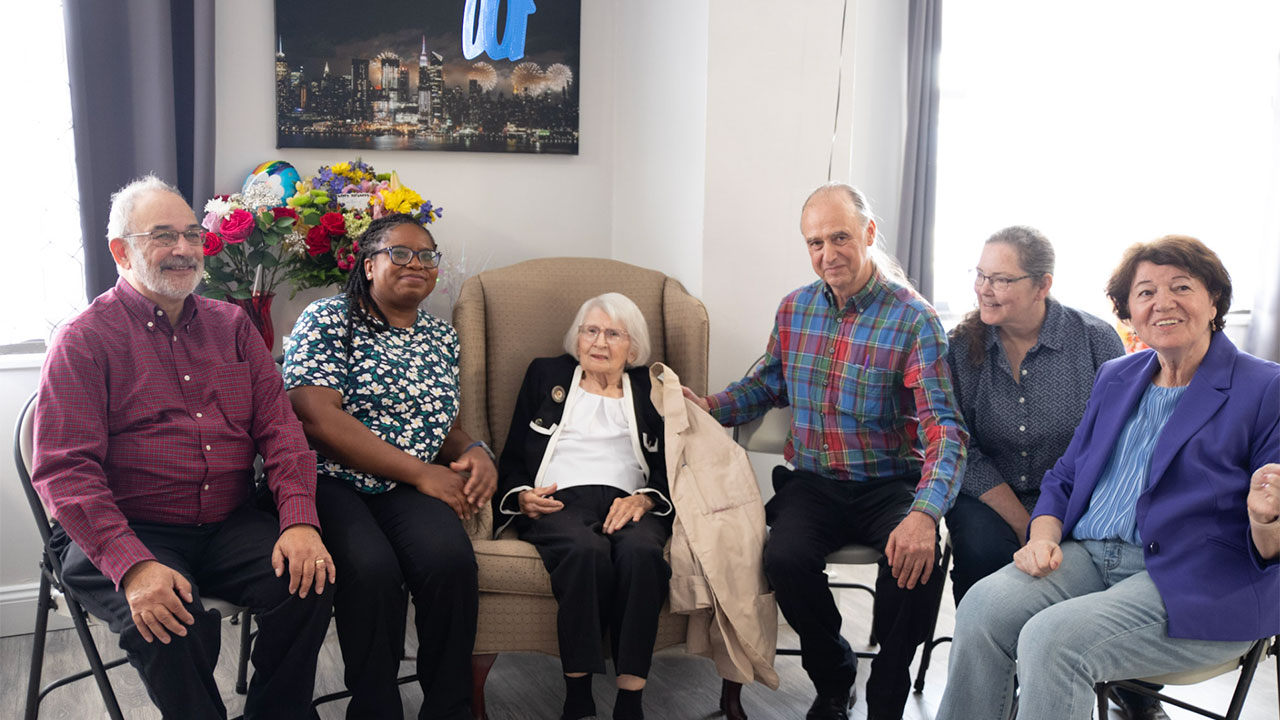
Rather than hold a memorial service for Hamilton, her family agreed that her 100th birthday party this September served as a celebration of her life.
“To be surrounded by her work friends was super special for her, because her work was her life. She was in her glory that day with her Fordham friends,” said Gill.
Hamilton is survived by her sibling Frances Olans, nieces, and nephews. Her family requests that memorial donations be made to the Hospice Foundation of America or to her endowed science fund at Fordham.
