

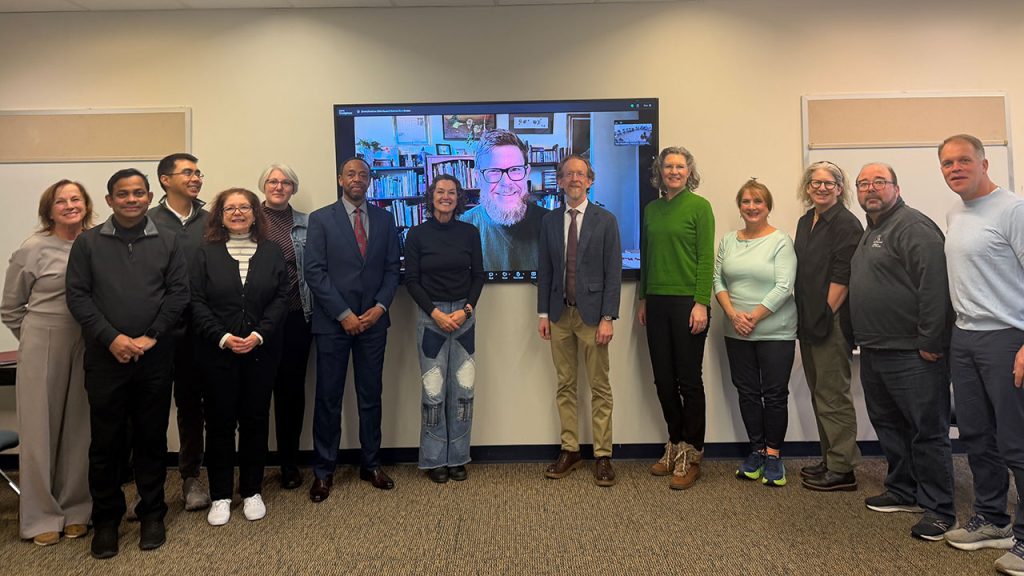
Three graduates of Fordham’s Doctor of Ministry program returned to Lincoln Center over winter break to share how their research enriched their faith-based work.
Before a class of current DMin students on Jan. 6., the Rev. Charles Dzawu, ’25 DMin, discussed his motivation for studying at Fordham over the past six years while also working as the pastor of Washington Heights’ A.M.E. Zion Church. Upon moving to the U.S. from Ghana, he realized that his congregants were suffering from racial trauma and questioning where God was in their suffering. To help them heal, he did his Fordham pastoral research on the psychology of racial trauma—and that research strongly informs his ministry today. “What I have now is my second Bible,” he said of his project. “I bring all these ideas into my sermons.”
Better Ministering Through Reading and Listening
The Rev. Dzawu shared his moving testimonial on the last day of Pastoral Theology and Practice, a research seminar taught by Tom Beaudoin, PhD, a professor jointly appointed to the theology department and the Graduate School of Education. Over the course of five days, the seminar gives current DMin students an in-depth overview of the research process.
“Learning how to do good, theologically informed research also happens to make you a better minister,” said Beaudoin. “Because theological research skills have to do with careful and critical reading; empathy with the worldviews of others; careful listening; and skills in designing projects and programs.”
The DMin program, which began in 2007 and is housed within GSE, provides the highest professional degree for ministers, as well as lay ministers—non-ordained ministerial leaders of a church or church-related organization. That’s unique for a Jesuit institution, said Beaudoin.
“We’re saying that the highest level of theological education for ministry should be not only for seasoned clergy, but it should also be for seasoned lay ministers.”
The 10 men and women in Beaudoin’s seminar reflected this range of experience. Students included a visiting Sri Lankan priest working at a Yonkers church; a parish life director on the Omaha, Nebraska, campus of Creighton University; a Jesuit from the Philippines residing at Spellman Hall; a deacon from Grand Rapids, Michigan; and an oncology nurse at Memorial Sloan Kettering Cancer Center who said spirituality has “everything to do with” her work.
Translating Personal Experience to Theological Research
Two other recent DMin graduates, both laypeople in ministry, shared their research projects and experiences with the class.
For her final project, Trena Yonkers-Talz, ‘25 DMin, director of the Belmont Catholic Community Center in the Bronx, wrote a memoir of her two decades in El Salvador as the co-director and community liaison for Casa de la Solidaridad, a study abroad program for students from Jesuit Universities run by Santa Clara University. After graduating, she applied her storytelling skills to create a live storytelling class, called La Mariposa, for Latina women to share their stories. (Its name, which translates to “The Butterfly,” is a nod to the Moth storytelling series that inspired it.) She is also teaching a course this semester at Fordham titled Spiritual Autobiography.
J.D. Long García, ‘25 DMin, an Arizona-based editor of America magazine, a Jesuit publication, used the program to better serve the poor and marginalized members of his Latino community in his reporting. To do this, he regularly met with community organizers around the country over a three-month period to deepen his understanding of stories to cover. His advice for current students was to trust in their own personal, unique stories as they delve into their research.
“No one else has the experience that you’re gonna bring to it. And that’s such a beautiful strength of this program.”
