

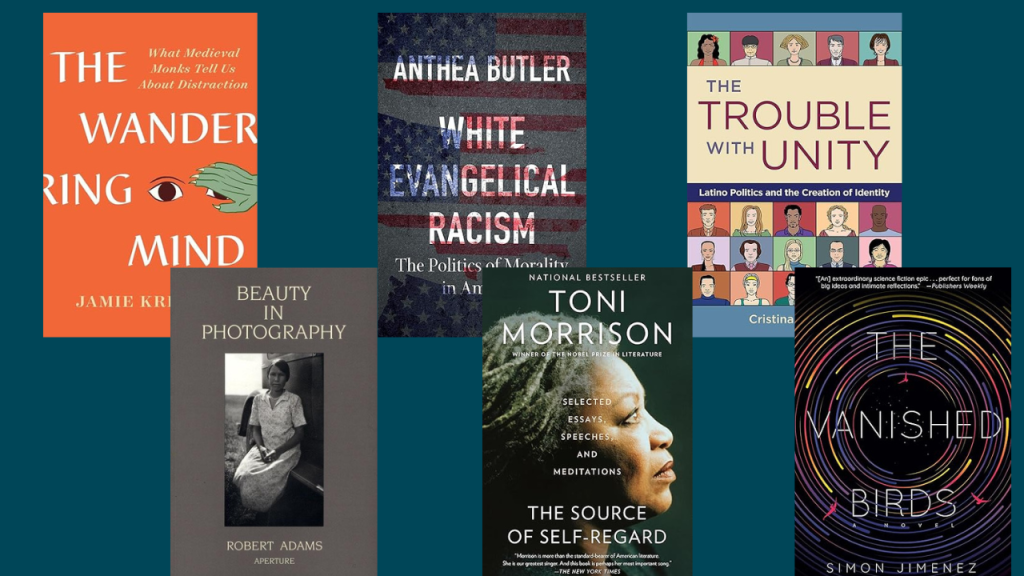
With the spring semester in full swing, we asked Fordham professors to share their favorite titles on their course reading lists. Here are six conversation-starting books to inspire your future reading.
The Wandering Mind: What Medieval Monks Tell Us About Distraction, Jamie Kreiner
Erez DeGolan, PhD, assistant professor of theology, is teaching a new class this semester titled Attention and Religion, which considers ways of cultivating attention through various religious traditions. On the syllabus is this deep yet highly accessible read. “Kreiner’s book offers students an opportunity to consider how premodern thinkers—long before the age of smartphones and social media—struggled with concentrating, and tried to come up with techniques for warding off distractions and sustaining their attention on what mattered to them,” said DeGolan.
Beauty in Photography, Robert Adams
In his photography classes, Stephan Apicella-Hitchcock, head of the visual arts program, enjoys teaching this book of essays by photographer Robert Adams, who was an English professor before he began documenting the American West. “It inspires students so profoundly,” said Apicella-Hitchcock, who shared this “dynamite” passage in the book as an example of why it resonates: “Why do most great pictures look uncontrived? Why do photographers bother with the deception, especially since it so often requires the hardest work of all? The answer is, I think, that the deception is necessary if the goal of art is to be reached: only pictures that look as if they had been easily made can convincingly suggest that Beauty is commonplace,” writes Adams.
The Trouble with Unity, Christina Beltran
Ivelisse Cuevas-Molina, PhD, associate professor of political science, likes to teach this book in her Latino/a/x Politics class. One of its key concepts, said Cuevas-Molina, “is ‘Latinidad,’ or Latino-ness—the sense of unity and belonging held by individuals who are part of the many Latino communities across the country, which can shape their political views and behaviors.” While Latinidad is not always a fixed force in American politcs, Cuevas-Molina said, “it can reach greater heights when Latino communities are targeted by policies and politicians at all levels of government.” This year in particular, she expects to see the effects of “intensified Latinidad on the level of participation of Latinos in the 2026 elections.”
The Vanished Birds, Simon Jimenez
Stephen Sohn, PhD, the Thomas F.X. and Theresa Mullarkey Chair in Literature, has high praise for this book, calling it one of the top-10 novels he’s read. “It has everything! It has a really fascinating science-fictional future in which corporations rule over human populations that have colonized distant star systems. It has heroes and villains and everything in between, and at the heart of the story is the care that exists between a woman and her charge, a strange young boy who she is tasked to care for, who may or may not have an extraordinary ability related to teleportation. The novel is essentially an epic space opera with a cast of unforgettable characters. It’s the type of novel I would recommend to anyone who loves to read.”
The Source of Self-Regard, Toni Morrison
Nojang Khatami, PhD, assistant professor of political science, regularly turns to this book of essays and speeches by Nobel and Pulitzer Prize-winning novelist Toni Morrison for his Intro to Political Philosophy class. Spanning four decades of her work, Khatami said the collection includes “brilliant reflections on race, memory, belonging, art, and the relationship between literature and politics. Though some of the pieces were written many years ago, they remain prescient and timely.”
White Evangelical Racism: The Politics of Morality in America, Anthea Butler
Orit Avishai, PhD, professor of sociology and women’s, gender, and sexuality studies, assigns this book in her Religious Freedom and American Democracy classes. ”It’s a powerful reflection on the long history of intertwinement of racial politics and evangelical Christianity that helps contextualize contemporary socio-political dynamics.”
