

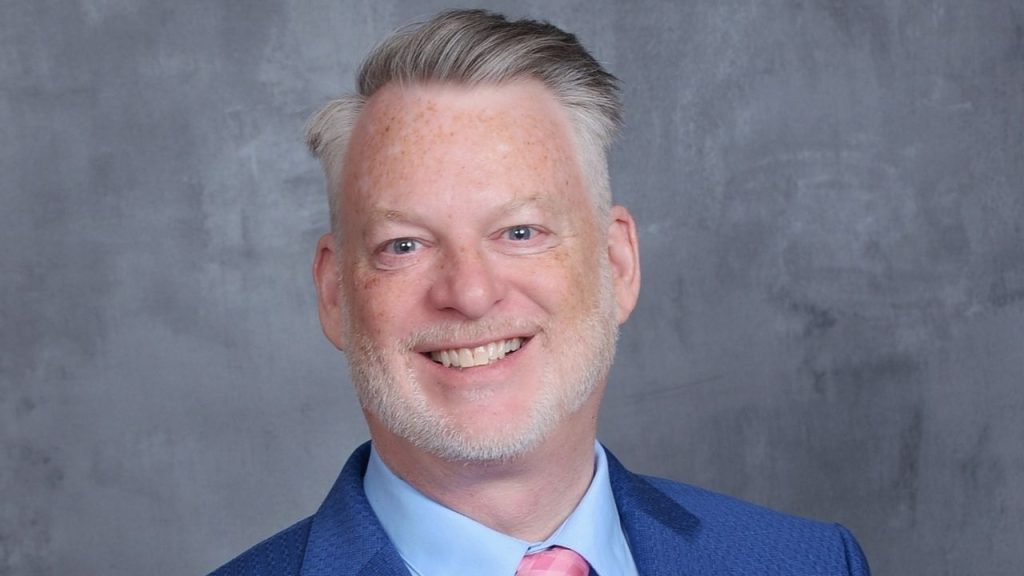
Fordham has named Michael P. O’Malley, Ed.D., as the next dean of the Graduate School of Education, effective July 1, 2026. Currently in his eighth year as dean of the College of Education at Texas State University, O’Malley brings deep experience as an educator, administrator, and scholar, as well as a strong grounding in the Jesuit tradition.
Fordham Now spoke with O’Malley to discuss his background, what drew him to Fordham, and his vision for the school’s next chapter.
What drew you to Fordham, and what excites you most about leading the Graduate School of Education?
There is so much that has drawn me to Fordham! I am excited about the University’s Jesuit mission and identity, which resonates with my own values and inspires us to pursue the greater good through socially transformative and just practices.
Another key factor for me is the notable strength of the faculty’s educational and scholarly expertise, which is so critical for excellence in graduate education and for the University’s success as a research institution.
A compelling and unique aspect of leading GSE is the opportunity to help support the largest public and Catholic school systems in the U.S. GSE has a well-earned reputation for excellence, and I’m excited to become part of that team.
You have a strong background in Jesuit education. What do you think the Jesuit tradition has to offer educators?
The Jesuit tradition supports us in caring for the whole person and being persons and communities for others. I love the ambitious commitment in this tradition, and its confidence that collectively we can make a transformative difference. I also think the Jesuit tradition’s emphasis on excellence supports robust intellectual and academic inquiry and a willingness to engage in dialogue with a wide range of perspectives.
Your accomplishments at Texas State included increasing enrollment, expanding degree programs, and leading major educator workforce initiatives. How do those experiences inform your vision for GSE?
My first approach at Fordham will be learning more deeply from GSE faculty and students about the academic programs’ strengths and opportunities. My big-picture takeaway from my work at Texas State is to bring key stakeholders together, including external partners.
This is work that the GSE faculty and staff are already engaged in, and I’m very interested in supporting meaningful partnerships between GSE and school systems, mental health agencies, related foundations and nonprofit organizations, and policymakers. Working in partnership creates opportunities for real-world impact that also attracts enrollment, illuminates new degree program possibilities, and responds to New York’s critical workforce needs for high-caliber educators and mental health professionals. Taking action in these areas also involves data-informed strategic planning.
The school recently merged with the former Graduate School of Religion and Religious Education. What opportunities do you see coming out of bringing the strengths of faculty from both schools together under GSE?
I think this is a truly unique interdisciplinary configuration that has great potential. We see polarization in our society expressed in many ways. One part of that is a tendency to see public or secular interests as wholly apart from or even in opposition to faith-based interests. By situating faith-based and public-facing faculty experts side-by-side, and doing the same with academic programs, GSE is creating opportunities for sustained dialogue and expanded understanding across our differences that can help heal and transform our schools, mental health services, ministries, and society. That is a project worthy of our energy!
What are some of the biggest challenges educators are facing today and how can GSE equip its students to handle them?
The list of challenges is, unfortunately, extensive. Educators are still responding to pandemic-related learning loss, leading social-emotional learning as well as academic learning, navigating frequently underfunded school systems and an undervalued teaching profession, adapting to new technological contexts, and working through the effects of poverty, racism, and racialization.
The bright light is that GSE’s faculty are precisely the experts to prepare educators to meet these challenges head-on. GSE’s commitments and success make it an attractive partner for external stakeholders, which is critical for offering graduate students the clinical experiences that we know set them up for robust careers.
Many people are concerned about how AI tools like ChatGPT could be undermining traditional evaluation methods, like the essay. At the same time, there’s a recognition that students need to know how to use AI effectively. How do you think educators can balance these challenges?
AI in education could easily be its own essay! There is so much potential with generative AI in terms of accessing and synthesizing knowledge, providing individualized learning assistance, accelerating collaboration, and more. There are also so many challenges, including the possibility of short-circuiting critical thinking and writing skills, affecting attention, increasing isolation or posing mental health risks, normalizing biases, and impacting environmental sustainability.
I think we’ll need to continue to lean on our faculty experts and researchers in this area, engaging relevant professional development, developing AI literacy, and identifying exemplary practices. In terms of evaluation methods, we are learning more about strategies such as documenting AI use, honor code structures, or in-class essay writing (I started college with handwritten essays in the old blue books!). I was really interested to learn that Fordham has launched an AI Hub, and I think there are significant opportunities for the GSE to engage with this work.
