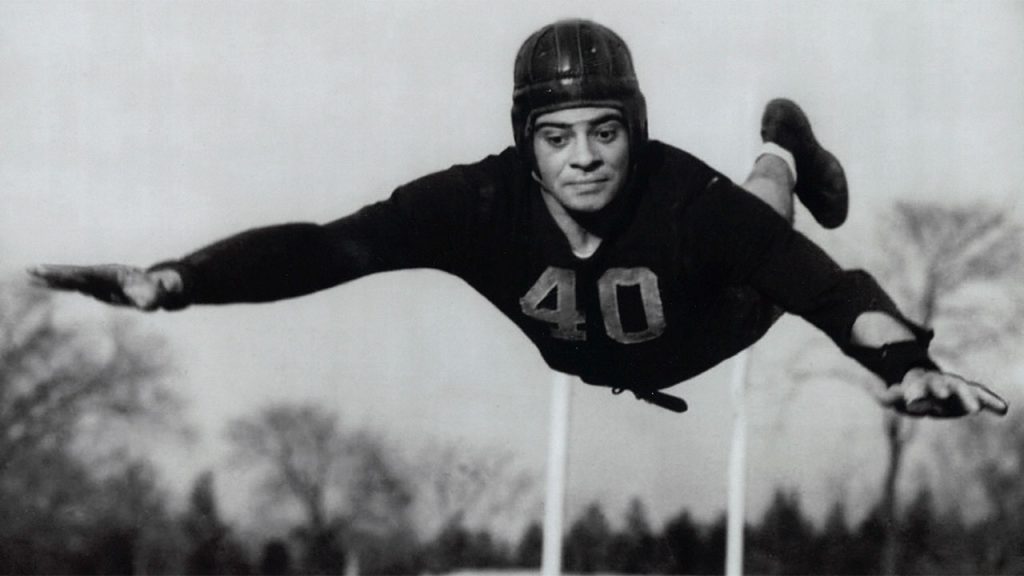
To many football fans, Vince Lombardi will always be the greatest NFL coach of all time. The 1937 Fordham grad became such an icon of American leadership and success that the Super Bowl trophy was named for him after he died in 1970.
The Lombardi legend has only grown since then, with documentaries and even a Broadway play.
But he was far “more complex and interesting than the myths that surround him,” according to Pulitzer Prize winner David Maraniss, author of the 1999 book When Pride Still Mattered: A Life of Vince Lombardi. Even Lombardi’s most famous quote—“Winning isn’t everything; it’s the only thing”—has often been misconstrued.
To see the real Lombardi, it helps to look back at what drove him—and how his Fordham, Jesuit education shaped him.
Here are seven things to know about the man behind the myth.
He Nearly Gave Up Football for the Priesthood
Lombardi was an altar boy at St. Mark’s Catholic Church in Sheepshead Bay, Brooklyn. He wanted to become a priest, but after four years at Cathedral Prep, a pre-seminary high school where football was banned for being too violent, he realized his calling was elsewhere.
“From first contact, football fascinated me,” he later said. He broke the rules by playing for sandlot teams and eventually left Cathedral for St. Francis Prep, where he played one winning season. Fordham recruited him, and Lombardi enrolled at the University in fall 1933 on a football scholarship.
A Fordham Ethics Course Shaped His Worldview
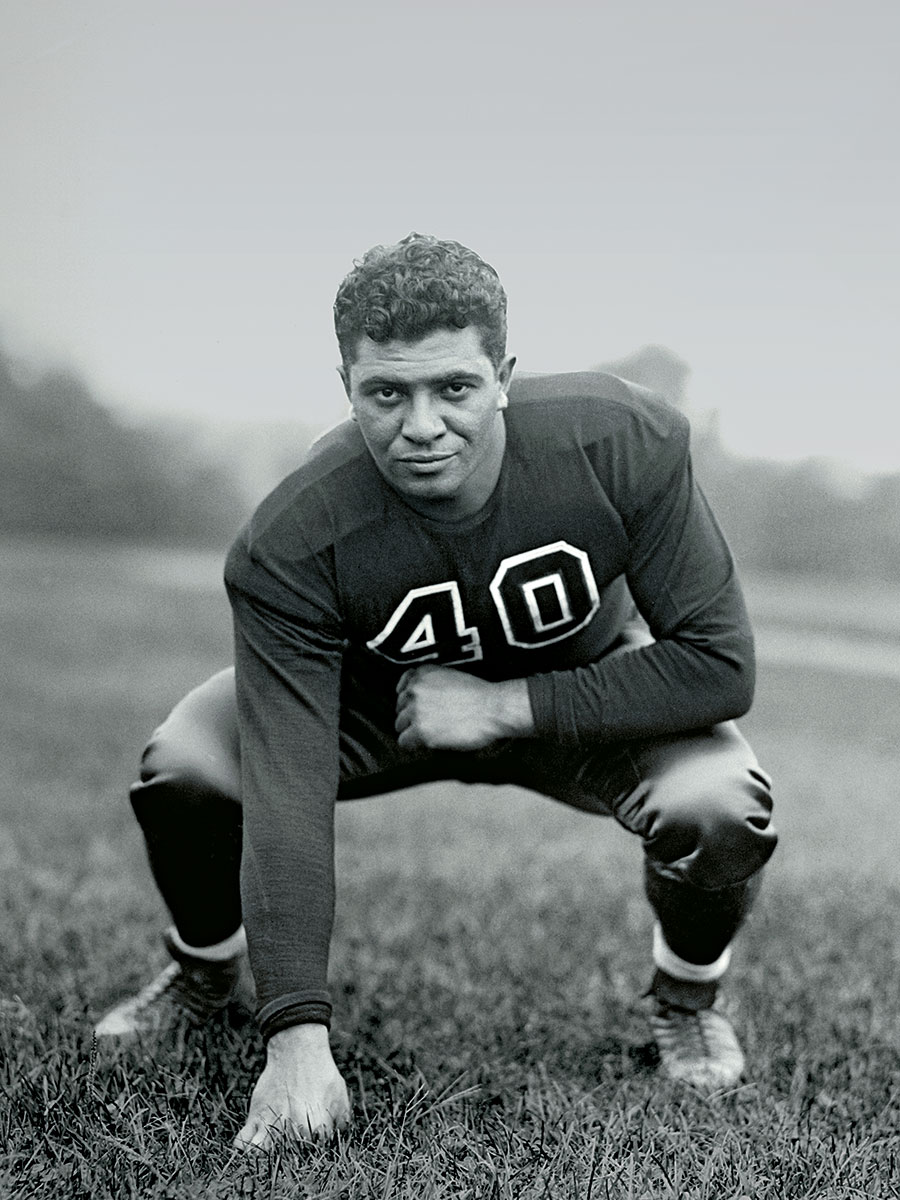
Lombardi was a solid if not spectacular student at Fordham. And he wasn’t always an obedient Ram—he and his teammate Jim Lawlor ’37 held a regular craps game in their dorm room after nightly prayers and lights out.
But he excelled in his senior-year ethics class taught by Ignatius W. Cox, SJ, who published the textbook Liberty: Its Use and Abuse just in time for Lombardi’s senior year.
Sitting in Keating Hall, Lombardi listened as Father Cox spoke about free will and subordinating individual desires “to join others in pursuit of common good.” He described each person’s will as “character in action.” Lombardi made those ideas central to his own philosophy.
A Legend Is Born: The Seven Blocks of Granite
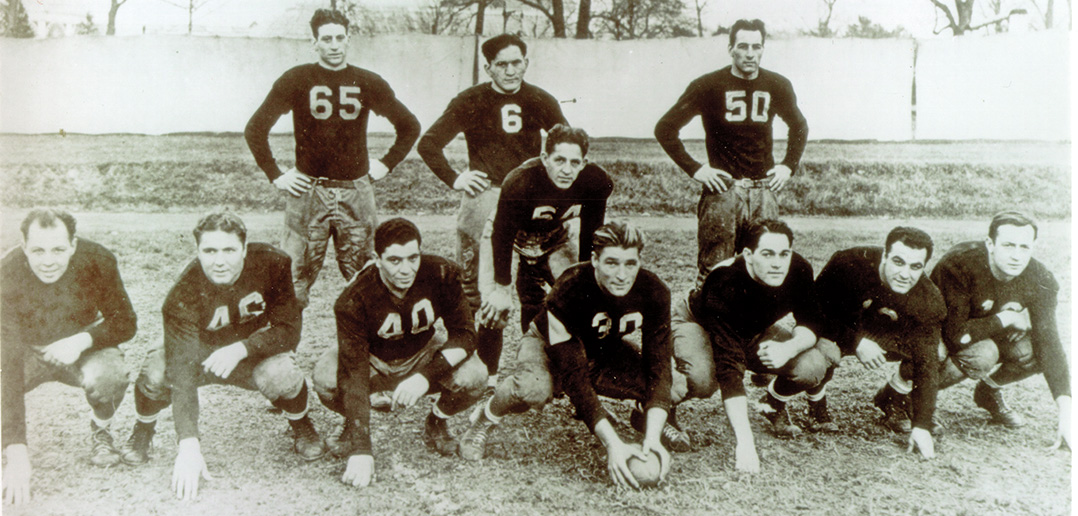
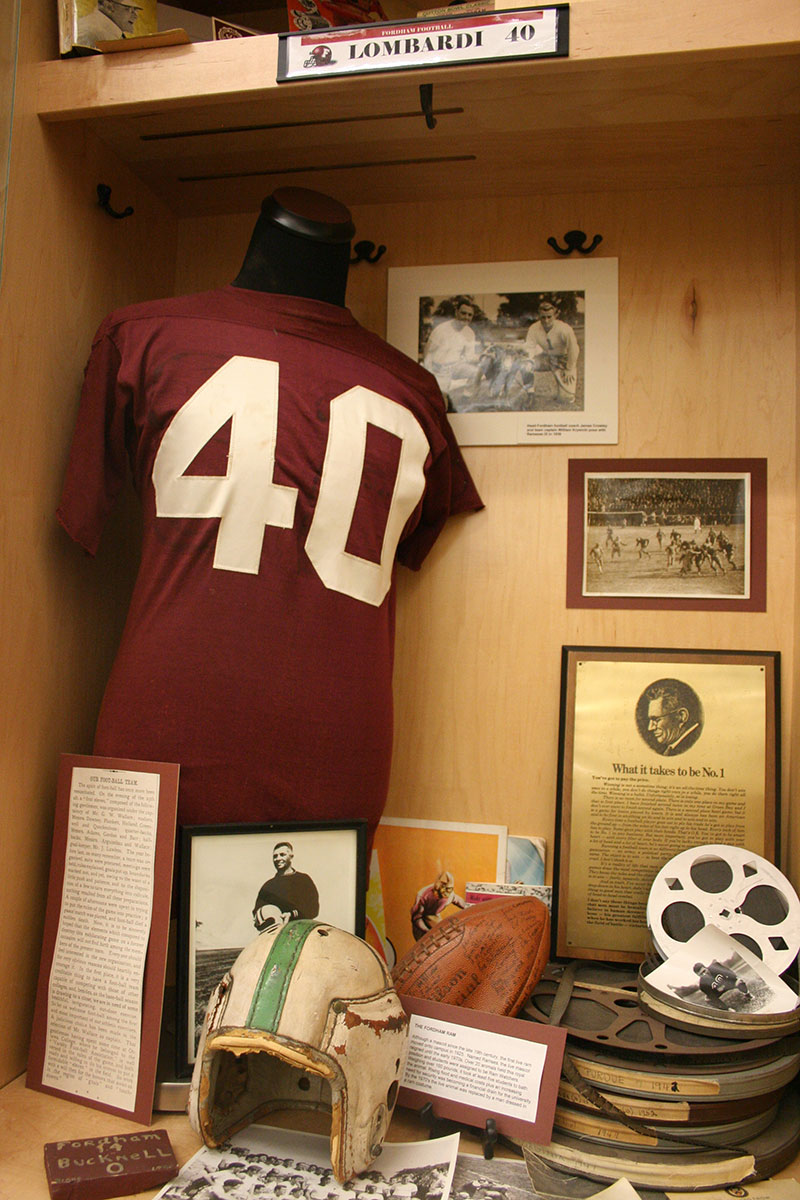
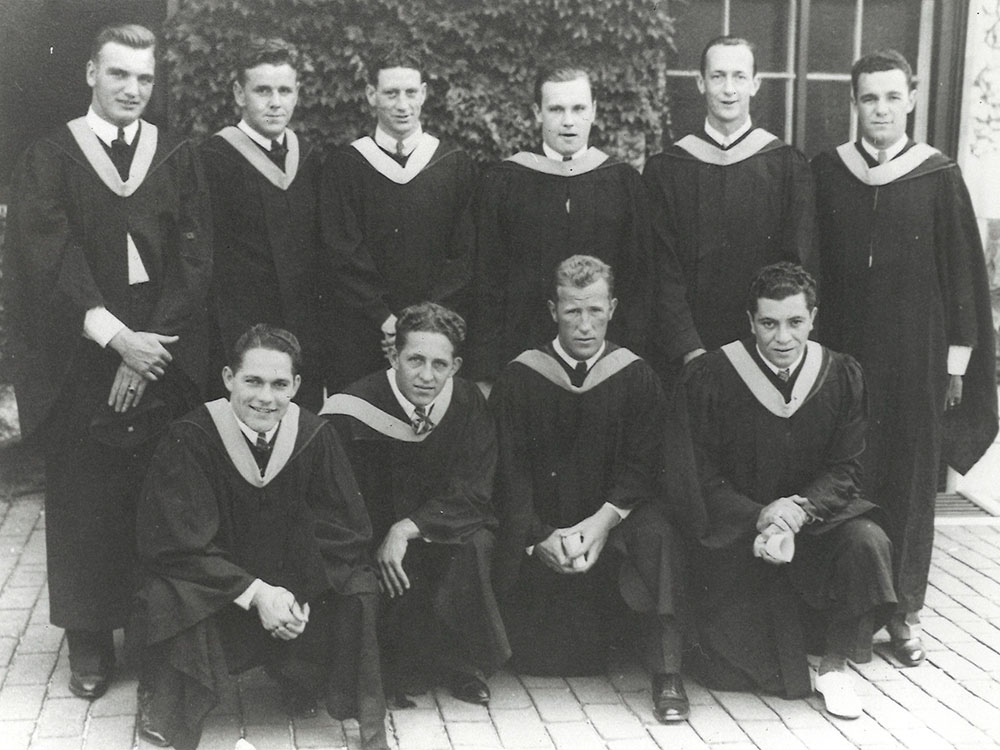
Lombardi wasn’t the most imposing lineman on Fordham’s powerhouse mid-1930s football teams. He was just 5 feet, 8 inches tall and about 180 pounds. But his infectious enthusiasm and fierce play earned him the respect of his teammates, and he became a key part of Fordham’s famed Seven Blocks of Granite.
Fordham publicist Tim Cohane ’35 popularized that nickname for Fordham’s stalwart line after a bloody game against the University of Pittsburgh ended in a scoreless tie. During one play, Lombardi took an elbow to the jaw that gashed his mouth. He’d eventually need 30 stitches. But not until after the game. He returned to the field in time for a final goal-line stand.
“I can’t put my finger on just what I learned playing … in those scoreless games,” he later said, “but it was something. A certain toughness.”
Before NFL Glory, He Was a High School Physics Teacher
After graduating from Fordham, Lombardi played for a couple of second-rung pro football teams and briefly took classes at Fordham Law School. In fall 1939, he finally found his calling as a coach and teacher at St. Cecilia’s in Englewood, New Jersey. He stayed there for eight years, teaching high school Latin, physics, and chemistry while leading his football and basketball teams to success.
While his intensity may have scared some students, he was by all accounts an effective teacher, according to Maraniss. He tried to keep things light with jokes (always “stale groaners”), but he took his new vocation seriously.
“In teaching, you must do more than transmit the facts of your subject,” he told this magazine in a 1967 interview. “You must be willing to give of yourself, to build character, to help someone become a better person.”
‘What Am I Doing Wrong?’: Balancing Humility with Pride
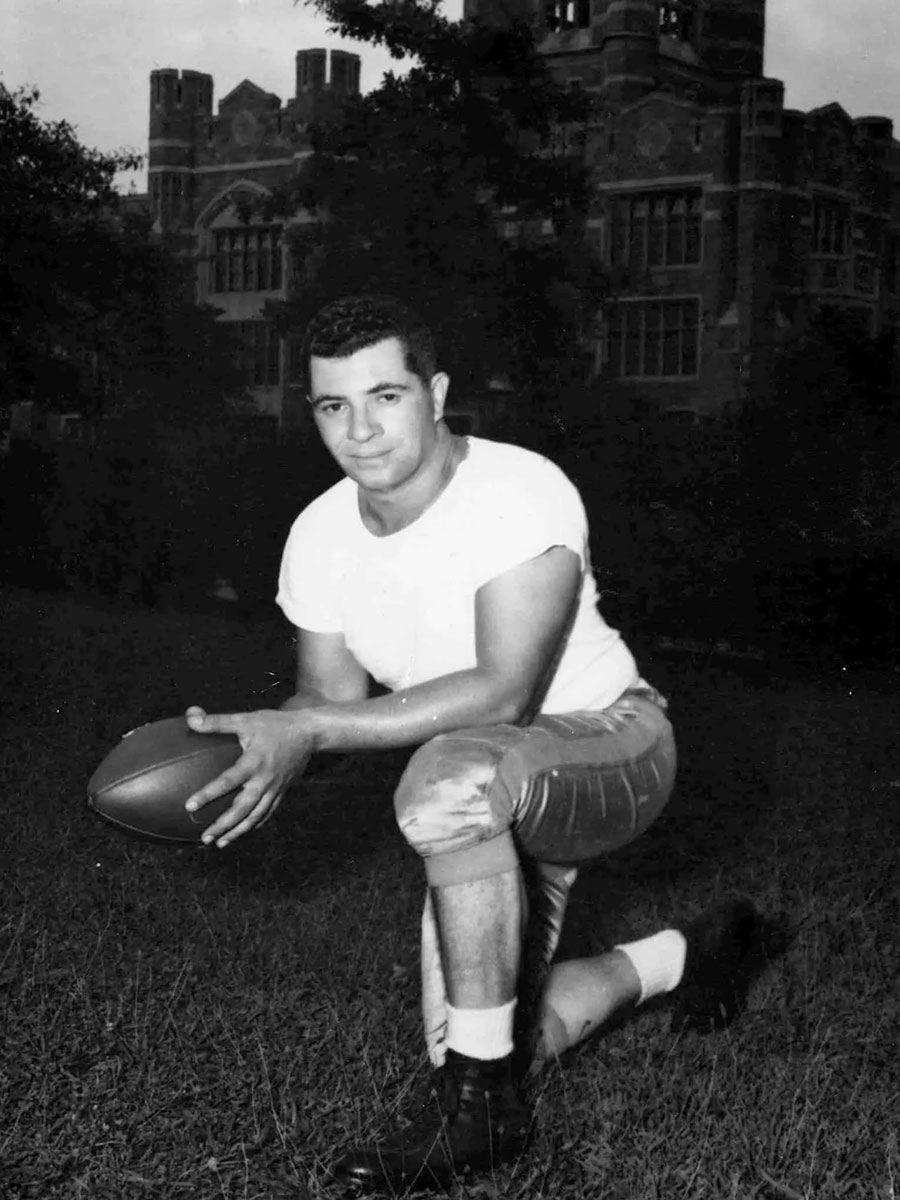
Following his success at St. Cecilia’s, Lombardi returned to his alma mater in 1947 and spent the next seven years as an assistant coach in the college ranks—two seasons at Rose Hill and five working alongside legendary head coach Red Blaik at the U.S. Military Academy at West Point.
Finally, in 1954, Lombardi broke into the NFL as an assistant coach with the New York Giants. He didn’t get off on the best foot, according to the team’s quarterback, Frank Gifford.
“He liked to treat us like we were in high school,” Gifford said in an NFL Films documentary. “When he did some silly things like yelling, barking, giving you a lap or something like that, it got to a point where he was laughable.”
Eventually, Lombardi went to Gifford and his roommate Charlie Conerly and asked, “What am I doing wrong?”
They told him, and Lombardi realized he had to change his way of thinking. “All of a sudden, football knowledge began to pour out of him,” Gifford said. “He became a success with us when he became one of the guys.”
A Fierce Commitment to Civil Rights
“Race was an issue that revealed the integrity of Lombardi’s character,” Maraniss wrote.
As an Italian American, he had “felt the sting of prejudice,” and at various points during his early career, he felt it kept him from getting a head coaching position. Those experiences strengthened his sense of empathy and made him fiercely protective of his players.
When he took over as head coach and general manager of the Green Bay Packers in 1959, he made it clear that he would not tolerate discrimination of any kind. He famously told local Green Bay business owners that if his Black players—including stars like Willie Davis and Emlen Tunnell—weren’t served in their establishments, the entire team would boycott them.
Later, when he learned that some of his players were gay, he warned his coaching staff that any disparaging remarks or discrimination would result in immediate firing.
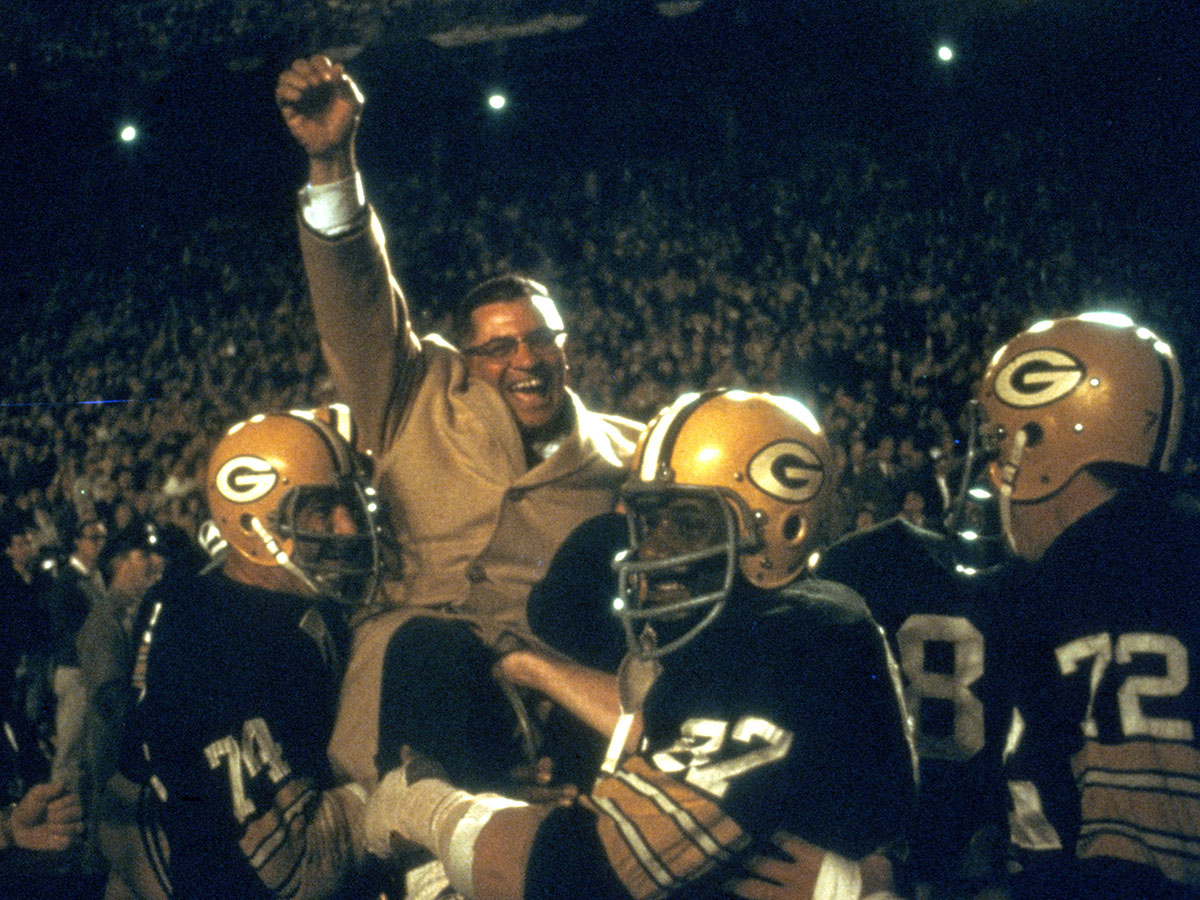
After the Packers narrowly defeated the Dallas Cowboys on New Year’s Day, 1967, to advance to the first-ever Super Bowl, a reporter asked Lombardi what made his team “great enough to withstand the pressures of so intense a finish as we just witnessed?”
“Because they love each other,” Lombardi replied. “There is a great deal of mutual respect by every man on this team. They love each other.”
His ‘Finest Moment’ Had Nothing to Do with the Super Bowl
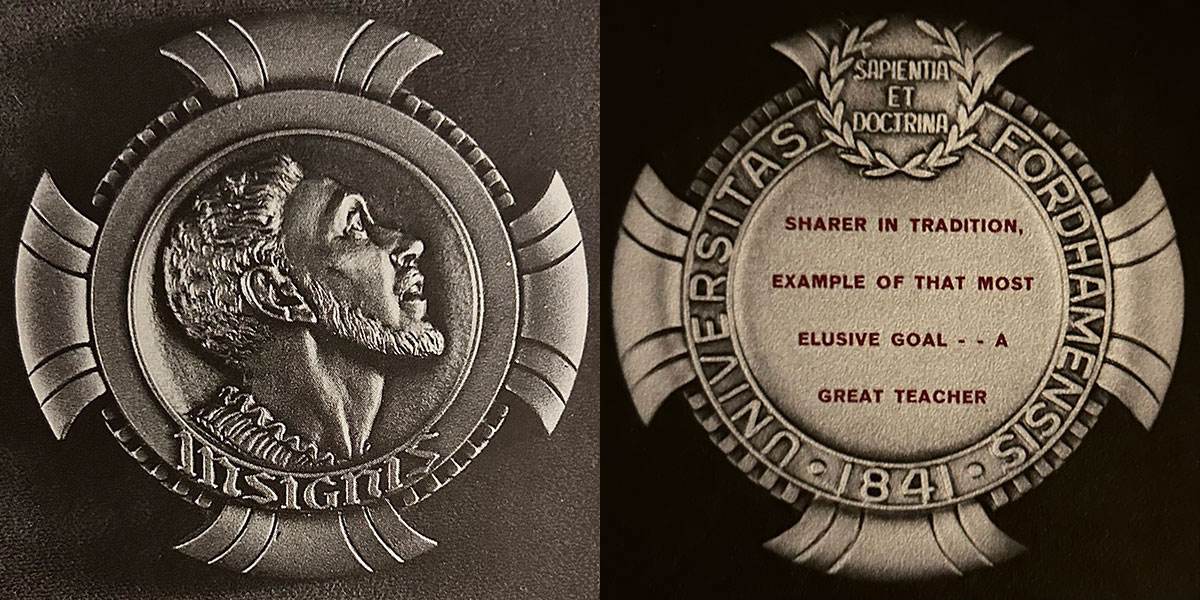
In May 1967, just months after winning the first-ever Super Bowl, Lombardi returned to Fordham. He wasn’t there to talk about the Packers’ “power sweep” or his championship ring. He was there to receive the Insignis Medal, the University’s highest honor.
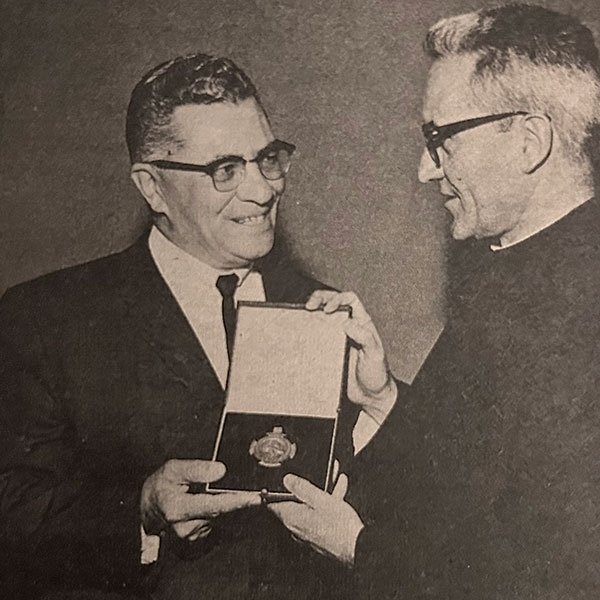
Fordham didn’t celebrate him as a football coach but as a great teacher, one in the mold of St. Ignatius Loyola, the 16th-century founder of the Jesuits. And Lombardi considered that “the finest moment” of his life.
By all accounts, including his own, Vince Lombardi was obsessed with winning. Late in his life, however, he expressed some misgivings about his most famous quote: Winning isn’t everything; it’s the only thing.
“I wish to hell I’d never said that,” he told a reporter. “What I believe is, if you go out on a football field Sunday, or any other endeavor in life, and you leave every fiber of what you have on that field, when the game finally ends, then you’ve won.”