

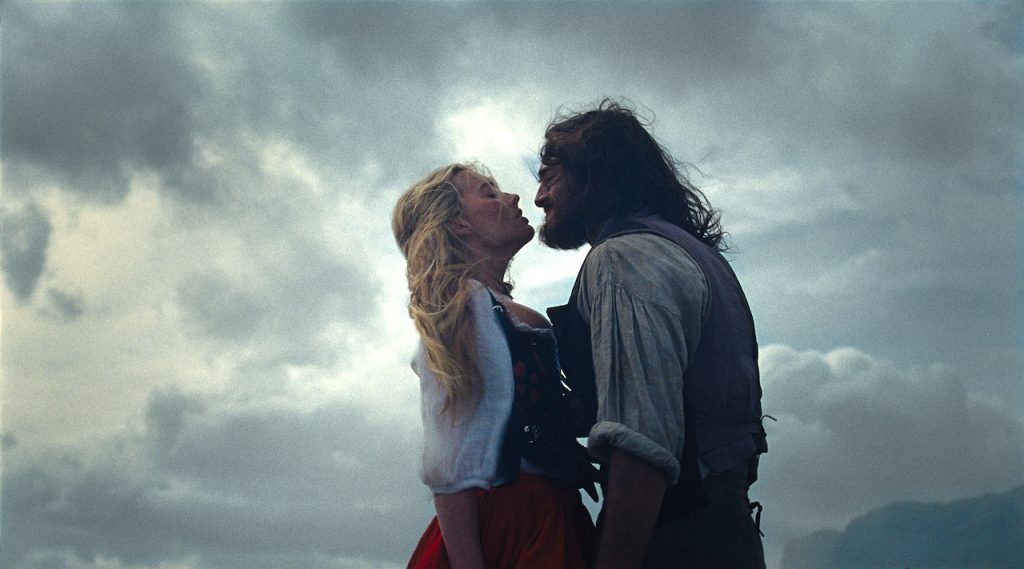
Emily Brontë’s 19th-century novel Wuthering Heights has been adapted for film more than 30 times, and just in time for Valentine’s Day, a new version has hit screens.
The film is directed by Emerald Fennell, known for sexually charged films like Saltburn. She makes it clear this is her own spin on the story of Heathcliff (played by Saltburn and Frankenstein star Jacob Elordi) and Catherine Earnshaw (Margot Robbie). But scholars and fans are already questioning her provocative take on the pair’s relationship—and her omission of other major elements in the novel.
“Wuthering Heights is more than a love story,” said Vlasta Vranjes, PhD, assistant professor of English. Yet at its heart “is an all-consuming passion that defies all constraints—I think that’s what has people coming back to it.”
An expert in Victorian literature and culture, Vranjes is currently teaching the book in her Victorian novel research seminar. She shared her thoughts—and her students’—on whether Catherine and Heathcliff share a love worth celebrating. (Spoiler alert: Plot details revealed below.)
Caught in a Bad Romance
The film’s trailer says it’s “inspired by the greatest love story of all time.” But after Cathy spurns Heathcliff and marries her wealthier neighbor in the novel, Heathcliff becomes vindictive and abusive. It’s then difficult to square his unending love for Catherine with his extreme cruelty toward others, said Vranjes.
As one of her students once put it, Vranjes said, “‘If Heathcliff were living today, you would be running away and getting a restraining order!’”
In her current seminar, Vranjes said, “virtually everyone wondered why anyone would consider Wuthering Heights a love story.”
Another student, who had never heard of the novel, was told when buying her copy that Wuthering Heights was a great love story. “Once she started reading it, she thought she’d bought the wrong version,” said Vranjes.
Whitewashing the Lead
Fans criticized Fennell’s choice to cast a white actor as Heathcliff. In the novel, he’s described as being dark-skinned when Cathy’s father brings him from Liverpool to live at their farmhouse, Wuthering Heights.
“We never learn where Heathcliff comes from,” said Vranjes. Characters in the book suggest he’s a lascar or a Spanish or American castaway; scholars have also read him as Romani, Irish, or “perhaps even a formerly enslaved child, because Liverpool was the major slave-trading port in Britain at the time.” Depending on how the role is cast, the passion between Heathcliff and Cathy “is going to have a different context, different connotations.”
Young Love
Vranjes has heard multiple students say that they romanticized Cathy and Heathcliff’s love as teenagers, then recognized its obsessive nature on a second read.
She said a student of hers offered this theory on why: “Your emotions are most intense when you’re a teenager, and that’s why Wuthering Heights’ love story appeals to teenagers—they can relate to the intensity of the emotions.”
Vranjes can relate. “I think that explains me at 15,” she said.
‘Til Death Do Us Part
One thing the novel does have in common with many great love stories, from Romeo and Juliet to Titanic, is that it involves a tragic death.
“Death is often what makes a love story a love story, because it freezes love in time. It’s a moment of intensity that becomes immortal,” said Vranjes.
Dust to Dust
In the novel, Heathcliff tries to unearth Cathy’s grave shortly after her death. On his second visit years later, he goes so far as to lift the coffin lid.
Not every adaptation includes these grisly scenes, and Fennell’s version only nods to this symbol of Heathcliff’s suffering.
“He doesn’t want closure; he wants Catherine to haunt him,” said Vranjes. “I think having him go to the grave is a shorthand for that.”
Wuthering Heights’ Deeper Meanings
So how does Vranjes read this novel?
“To me and to many others,” she said, “it’s a story about how we treat strangers and the vulnerable, and about the limits of our sympathy and empathy, especially for those who don’t look like us, speak like us—who end up among us uninvited.”
Note: At a Westchester screening of the new film on Feb. 15, English professor Keri Walsh, PhD, will be speaking about the novel. Find more details here.
