

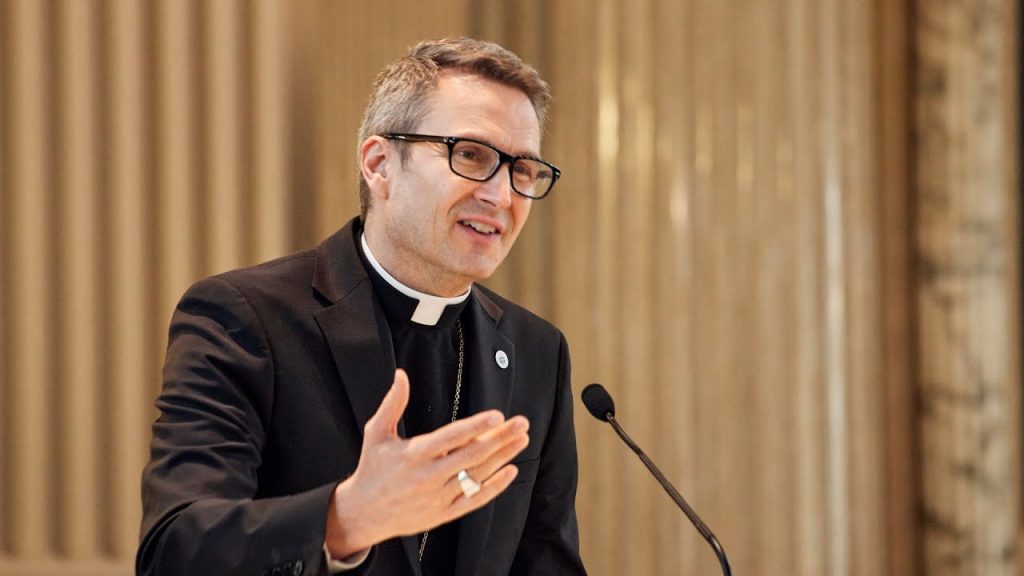
David Gibson, director of the Center on Religion and Culture at Fordham University, spoke with The New York Times about the installation of Archbishop Ronald Hicks, offering his take on the structure of the Archdiocese of New York and what the leadership transition means for one of the nation’s largest and most influential Catholic dioceses.
But the Archdiocese of New York is “a huge corporation, if you want to look at it that way,” said David Gibson, the director of the Center on Religion and Culture at Fordham University. At its center is St. Patrick’s Cathedral in Manhattan, where Hicks appeared at a news conference on Thursday. But Gibson noted that the archdiocese has 264 parishes, “each of them like a branch office.”
“Not to be too irreverent, but the archdiocese looks more like Dunkin’ Donuts,” Gibson said, and the formula for success as an archbishop is the same as for a corporate executive. “You have to delegate,” he said. “But at the same time, you have to make sure that you’re serving people and you have quality control.”
The archdiocese is different from a large corporation, of course: The person at the top does not earn multiples of what employees make. The archbishop’s salary is the same as a parish priest’s — $3,344 a month. And with degrees in philosophy and divinity and experience running a home for abandoned children in Latin America, Hicks arrives with a résumé that is different from those of most chief executives. “No bishop has an M.B.A.,” Gibson said.
“Even if you have an M.B.A., you can’t run the archdiocese of New York alone,” he said. “If he wants to be a shepherd, which he does, he will find people who will help him to do the business of the church.” That involves approving large expenditures, Gibson said — including potential payouts from a $300 million fund for victims of sexual abuse by priests.
