

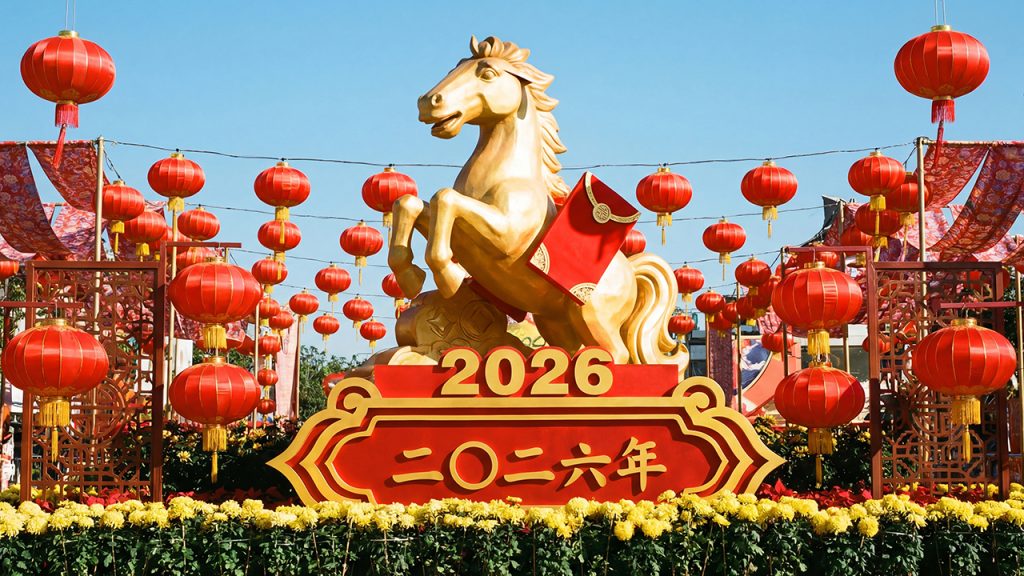
As celebrations of the Lunar New Year kick off this week, one of the more stirring animals in the Chinese zodiac calendar is having its day.
The Year of the Fire Horse portends ambition, turbulence, audacity—harbingers of big change, according to some, said Dongxian Jiang, PhD, a political theorist and intellectual historian and professor of Chinese studies. He noted that the horse is “one of the best zodiac animals in Chinese culture.”
“It’s always associated with positive things,” he said. (Last year, by comparison, was the year of a more sinister-seeming animal, the snake.)
A Potent Combination
Every year, one of the 12 animals in the Chinese zodiac—rat, ox, tiger, rabbit, etc.—corresponds with one of five elements—wood, fire, earth, metal, and water—that bring their own characteristics to that year’s animal, according to tradition. Because the animals and elements follow different calendar cycles, each animal combines with each element only once every 60 years. But this year’s combination is especially powerful and brings extra significance, Jiang said.
Here are three things to know about the Year of the Fire Horse.
‘Fire’ and ‘Horse’ are a special pairing.
Tradition holds that people born in the Year of the Fire Horse are strong, independent, and charismatic, owing to a combination of the fire element—seen as intensifying the traits associated with a given year—and the horse, which holds a special place in Chinese culture, Jiang said.
“The horse actually is associated with aggressiveness,” as well as risk-taking and success, “because we know that a horse can run very fast, and the horse is always used on the battlefield,” he said. He said that in ancient times a Chinese emperor would have paid “a huge sum of money” just for one horse of a good breed.
He noted that fire is seen as amplifying both the benefits and drawbacks of a horse’s traditional traits. The fire element “actually doubles the traits of the horse,” he said. “That means that if you take risks, your risks would also double.” He said people are likely including this year’s element when referring to the year, contrary to traditional practice, because “fire” and “horse” are such a potent pairing.
During the last Year of the Fire Horse, there was a revolution in China.
History provides at least some grist for those who believe in the zodiac—in 1966, the last Year of the Fire Horse, the 10-year Chinese Cultural Revolution began, “so that was a very intense year,” Jiang said. “Many people died, and many people died for utopian ideas.” (Ironically, the revolution’s supporters dismissed traditional cultural notions like the zodiac, he said.)
The Year of the Fire Horse may not go quietly.
According to Chinese tradition, the influence of the Fire Horse will still be felt next year, the Year of the Sheep, he said. “[This is] a very special year, so its influence actually would extend beyond just the year of the horse,” he said.
Celebrations at Fordham
On Friday evening at Fordham’s Lincoln Center campus, the University’s student-led Chinese Cultural Society will hold its fourth annual Lunar New Year banquet, featuring a martial arts display and dance performances, including a lion dance, traditionally meant to ward off evil spirits and bad luck. The celebration is a joint effort with the Korean and Japanese student organizations and Asian Pacific American Coalition, said the Chinese Cultural Society’s president, Erin Liu, a junior.
The celebration is a way for students of all backgrounds to take part in the holiday’s festive spirit, she said. The event resonates with her because she grew up seeing the Lunar New Year holiday celebrated within her household but not in school.
“Seeing it … in a broader community with students and people my age, and staff also celebrating it, it gives a sense of community engagement that I think is really nice,” she said.
The Chinese Cultural Society’s Lunar New Year Banquet will take place Friday, Feb. 20, from 6:30 to 9 p.m. in the G76 multipurpose room, 140 West 62nd Street, Lincoln Center campus.
