

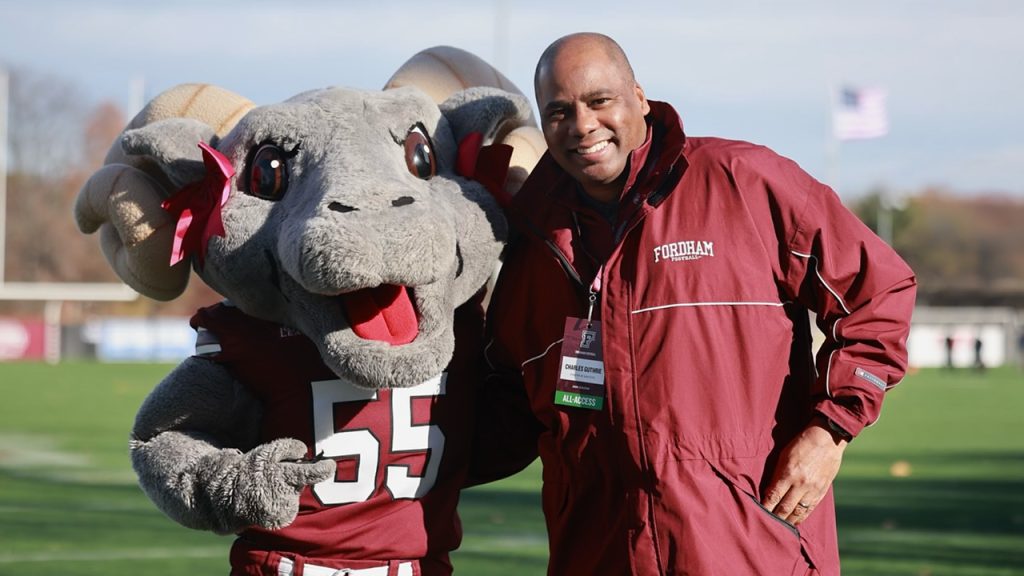
For Charles Guthrie, it’s all about the long game. During his first 15 months as director of intercollegiate athletics at Fordham, he has laid the groundwork for future victories by making a host of immediate changes—boosting the game-day experience, raising funds, enhancing facilities, and refining the process of recruiting new student-athletes.
But he’s also focused on the long-term culture of Fordham athletics, emphasizing things like hard work, self-discipline, commitment to learning, and giving back to one’s community.
In other words, Jesuit values. The values of Fordham. Embracing the University’s Jesuit identity is at the heart of his vision for advancing Fordham athletics and ensuring that student-athletes make an impact that resonates beyond the playing field.
Below he shares insights from his first year and his vision for the future of Fordham athletics.
What are some changes you’ve made in your first year?
We’ve done a comprehensive study of our facilities along with a full financial analysis of the department. We just completed a renovation of the football locker room, and upgrades to weight rooms and training rooms for our teams are going to be a priority. We are focusing on the fan experience for ticketed events, everything from parking to in-game activities, like giveaways. And we started the Courtside Club, a premium space with hospitality for designated Maroon Club members. We also are aligned on a central operating mantra, or philosophy—‘find a way,’ and that means not making excuses and becoming more of a solution-based organization.
In our coaching, we’re really leaning into building character, community, and discipline. You win championships on discipline.
What moments have inspired you the most since coming to Fordham?
I enjoy the winning moments. In particular, I have really enjoyed the success of our water polo team; I loved attending the Final Four in California. I’m also impressed by how the program looked at the advantages of our University, the location in New York, and used those things to build a championship program with a combination of student-athletes from the U.S. and abroad. And Fordham athletics had all-time high GPAs this past fall—overall, as well as for baseball, men’s basketball, both men’s and women’s track and field, rowing, squash, and water polo.
Can you describe your strategic plan for Fordham athletics and your vision for its future?
Everything begins with integration into the larger strategic plans for the University. I did a presentation for the faculty senate on athletics and how our students were performing in the classroom, and that was great, because it was the first time an athletic director has presented to that group. So we’re at the table, which is very important.
Our core four priorities are competitive excellence, integrity, service, and protecting the Ram, meaning our brand, through our behavior. I’m consistently receiving notes from hotel general managers on how well-behaved our teams were, and what a delight it was to have them at their hotels. That’s protecting the brand. It is all-encompassing—being respectful, mindful, understanding that we’re all blessed to have this opportunity to be part of a Division I program.
What is uniquely Fordham about our teams?
We’re really leaning into our Jesuit principles of caring for the whole person and how athletics is body, mind, and spirit. There’s the Jesuit principle of magis, or more; to become a champion, you have to push yourself to the limits in pursuit of personal and team improvement. And then community and service—when you look at what our student-athletes are doing in the Bronx, working with different schools, our community engagement is just really high.
What are some of Fordham athletics’ innate strengths, and how do they help in recruitment?
We’re a top academic institution in the capital city of the world, affiliated with the Atlantic 10 conference, which has an exceptional reputation for winning across all sports programs, and the Patriot League, one of the top Football Championship Subdivision conferences. Those elements add to our ability to recruit student-athletes who want to compete in their sport but also compete for their future. We are getting some of the best and brightest in the world. This entire area continues to evolve—we’ve made it a priority for our coaches to think outside the box and attack recruiting proactively. Plus, retention is so critical. We’re not only recruiting new players; we’re ‘recruiting’ our current student-athletes day in, day out. The more positive experiences they have, the more likely they are to return to Fordham.
Why is our academic reputation important for athletics?
There’s a correlation between great academics and being able to recruit the best players. When the game gets hard, when fatigue sets in, it comes down to mental toughness. And that goes to discipline. When you have academic rigor, you’re disciplined and tend to make smart decisions as the game goes on.
