

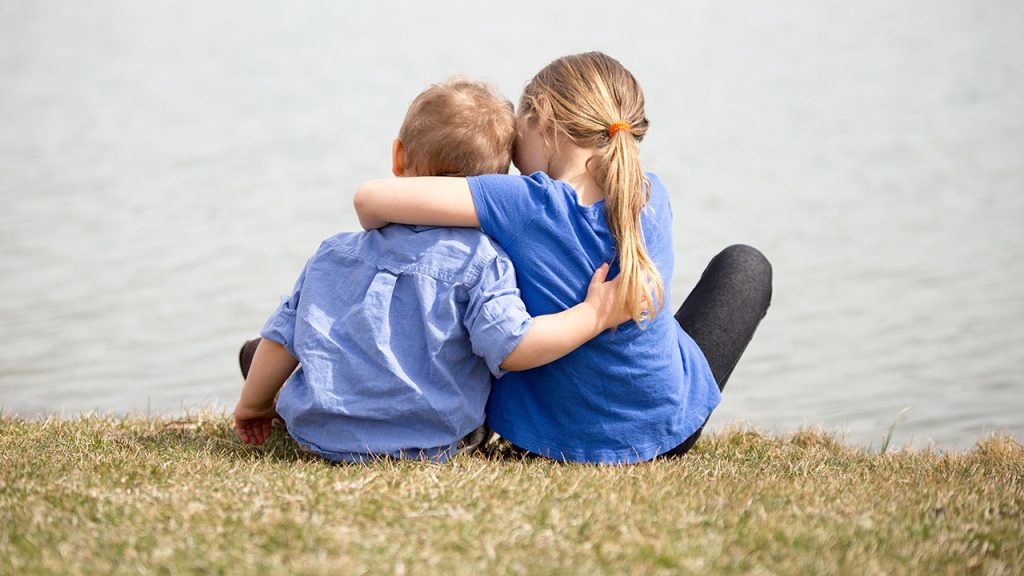
Our parents raise us, yes, but our siblings have an influence too—a fact that science hasn’t spent a lot of time exploring, according to a study co-authored by Fordham psychology professor Alexander Kriss, PhD.
“Siblings in general have been overlooked broadly in psychological research,” and there are few studies of how sibling relationships might affect what’s happening between children and parents, Kriss said. “The sibling relationships have always been looked at as so subordinate to parent-child relationships.”
The study offers a few surprising findings:
First, it suggests that children’s sense of well-being and security can come not only from their attachment to their parents, but also from their relationships with their siblings. Sibling bonds, the study found, can give them strength and support to make up for weak attachment to disengaged or troubled parents.
Second, the study challenges another common idea—that oldest children feel usurped by the birth of a sibling. In fact, more often the older child is the one with the more secure attachment to their parents, the study suggests.
The upshot? Sibling relationships have a lot to teach us about how people grow up and turn out. Kriss spoke to Fordham Now about the study in advance of National Siblings Day on April 10.
Shared Family Struggles, Stronger Sibling Ties
Kriss co-authored the study with Howard Steele and Miriam Steele of the New School for Social Research. Published earlier this year in the journal The Psychoanalytic Study of the Child, it focused on data from the London Parent-Child Project, a multi-decade study of 25 English families begun in the 1980s. It centers on attachment theory, or the idea that children’s sense of safety “is primarily derived from reliable, ongoing interactions with their caregivers,” Kriss said. Children become insecurely attached when parents are aloof, disengaged, or overly anxious and intrusive; they’re securely attached when parents provide a sense of stability and security.
The prevailing idea has been that the quality of sibling bonds is determined by a “trickle-down” from how secure or insecure their parental attachment is, Kriss said. But the study found that even when their attachment to their parents was weak or fraught, siblings’ shared experience of their parents could foster a sense of closeness “or even protection from an otherwise insecure environment,” Kriss said. “So it’s not just that if you’re insecurely attached to your parents, everything suffers.”
The support formed in such cases can radiate outward in the form of strong relationships with friends and peers, potentially fostering achievement in school or other areas and showing the need to better understand how our siblings influence us, Kriss said.
“The idea that there’s something that contributes to growth and self-understanding and how you function in the world with people around you that is operating … in its own domain, separate from just the influence of your parents, is a really important idea,” he said.
Upending Stereotypes of the Oldest Child
The study also examined the weaker ties among siblings who are “discordantly attached,” meaning one feels secure in their relationship with the parents but the other does not. “If these two siblings are living in different psychological worlds or have very different understandings of the kind of home environment that they’re being raised in, it’s going to affect their ability to relate to each other” and develop a warm relationship, he said.
In such cases, he said, the securely attached sibling is more likely to be the older one, the study suggested—challenging the “longstanding idea … that the older sibling is the beleaguered one who gets usurped by the younger one,” Kriss said.
Rethinking Sibling Rivalry
“There’s such a long history, going back to the Old Testament, of siblings as rivals being the only metaphor we have for understanding the relationship, but our work … showed that things were much more complex than that, that siblings could have really competitive dynamics that also had these really playful imaginative sides, or they could be not competitive at all, but also kind of alienated from each other,” he said.
“It’s just striking how resistant the narrative around siblings and the research around siblings has been to taking a more nuanced, three-dimensional view of how rich these relationships can be.”
