

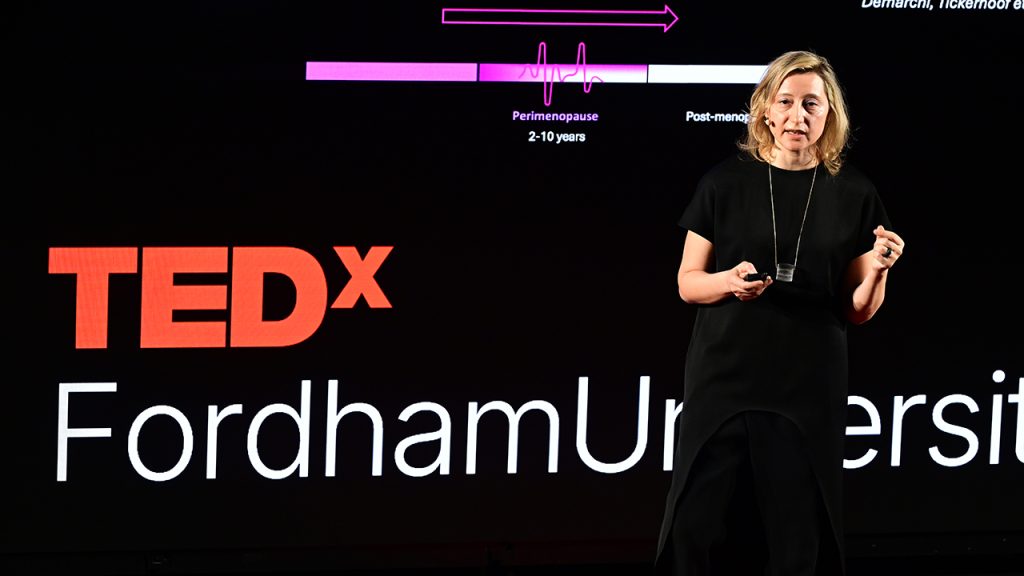
A Fordham biology professor’s recent presentation on perimenopause and the brain has been chosen as an Editor’s Pick among TEDx videos, providing greater visibility for her message about the underrecognized mental illnesses that can afflict women during this life stage.
“Women’s health has been severely understudied,” said Marija Kundakovic, PhD, in presenting her brain research this spring at TEDx Fordham University: For What Matters, one of many independently organized events licensed by TED. Hers was one of nine presentations by Fordham faculty and alumni.
Changing the Future of Women’s Health
The moment is ripe for research into the mental health of women undergoing menopause, Kundakovic said in her talk. “Women literally report not feeling [like] themselves” because of hormone changes, she said. She described her research focused on postmortem brain tissue that could bring about new treatments for menopause-related mental health challenges that have long been dismissed and minimized. “We may not be able to change the past, but we can certainly change the future for women’s health,” she said.
Other Fordham TEDx presenters shared a variety of ideas for personal progress—like resisting distraction and overcoming bullies—as well as insights into societal issues, such as the perils and potential of AI.
The Trap
Brandon Kim ’15, Co-Founder of Brevitē, Award-Winning Maker of Sustainable Backpacks
Kim’s talk focused on avoiding “the trap,” an idea he developed while running the backpack company he co-founded as a Fordham student. “The trap is the anxiety and the anger, it’s the shiny objects and the distractions,” he said. “It’s the things that feel urgent but aren’t actually important. Left unchecked, they’ll eat all that you are and all that you ever will be.”
“It is everywhere, and everything you could ever want is on the other side of it,” he said.
On the Spot: AI and Education
John Craven, Graduate School of Education; Jie Ren and Yilu Zhou, Gabelli School of Business
Three Fordham experts laid out the limitations and the potential of AI in this “On the Spot” TEDx presentation. Rather than a standalone tool, AI will be “an infrastructure that’s going to change the way we work and collaborate,” said Zhou. Skill sets will change, but human knowledge will remain important because of the false information AI generates, she said.
Craven spoke about helping students learn to use AI tools “while not allowing those tools to do all their thinking for them.” The future “will be shaped not by those who don’t use AI,” he said, but “by those who have learned to think with it.”
In the age of AI, “students need to focus on learning the ability to learn, to build the ability and creativity that are the very core of our human advantage,” Ren said. “And then, AI can come in as an amplifier … to make our dreams come true more easily than before.”
How to Fight a Bully Without Using Your Fists
Jennifer Cassetta ’98, Author, Performance Coach, Martial Artist
What’s the best way to counteract a bully, even when you feel outmatched? Martial arts offers an answer—and it’s not brute force, Cassetta said. The key, she said, is “being strategic rather than reactive … redirecting force instead of matching it … [and] conserving energy instead of burning yourself out.”
Rather than try to overpower a bully, “you just need to work the right angle,” she said. “Ancient martial arts wisdom teaches us that no matter what you’re up against, you always have leverage.”
Coming Back from the ‘Edge of Extinction’
Natalie Anderson ’98, CrossFit Coach, Personal Trainer, Reality TV Star
Anderson shared her five-part strategy for overcoming setbacks, drawing on her escape from Extinction Island as a contestant on the reality TV show Survivor: Accept what happened. Commit to doing the work. Be present and persistent. Stay ready to seize opportunities. And tap into the power of affirmations: “Find the words in your life that make you feel powerful, that can change the way you feel and the decisions you make daily,” she said.
On the Spot: AI and the Environment
Marc Conte and Giacomo Santangelo, Department of Economics; Adam Orford, Fordham Law School
The decision to build new data centers needs to be informed by costs like pollution, water depletion, and strain on the electrical grid, which “are borne by members of nearby communities and the general public, not AI companies,” said Conte, who described how municipalities can protect their interests. The communities that are disrupted will be those with lower incomes and “less representation and political clout,” said Santangelo, who described a model he’s developing to identify the impacts of proposed data centers by zip code.
Orford described how laws and the political process can give people a voice when a new data center is proposed near them. “Every single one of us … deserves to have a say in what impacts artificial intelligence is going to have on our environment, on our natural resources, and on our society.”
Rehearsing Hope with Migrants
Fadi Skeiker, Chair, Department of Theatre and Visual Arts
Theater can be a tool for social justice, Skeiker said, describing the theater exercises he has led for migrants and refugees around the world—not for entertainment but rather “to create space for dignity, hope, collaboration, community.”
“Theater allows us to rehearse hope,” he said. “I’m not talking here about hope as optimism or about hope as denial, but hope as practice—social, embodied, and fragile. Because before people move forward, they sometimes need to rehearse what forward feels like.”
AI as a Scientific Mirror
Sam McGrath, Department of Philosophy
McGrath described AI as something that can help us better understand human capabilities. “AI is a kind of a mirror that we can hold up to ourselves to discover more about our own minds,” McGrath said, noting that “in some cases, it seems like these artificial intelligence systems are achieving human-like behavior and capacities.”
AI may or may not turn out to be capable of everything humans are, but “in either case, [it] promises to offer a sort of a new vantage point on a whole set of questions that us philosophers have really been knocking our heads against for millennia.”
Sick from Scrolling: Social Media’s Hidden Health Crisis
Michael Dowling ’74 MSW, CEO Emeritus of Northwell Health
Dowling used his talk to highlight two dangers facing today’s children and young adults: The first is gun violence, and the other is social media apps designed to attract and keep customers, leading to addictive behavior and fueling problems like social isolation and sleep loss, he said.
He noted the children he has seen seeking treatment in mental health clinics for the effects of social media addiction. “It’s not just a technology issue, it’s a public health issue, because we see the results of it all over the place,” he said.
Gun violence and social media addiction are two examples showing how “so many of our children, adolescents and young adults, are bearing the burden of major societal issues,” he said. “This is something we have to worry about. This is something that puts upon all leaders, whether you’re in education, in health, in business … a special obligation and responsibility to get engaged, to know and to act.”
The video of Michael Dowling’s TEDx talk is not yet available.
