

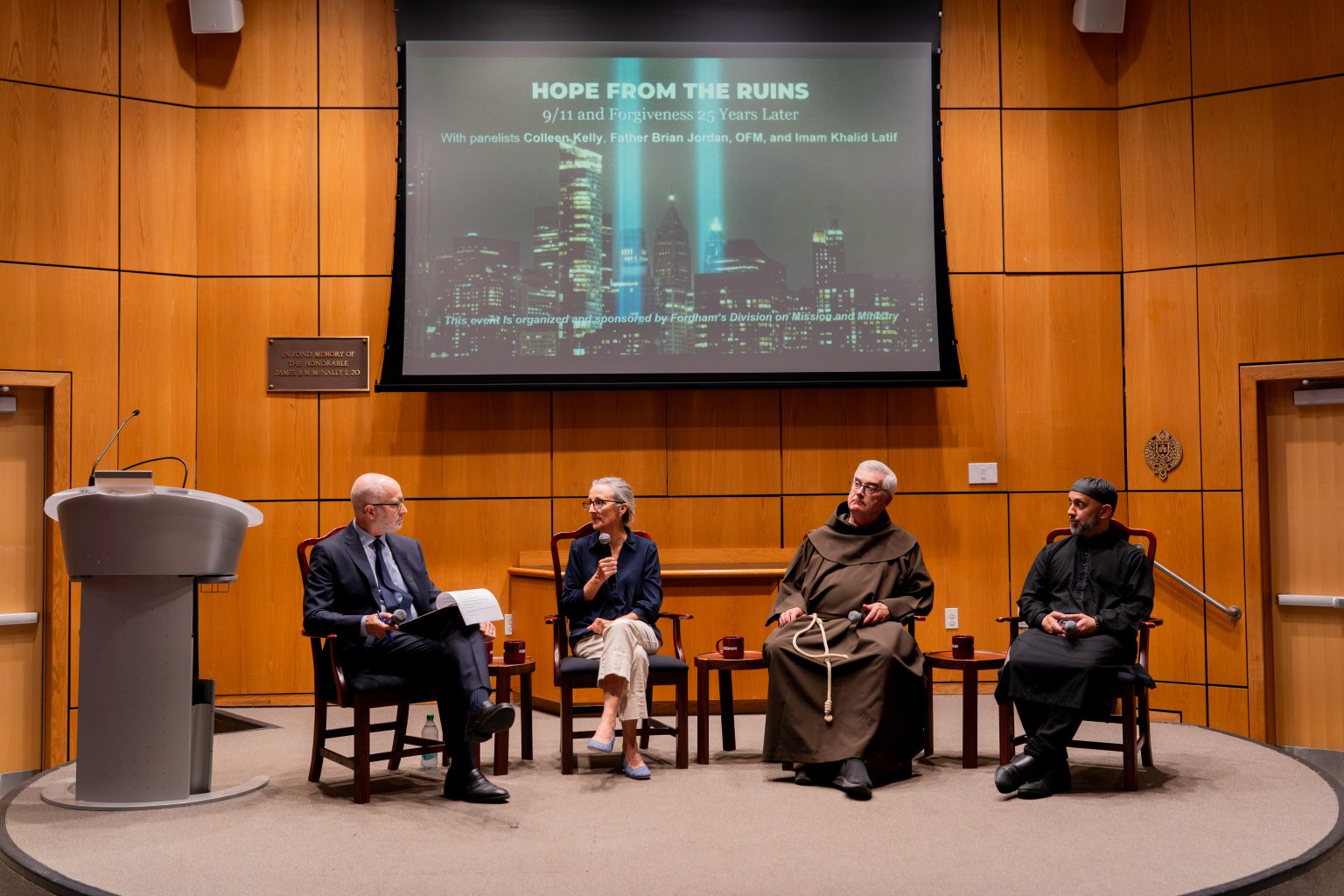
As we mark the 25th anniversary of the terror attacks of September 11, 2001, what lessons can we reflect on? And where can we find hope?
These were questions explored during a discussion titled “Hope from the Ruins: 9/11 and Forgiveness 25 Years Later” hosted by Fordham’s Office of Mission Integration and Ministry on Wednesday at the Lincoln Center campus.
“The attacks of September 11th were deeply personal to Fordham,” said University President Tania Tetlow, noting that three students and 36 alumni were killed in the attacks, and many more members of the Fordham community lost friends and relatives. “Their names remain part of our University’s living memory,” Tetlow told the audience of students, faculty, staff, and members of the public gathered in McNally Amphitheatre.
Kindness from Strangers
After an opening prayer by Rabbi Katja Vehlow, Fordham’s chaplain for Jewish life, David Gibson, director of Fordham’s Center on Religion and Culture, moderated the conversation between three people with personal connections to the tragedy.
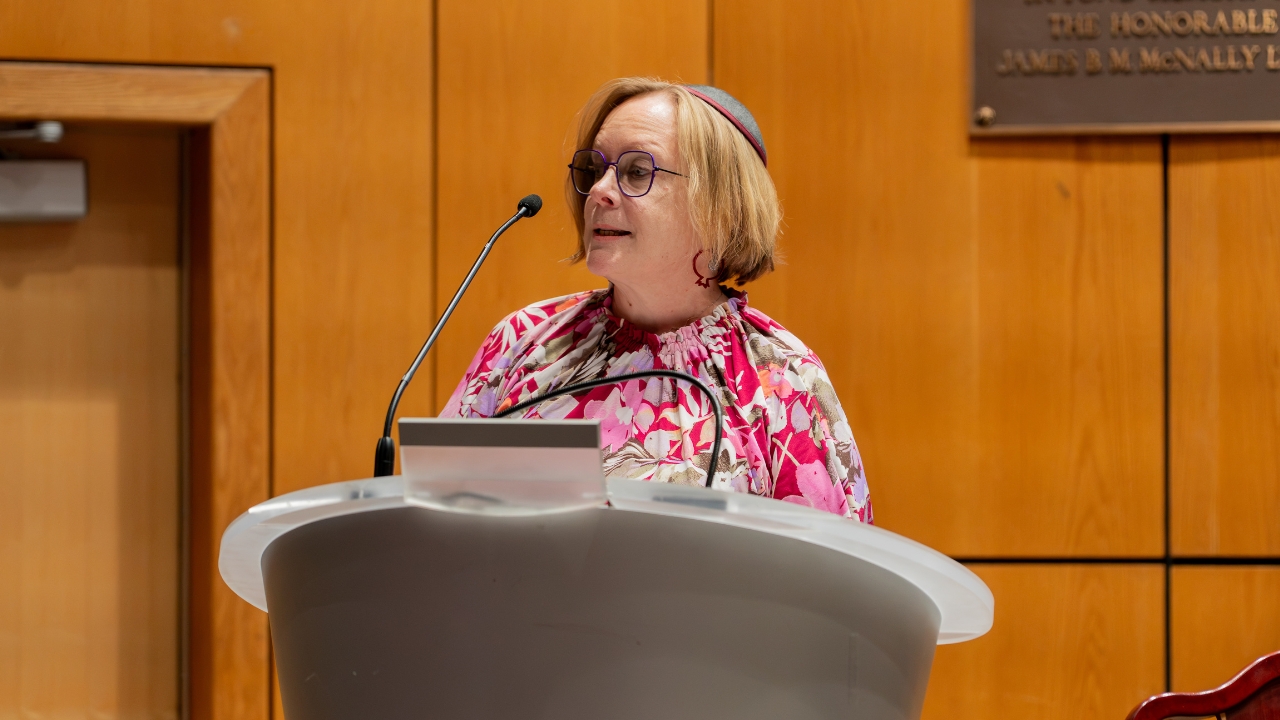
Colleen Kelly, a founding member of September 11th Families for Peaceful Tomorrows, shared how she spent that evening walking from hospital to hospital, hoping to find her brother, Bill Kelly Jr., among the survivors. He never returned home and his remains were never identified.
Kelly said she remembers the horror of that day, but also the humanity she witnessed.
“People helped me get home, people helped me get my children from school,” she said. In a bizarre twist, her son had broken his leg on 9/11, and the nurse who helped them shared that her brother had been missing for hours after the 1993 World Trade Center bombing.
“Here I had this woman who knew exactly how I was feeling at that moment. I think she was placed there to help me,” said Kelly.
Since that day, Kelly has devoted herself to the cause of peace through her organization. She said that she was inspired by the biblical story about how Jesus reacted after learning that John the Baptist had been killed. Jesus went by himself to pray, then later that day performed the miracle of multiplying the loaves of bread and fishes to feed 5,000 of his followers.
“Jesus’s message is one of community and sharing and being with others,” said Kelly. “I thought, I want to react in loving kindness, compassion, and understanding, because it makes me feel better.”
Sisters and Brothers of the Same God
Father Brian Jordan, OFM, a Franciscan friar and pastor at St. Francis of Assisi parish in midtown, made his way to Ground Zero when he heard about the attacks. There, he blessed bodies as they were pulled from the rubble. He returned to the site day after day to preside over masses for workers of all faiths.
“Jewish, Muslim, Protestant, it didn’t matter. We’re all sisters and brothers of the same God,” Father Jordan said.
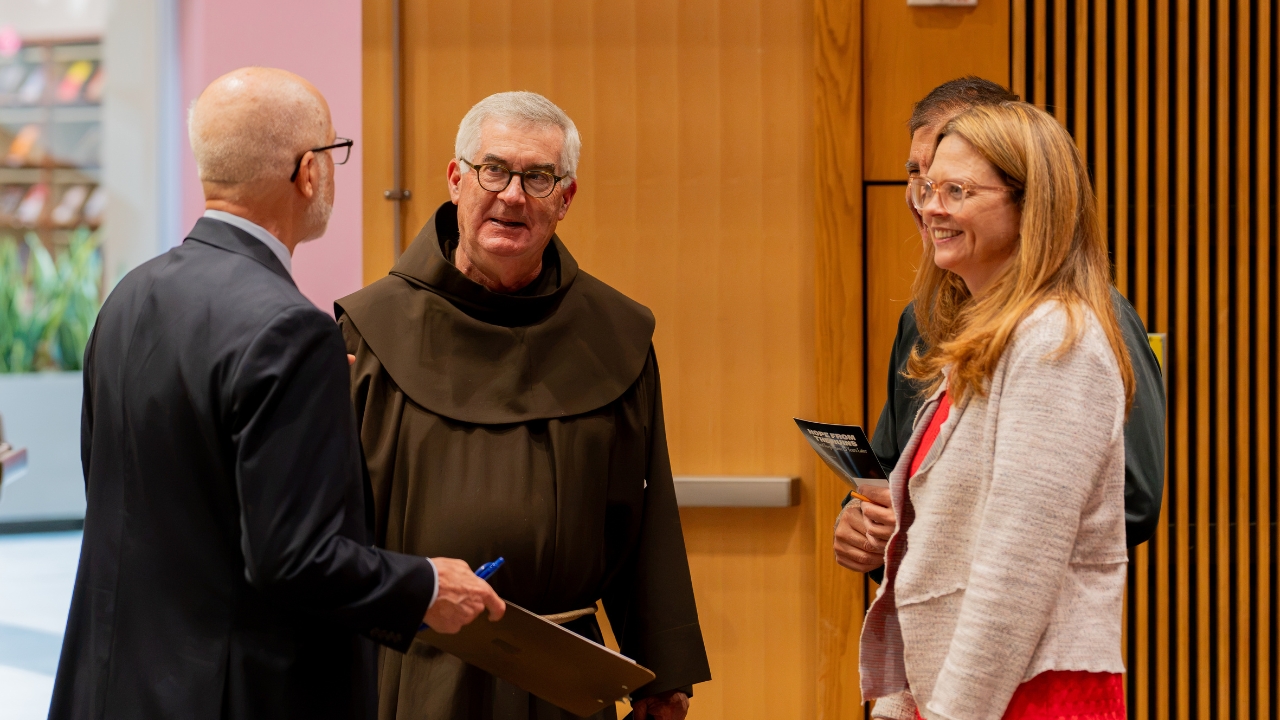
For Imam Khalid Latif, director and co-founder of the Islamic Center of New York City, those interfaith connections were vital. He experienced firsthand the Islamophobia that gripped the nation, both at Ground Zero and later on, but also recalled the Catholic leaders who preached tolerance.
He pointed to the example of Pope Francis, whom he met at the 9/11 Memorial site in 2015. Latif recalled how Francis had gone off script the night before during a speech at St. Patrick’s Cathedral, praying for the 700 Muslims who had died during the Hajj pilgrimage that day.
“He was in the city where the terror attacks took place. No one would have faulted him for not praying for those Muslims. He simply did it because it was the right thing to do,” Latif said.
Finding Hope after Tragedy
The power of choosing connection over division ran through the evening’s discussion. For Kelly, healing has meant advocating for peace through her organization, which has battled human rights abuses at Guantanamo, aided civilians in Afghanistan, and fought against Islamophobia.
Father Jordan said he’s found hope by remembering not only the horrors of that day, but the community and compassion it revealed.
“God did not abandon us at Ground Zero,” said Father Jordan. Instead, he showed us “that despite all this hatred, you should love one another as I have loved you.”
