

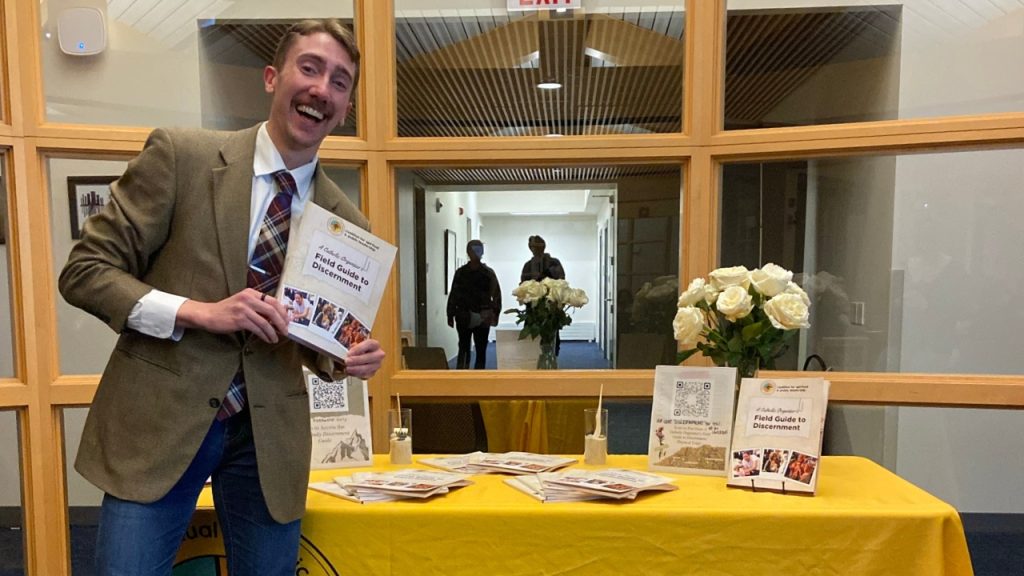
Fordham theology PhD student Alex Gruber spent his summer helping community organizers in Chicago enhance their social justice work by tapping into a centuries-old Catholic spiritual practice.
During an internship with the Coalition for Spiritual and Public Leadership, Gruber created “A Catholic Organizer’s Field Guide to Discernment.” The 119-page guide offers a framework for practicing discernment, a prayerful process of reflection and decision-making rooted in Catholic tradition.
According to Gruber, the guide is designed for organizers working on issues ranging from environmental justice to immigrant rights, including efforts to secure pastoral care for people held at a Chicago-area immigration detention center.
Gruber said the project was an opportunity to apply academic training beyond the classroom.
“It was an experience that helped me see how I could put my education here at Fordham to use for the common good in a very direct way,” he said.
Bringing Discernment Into Community Organizing
CSPL is a grassroots organization that brings together churches, universities, and community groups to advance racial, economic, social, and environmental justice. One of its most prominent recent efforts has been securing spiritual care for immigrants detained by federal authorities at the Broadview detention center outside Chicago.
The coalition has organized religious processions, celebrated Mass outside the facility, and pursued legal action to secure access for clergy and other faith leaders to minister to detainees.
It’s demanding work, requiring organizers to make difficult decisions, confront uncertainty, and draw strength from their faith, according to Tiffany Swann-Covington, a parishioner at Chicago’s Our Lady of Africa Catholic Church and a CSPL organizer. According to Swann-Covington, discernment helps people understand both the demands of justice work and their own capacity to contribute.
“You’re going to be asked to do some things that pull you outside of your comfort zone,” she said, noting that some organizers participate in civil disobedience and even risk arrest.
Discernment, a central practice in Jesuit spirituality, involves prayerful reflection, attention to one’s inner movements, and consideration of how God may be calling one to act. This is a practice that can help organizers navigate complex decisions, Swann-Covington said.
Although often associated with individual decisions, Gruber’s project explored how discernment can guide communities working together toward a common goal. To create the guide, he interviewed organizers, parishioners, and religious leaders about how they incorporate discernment into their work.
“These justice leaders are already discerning,” Gruber said. His goal was to help them deepen that practice and make it a more intentional part of their organizing.
Gruber returned to Chicago in September to launch the resulting field guide, which draws on Ignatian spirituality, Catholic social teaching, and traditions ranging from Benedictine and Franciscan spirituality to Black and Latino Catholic experiences. It includes prayers, reflection exercises, and guidance for facilitating group conversations.
Swann-Covington said the guide is already being distributed at CSPL events. She hopes it will become a go-to resource for organizers and new members looking for guidance.
“Everybody should have a copy and use it accordingly,” she said.
Putting Theology Into Practice
For Gruber, a fourth-year doctoral student, the internship offered an opportunity to apply his academic training to pressing real-world challenges.
Originally from Wisconsin, Gruber studied theology and history as an undergraduate before earning a master’s degree in theological studies from Boston College. He later taught introductory theology at his alma mater, an experience that inspired him to pursue a doctorate. Ultimately, he’d like to pursue a career in teaching at the university level.
He says his studies at Fordham have helped him develop the research and writing skills to undertake the ambitious field guide project. He credits a course called Writing Religion with preparing him to communicate theological ideas to audiences beyond academia.
But Gruber said Fordham’s theology department emphasizes community engagement in a way that was equally formative.
“The department sees a lot of value in community care, pastoral care, and justice work,” he said.
The internship was part of the American Council of Learned Societies’ inaugural Graduate Internships on the Spiritual Infrastructure of the Future program, which places doctoral students with organizations working in communities across the country.
