

Fordham University’s faculty and staff remain leaders in their fields, innovating and making meaningful contributions across disciplines. Their dedication and expertise are regularly recognized with prestigious honors and awards. Take a look at the latest achievements from our community below.
Have an accomplishment you’d like to share? Fill out this form.
Fordham University’s faculty and staff remain leaders in their fields, innovating and making meaningful contributions across disciplines. Their dedication and expertise are regularly recognized with prestigious honors and awards. Take a look at the latest achievements from our community below.
Have an accomplishment you’d like to share? Fill out this form.
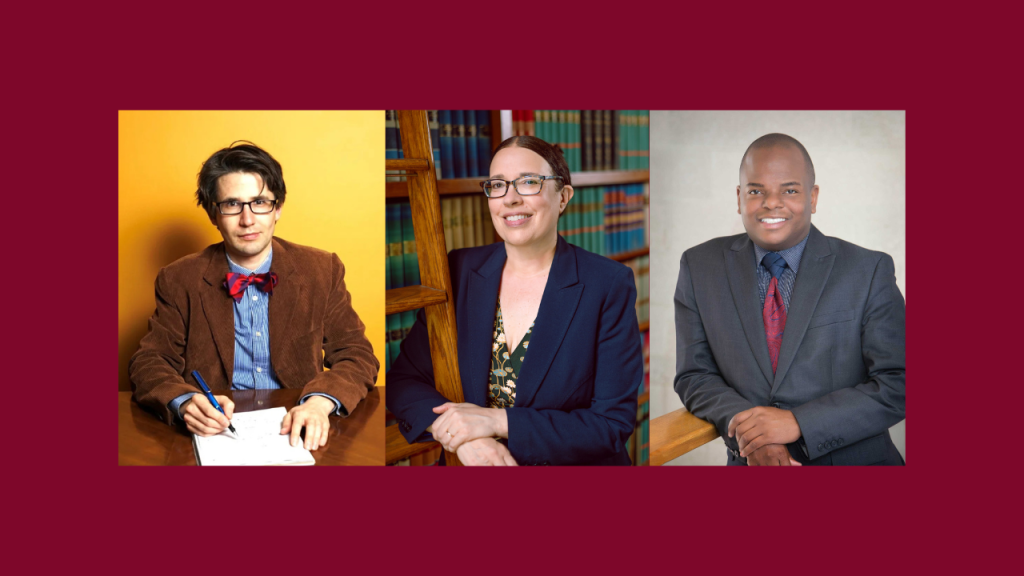
Jacob Easley II, PhD, GRADUATE SCHOOL OF EDUCATION, assistant dean, received the 2026 AACTE Edward C. Pomeroy Award for Outstanding Contributions to Teacher Education. The Pomeroy Award recognizes distinguished service to the educator preparation community and the development and promotion of outstanding practices in educator preparation at the collegiate, state, or national level.
Maria Farland, PhD, ARTS AND SCIENCES, associate professor of English and director of placement and professional development in the English department’s graduate program, delivered three guest lectures in November. At the University of Edinburgh in Scotland and the Cornell Medical School DeWitt Wallace Institute for the History of Psychiatry in New York, she gave a talk titled “Sylvia Plath and the 1950s Critique of Psychiatry.” (Watch the lecture here.) At Durham University, England, she delivered the lecture “Antipastoral, Agribusiness, and Post-1945 Literature of Postmodern Farming,” based in part on her recent book Degraded Heartland: Antipastoral, Agriculture, and the Rural Modern in US Literature, published by Johns Hopkins University Press.
Joshua Schrier, Ph.D., ARTS AND SCIENCES, Kim B. and Stephen E. Bepler Chair Professor of Chemistry, published a paper on Jan. 28 titled “Augmenting Large Language Models for Automated Discovery of F-Element Extractants” in the Journal of the American Chemical Society. Developed together with Fordham postdoctoral fellow Baosen Zhang, PhD, and collaborators at Los Alamos National Laboratory and the Karlsruhe Institute of Technology Institute for Nuclear Waste Disposal, it describes a new agentic AI approach to performing separations related to rare-earth minerals and nuclear fuel processing.
Schrier also recently coauthored a workshop report titled “On the Need for Autonomous Science Instruments: A Call to Action,” sponsored by Renaissance Philanthropy, which identifies critical bottlenecks in the booming field of autonomous experimentation that are threatening the future of AI-driven scientific discovery.
