

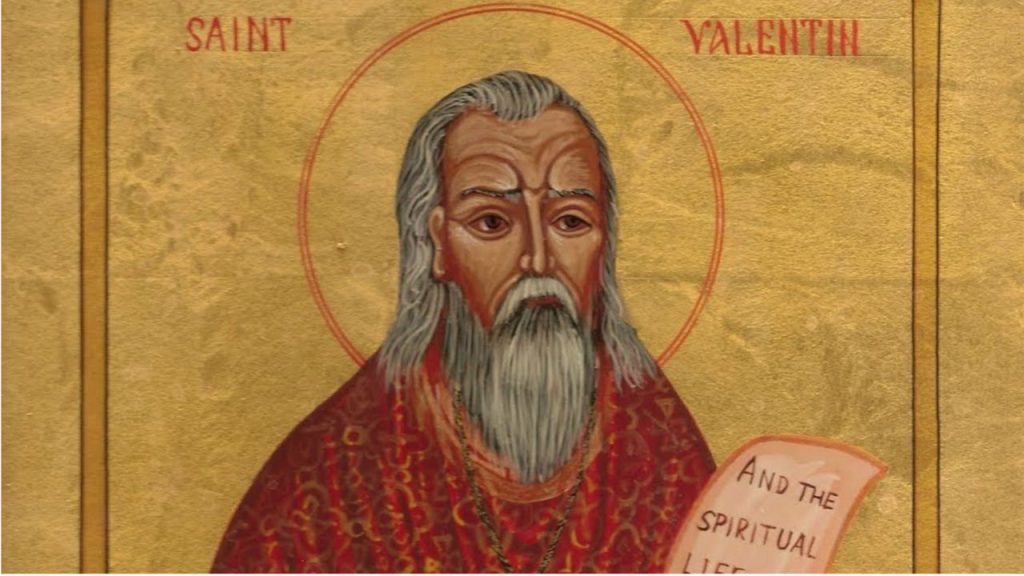
Though St. Valentine is arguably one of the most famous saints, there’s a lot we don’t know about the mysterious figure (or figures) behind Valentine’s Day. In fact, much of what we associate with him—greeting cards, chocolates, and hearts—evolved over centuries of storytelling, taking on layers of symbolism that aren’t rooted in the historical record from his lifetime.
Here are a few interesting facts about the elusive St. Valentine, and how he developed his reputation for romance:
1. He may have been more than one person.
First, there are accounts of multiple St. Valentines, and it’s unknown if they refer to separate people or not.
“Three distinct martyrs named Valentine are associated with the feast day of Feb. 14, yet little is known historically about any of them,” said Brenna Moore, professor of theology at Fordham.
There was an African St. Valentine who was said to have been persecuted and killed with his companions and about whom nothing else is known. The two others were a Roman priest and a bishop from Terni, Italy, both said to have performed healing miracles, refused to renounce their faith, and been executed by beheading in the third century. There are so many similarities between Valentine of Rome and Valentine of Terni that Vatican News has suggested they may have been the same person.
However, stories about why the St. Valentines from Terni and Rome were martyred differ. Legend holds St. Valentine of Rome was executed for converting people to Christianity, while the bishop of Terni drew the emperor’s ire by marrying couples in secret after marriage had been outlawed.
2. Romantic love entered St. Valentine’s story centuries later—thanks to a poet.
The earliest known association between St. Valentine and romantic love appears in the work of the 14th-century English poet Geoffrey Chaucer. In his poem The Parlement of Fowls, Chaucer wrote that birds choose their mates on St. Valentine’s feast day, linking the occasion to love, fertility, and the coming of spring.
This evolution in St. Valentine’s story a millenium after his death shows how “popular imagination and symbolic resonance can reshape the meaning of a saint beyond his historical martyrdom,” Moore said.

3. St. Valentine is the patron saint of much more than romantic love.
In Catholic tradition, Valentine is the patron saint not only of engaged couples and lovers, but of beekeepers, people with epilepsy, plague victims, travelers, and those suffering from fainting spells.
4. His feast day is no longer officially recognized
Although Valentine’s Day has gained popular recognition as a holiday for lovers, St. Valentine’s feast day (Feb. 14) was removed from the General Roman Calendar in 1969 due to a lack of verifiable historical information.
This change reflects how the church tries to balance tradition with empirical information, according to Thomas Worcester, SJ, professor of history at Fordham.
“The Catholic Church promotes saints as models of Christian life to imitate and as intercessors to whom one may pray,” said Worcester. “But when a supposed saint may in fact have never existed, he or she may be removed from the calendar of saints.”
Though St. Valentine’s feast day was removed, the Church still recognizes him as a saint.
5. Valentine’s cards may trace back to a prison legend.
One enduring legend claims that while imprisoned before his execution, Valentine healed his jailer’s blind daughter and left her a farewell note signed, “Your Valentine.” Though the story can’t be verified, some say it helped inspire the tradition of exchanging messages of affection on Feb. 14.
The gap between our modern Valentine’s Day traditions and the historical record reflects our tendency to invest religious figures with our own feelings and needs over time, Moore said.
“The roses, cards, and romantic associations attached to Valentine’s Day reveal less about the martyrs themselves and more about how Christian symbols are continually reinterpreted to express human longing, love, and the search for divine meaning,” Moore said.
