

For our series, A Fordham Focus on AI, we’re speaking with faculty experts from a range of disciplines about the impact of this rapidly evolving technology and what to expect next.
In this installment, we sat down with Yilu Zhou, PhD, an associate professor at the Gabelli School of Business. Zhou has spent 25 years researching natural language processing and image recognition. An expert in data analytics, she helped launch the graduate-level class on large language models and generative AI. Her current research is focused on two seemingly unconnected areas: fashion and technology.
How will your research shape AI tools that support the fashion industry?
I’ve led multiple projects in the fashion industry since 2014. Before AI and large language models became popular, I was looking at runway data to try to predict where broader fashion trends were headed. Right now, I’m working on projects focused on individual companies instead.
We’re looking at brands and asking, how do we break down the different fashion components in their designs to help us understand and predict what sells? We take over 1 million images and descriptions and run them through deep learning AI models, which are computer systems designed to mimic the way brain neurons analyze data and find complex patterns.
Then we analyze sales data to see which fashion element combinations make a garment a good seller. If you’re in charge of a brand, you can use this data to decide if you want to reproduce the garment exactly as it was, or if you want to borrow new elements from the runway or other trends.
In a forthcoming paper, we analyzed 10 years of data and found that the combination of certain design elements has predictive power for what will sell the next year.
You’re also using AI to generate better maturity ratings for apps. How does your work help parents looking to protect their children?
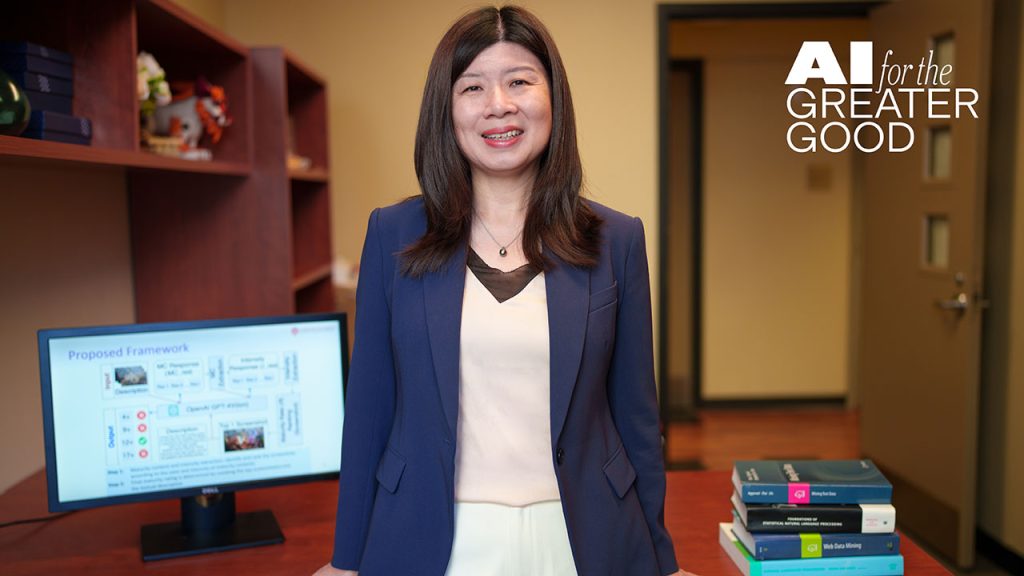
This started in 2017. The idea was to examine inconsistencies in app ratings on iTunes and Google Play. Right now, we’re using deep learning image recognition to pair images within an app with text descriptions, to better predict each app’s true maturity rating. There are millions of apps with maturity ratings that are automatically generated based on surveys of app developers, and many of the ratings are inaccurate. And as a mom, I always worry about which app my kid will download.
My research partners also use another AI model, called Chain of Thought, to ask, How do you know this app is not suitable for a child? Is it because there is violence? Is it because of nudity? Or is it because of gambling? The system breaks the question down into smaller components so we can draw a clear conclusion for parents to see why an app might be a concern.
You have also been working with your students to support the United Nations. Tell me about that.
As large language models have become popular, the U.N. has turned to Microsoft Copilot to build a system to support its internal processes. I teach a class called Agentic AI with Copilot, and as part of it, we’re submitting proposals to the U.N.’s Office of Information and Communications Technology. Students receive training on Copilot and then meet with clients at the U.N. to understand their needs. They build AI agents, or bots, and present them to the department each week for feedback. The final product could be an HR chatbot that serves as their help desk, or it could crawl the news and generate a summary every morning at 5 a.m.
What is one thing you want people to know about AI?
Many people think AI is just a matter of writing a prompt, and if they don’t get the answer with a couple of prompts, they give up.
A blind spot I see is that people who are experts in their specific fields, but aren’t as fluent in AI, don’t stay up to date on new AI technology. As a result, they dismiss many of its capabilities. I see a lot of examples like this in fast-developing areas such as customer service, because systems are not implemented correctly. There’s a learning curve with the technology, but applying it to specific fields requires significant effort.
Learn more about AI for the greater good at Fordham.
