

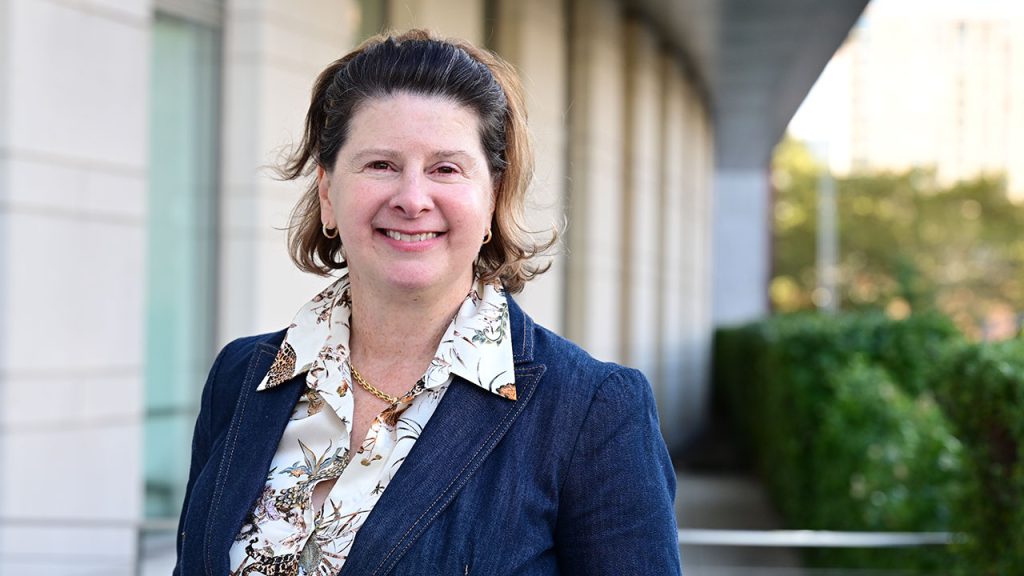
By 2030, U.S. women will control an estimated $34 trillion in wealth, or nearly 40% of the country’s total assets, financial experts predict. So now is the time to prepare for that transition, said Gabelli School of Business graduate Liz Nesvold, chair of Emigrant Partners and vice chair of Emigrant Bank, at the 9th annual Fordham Women’s Summit on Oct. 22.
Women already control a greater share of wealth at home and at work as company CEOs and as board members, Nesvold noted before an audience of alumnae, friends of Fordham, and female executives including Fordham President Tania Tetlow. And this trend will continue because of the coming “great transfer of wealth.” Experts predict that aging Baby Boomers will pass down as much as $128 trillion in assets.
“Take it 10 years forward, and we will be at parity with men in terms of control of assets,” said Nesvold. And 10 years beyond that? “You’re going to control the purse strings,” she said, addressing the Gen Z women in the room.
Together with Jane Bartnett, MC ’76; Betty Burns, FCLC ’83; and Deneen Donnley, LAW ’92, Nesvold was among four Fordham female graduates honored for their philanthropy and leadership at the event. A pioneer in the wealth management industry, she is keen to help women gain financial literacy not just to save for their future but also to be philanthropic.
In an interview, Nesvold spoke about her mother’s impact on her career, how to begin financial planning, and more.
How did you become interested in financial services?
Growing up it was assumed that my father’s business, which was construction, would go to my brother to run. But he had no interest. And I never even considered that I might want to be a CEO, but when my father got ill and my mother stepped in to take over his business, it became very clear to me that women can run anything.
How did you choose the Gabelli School of Business and how did it help shape your career?
I had to earn my M.B.A. at night [which Gabelli offered], and I just fell in love with the campus. I loved the mission. I loved everybody that I interacted with. And I met the love of my life here [Peter Nesvold]. So that brings special meaning as well.
As a liberal arts major, I entered into investment banking missing some of the fundamentals. I learned them at Gabelli, and I’m so grateful for the curriculum, for the professors, for the adjuncts that really helped me in my career.
What can everyone do to begin financial planning for themselves?
Start with learning how to create a balance sheet. There are so many free and paid tools out there—Mint, Zogo, Fruitful—to help you understand what your personal financial statement looks like. That is the first wonderful step to controlling your own financial destiny. [See her top piece of financial advice for women in this short video.]
Why is it important to you to be philanthropic and what are the small ways that you practice it?
To give and do something for someone else is so impactful. It doesn’t matter if you are donating a hundred dollars or one dollar. I carry singles, and if I see somebody in need, I’ll give them a dollar or preferably, I’ll buy them a meal. That’s one level of philanthropy, when you help somebody who’s in need. But then philanthropy is also about consistency, even if it’s a hundred dollars to public broadcasting consistently, or for me, education. Those things matter.
The summit was co-sponsored by Emigrant Bank, EY, and Macari Vineyards. View the speakers, sessions, and 2025 Pioneering Women in Philanthropy honorees at the Fordham Women’s Summit website.
