

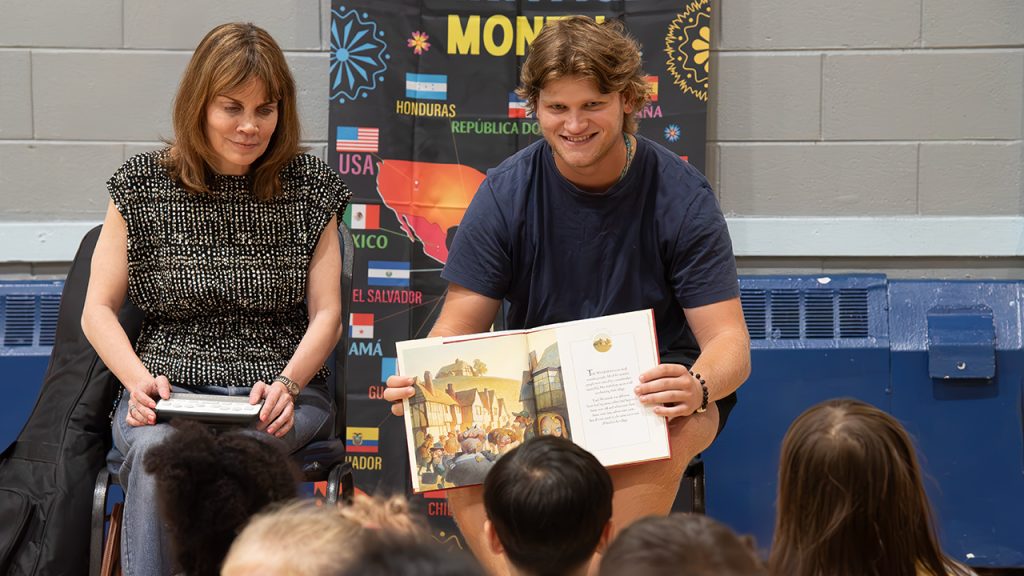
This September, as International Literacy Day and National Literacy Month once again highlight the importance of spreading the crucial skills of reading and writing, Fordham students and staff did their part, gathering with local volunteers at a community center to show schoolchildren the joy of the printed word.
Their tools? Music, a picture book, gentle questions, and loving attention.
The children gathered around as acclaimed singer-songwriter Ginny Owens, a local resident, performed music and led a discussion of the children’s book You Are Special, helped by a Fordham student. Then the students sat with the children for arts and crafts that reinforced the feeling of book-centered fun.
The idea is that “after reading a book and having fun like this, they want to keep doing it in the future,” said one of the student volunteers, Marisa Burke, at the event held at the Goddard Riverside community center in Manhattan.
‘A Powerful and Important Gift’
The Storytime activity is one of Fordham’s many efforts to promote literacy among New Yorkers, from children getting their first taste of books to adults who may be achieving basic English literacy for the first time.
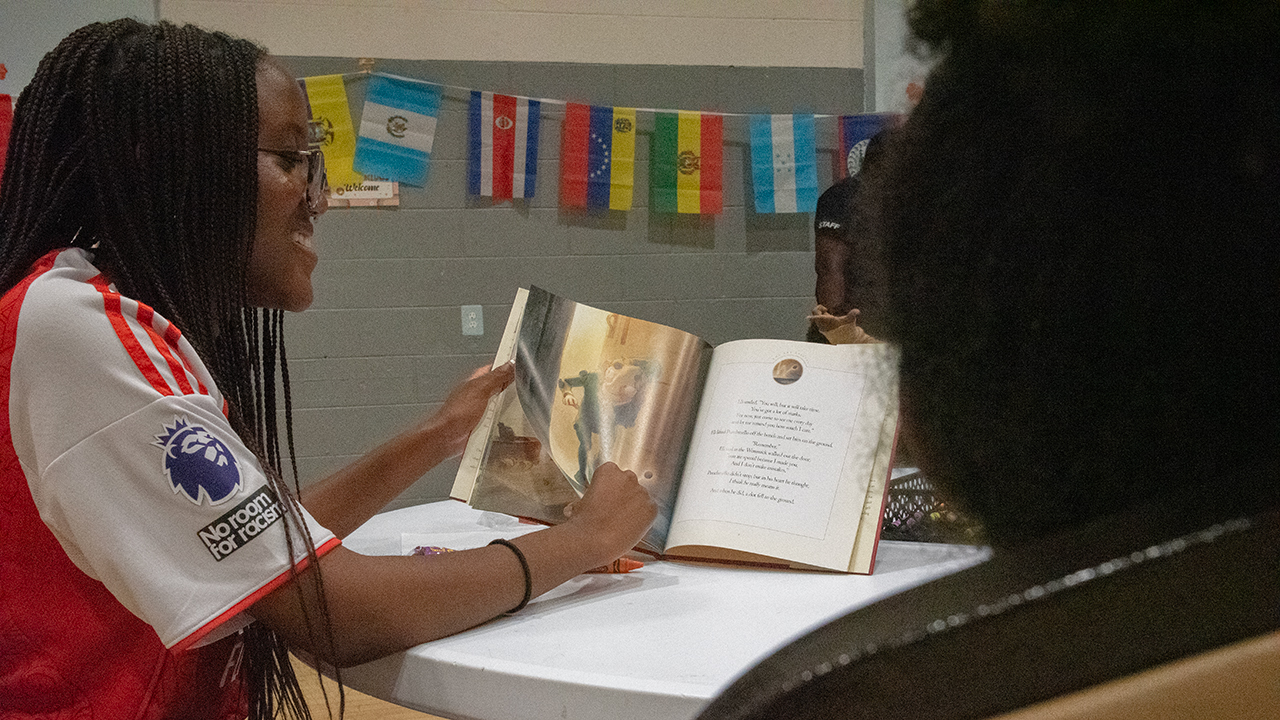
The monthly Storytime gathering is one of many literacy-related events sponsored by Campus Ministry and its student-led Pedro Arrupe Volunteers, said Carol Gibney, director of Campus Ministry for solidarity and leadership. Such events are “all about celebrating,” she said. “A love of reading is just such a powerful and important gift for us to pass on to little ones.”
Literacy for the Whole Person
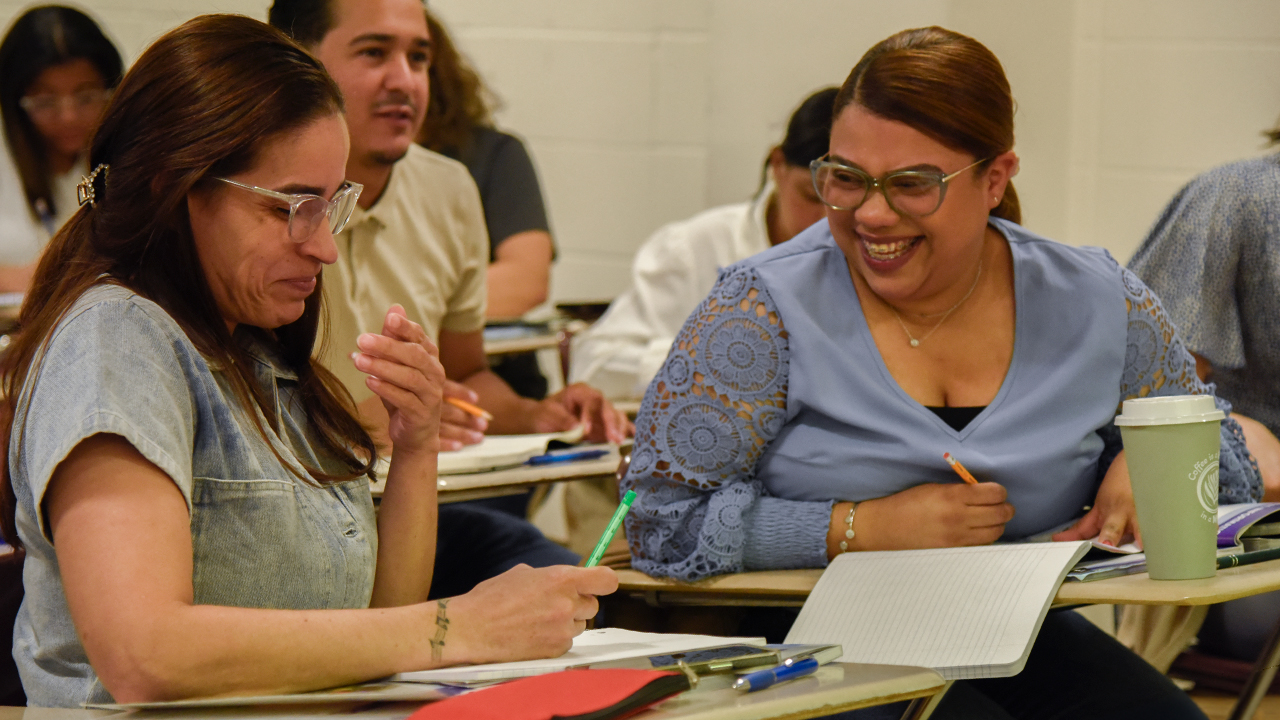
The evening before, at Fordham’s Rose Hill campus in the Bronx, dozens of community members gathered for the free adult ESL program run by Fordham’s Institute of American Language and Culture, with support from the Mother Cabrini Health Foundation and other funders. Students in this program have varying backgrounds—some may have earned college degrees, while others weren’t able to achieve basic literacy in their native languages before joining the program, said James Stabler-Havener, PhD, director of the institute.
The four-year ESL program covers everything from basic English literacy to the reading, writing, and comprehension skills needed for college, case manager Clarisa González said. “It’s super satisfying to see that growth, that progression, and know that we put our little drop in the bucket for them to have a positive experience in this country,” she said.
The program supports “the whole person,” in Fordham’s Jesuit tradition, by also focusing on physical and mental health literacy, digital literacy, and other topics, Stabler-Havener said.
Providing Literacy Coaches in Schools
For other literacy efforts, Fordham faculty and students go directly to New York City schools. Fordham’s Center for Educational Partnerships runs a state-funded program that supports teachers of English learners throughout New York City. And the center is marking 20 years of providing coaching for city teachers of all types, conveying best practices that help them develop students’ literacy, said Anita Batisti, PhD, founding director of the center and associate dean at the Graduate School of Education.
The coaches, Fordham faculty or outside experts, work with teachers to model new strategies—for instance, asking students more engaging questions about a text while reading it aloud.
“We find that in schools where students may have challenges coming in with a vocabulary deficit that this kind of professional development helps tremendously,” Batisti said. “It’s to really [teach]higher-order thinking skills, and it’s never too early to start that.”
Students Helping Students
The center also offers paid tutoring positions for Fordham students in two New York City schools. Nesrine Allahabi, a junior, worked with an eighth-grader who was entirely new to reading and writing because his native African language is only a spoken language.
It was “really great, very rewarding” to work with the student, she said—with help from her and another tutor, he gained not only English speaking skills “but also the ability to write and think critically,” and was able to move on to high school, she said.
She recalled being a new immigrant herself in 2016, knowing little English. “When I see those kids, I see myself,” she said.
Fordham student tutor Matthew Gatto worked with kindergartners and first-graders. He learned along the way about the importance of connecting literacy with students’ interests, keeping it fun, and showing them “that reading and literacy open up a whole world where they can gain knowledge,” he said.
His fellow tutor Kristine Kalu came up with a spelling game to get the kids excited, and also helped a student who struggled with focus and anger. “I think he knew what he wanted to write, but I think he just needed the encouragement to do it,” she said.
Research in Support of Literacy
Other Fordham faculty are supporting literacy through their research. Elizabeth Gil, PhD, of the Graduate School of Education, is conducting a study of a tutoring program run by the nonprofit READ Alliance, which pairs New York City high schoolers with young children who are “striving readers,” she said. She’s studying not only the children’s literacy growth but also the benefits for the high school students, like leadership experience.
Her research is funded by a grant awarded by Fordham’s Bronx Research Institute for Community Solutions (BRICS) and sponsored by the University’s Center for Community Engaged Learning.
It’s rewarding to do community-engaged research, “which means that you are truly partnering with an organization” for mutual benefit, she said.
Also exciting, she said, is “[being]able to go out into the field of education and say, ‘When you’re developing partnerships between elementary schools, an organization, and a high school, here are some things that really make a difference in students’ lives now and for their futures.’”
