

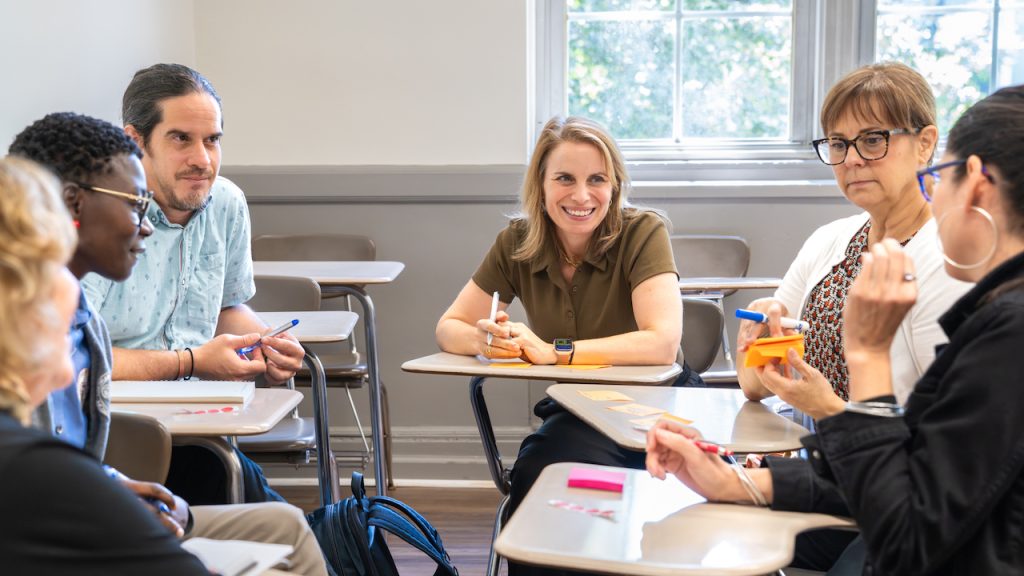
As Fordham’s inaugural dean of arts and sciences, Jessica Lang, Ph.D., is deeply involved in the University’s “one Fordham” strategy. In this newly established role, she oversees faculty matters, academic programs, and campus-based initiatives across the University’s three centers of arts and sciences: Fordham College at Lincoln Center, Fordham College at Rose Hill, and the Graduate School of Arts and Sciences.
“President Tetlow has been talking about ‘one Fordham,’ and we’re the vanguard for that,” said Lang, formerly the dean of Baruch College’s Weissman School of Arts and Sciences. “We’re going to be thinking about ourselves more holistically—as a single community with a single mission.”
Midway through her first semester, Lang shared her plans for supporting faculty mentorship, getting to know Fordham students, and enhancing Fordham’s interdisciplinary programs.
What does this new unified dean structure allow Fordham to do?
There are a lot of internal structures that can benefit from this new leadership framework. Different practices had evolved on the two campuses, which has led to complicated distinctions and differences. There are chances to organize and streamline resources, like funding opportunities, and to support programs and departments equally across both campuses. If we think about them holistically and fundraise for them holistically, we can create opportunities for all faculty and students associated with that program, rather than having that be a divided ambition.
Have you had any early successes?
We restructured how we deliver a series of grants and funding opportunities for faculty to support their research and teaching innovation.
It may not sound very exciting, but we are designing processes, forms, and practices that are uniform; doing so de-complicates our infrastructure and creates an equitable environment. As a team, we have sight lines across the faculty, graduate student, and undergraduate experience, and that allows us to engage in so many building opportunities.
What is a longer-term goal of this restructuring?
We have roughly 20 interdisciplinary programs—like neuroscience, environmental studies, comparative literature—that straddle both campuses. But, they’re not housed in a department, which is challenging because it means that they don’t have the traditional support systems or mechanisms that are formalized in departmental life, like administrative help and budgetary opportunities. It also makes hiring much harder.
My colleague Bob Hume [Robert Hume, Ph.D., vice dean for faculty affairs] has brought on a dean fellow [Orit Avishai, Ph.D., dean fellow for interdisciplinarity and program review] to really focus on ways to better support these programs and ensure that they’re thriving. They’re great programs—I think they could become a signature of Fordham Arts and Sciences because they allow students so much flexibility in terms of a course of study they want to pursue.
You built faculty mentorship programs at Baruch. What do you have planned at Fordham?
In Bob Hume’s office, there is now a dean fellow for equity and inclusion [Ivelisse Cuevas-Molina, Ph.D.] who’s thinking about a cohort model with our new faculty. She has designed workshops and community conversations that cover many of the features that make being a new faculty member feel overwhelming.
For department chairs, I’m feeling out what mentorship process would work best. When I ask if chairs would like mentors, they say they don’t want to place a burden on another chair, which is so thoughtful. But I don’t think many people here would view that as a burden. The gift of mentorship is that when you’re discussing a challenge, it sharpens your own thinking, so both people come out enriched from that conversation.
How is your first semester going?
Fordham is a very special place. I’ve never seen such care toward others that extends across faculty and staff. I see how much care staff and leadership faculty extend to students, too. I would like to have my own interactions with students, so I’m looking forward to that in the future.
Any plans to teach at Fordham?
The English department was so wonderfully receptive to the idea of me teaching a Texts and Contexts class next fall. I am thrilled to have the chance to meet more students, and especially new students—I can identify with them.
