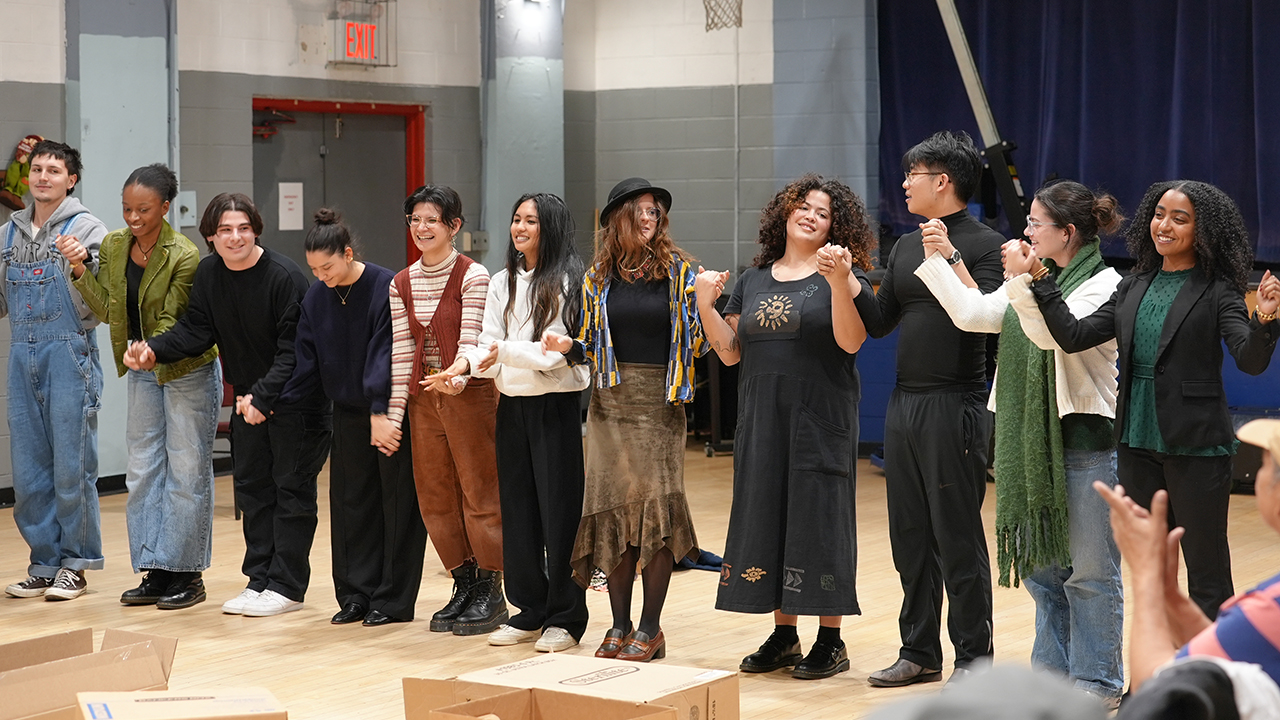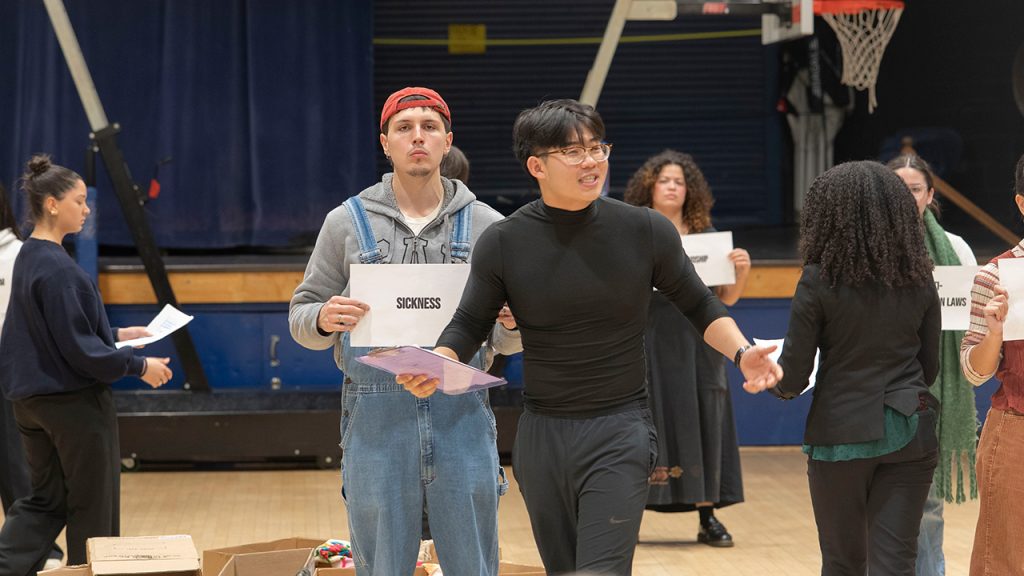
How can theater make a difference in the world? Fordham students recently explored that question for a class project, leaving behind their familiar classrooms and rehearsal spaces at the Lincoln Center campus and heading out to a new performance venue in the neighborhood beyond.
They gathered in a gymnasium at nearby Goddard Riverside, a neighborhood service agency providing everything from early childhood education to Meals on Wheels and more.
Surrounded by an audience of both school-age children and older adults, the students performed lively scenes that dealt with big issues—immigration, health care, inequality—and then took questions from the audience.
“What I loved most was seeing everybody’s reactions to what we were saying, and hearing what they specifically were responding to when we had mentioned different topics,” said one of the student performers, theater major Zara Dautruche. “I feel like theater is such a powerful tool to get us together and be in community with one another.”
A Theater Class Focused on Community Action
That was the idea behind the theater class the students were taking, Producing Through a Social Justice Lens, a community-engaged learning course that emphasizes theater’s power to foster dialogue and activism around social issues.
Through the course, students learn to be “the kind of artists who want to engage in questions and answers and have back-and-forth dialogue with the community they live in, and they serve,” said the instructor, Fadi Skeiker, Ph.D., chair of Fordham’s Department of Theatre and Visual Arts.
”When you are doing theater, you are able to carry the voices of the marginalized and make sure that they are visible,” he said.
‘I Want a Country’
The students wrote short scenes based on two literary works with political and social themes: Allen Ginsberg’s poem “America” and Andreas Flourakis’ play I Want a Country.
In one scene, the players portrayed demanding, unproductive political dialogue by trading petulant statements about what their country should be—“I want a country with no other countries bordering it,” for instance. After frenetic activity, the characters all wound up splayed on the floor, exhausted.
The students realized all the “I want” statements from Flourakis’ play sounded “like children trying to build a country, so that’s what we did—we played as children, trying to build a country,” said Lisa Virginia, one of the students.
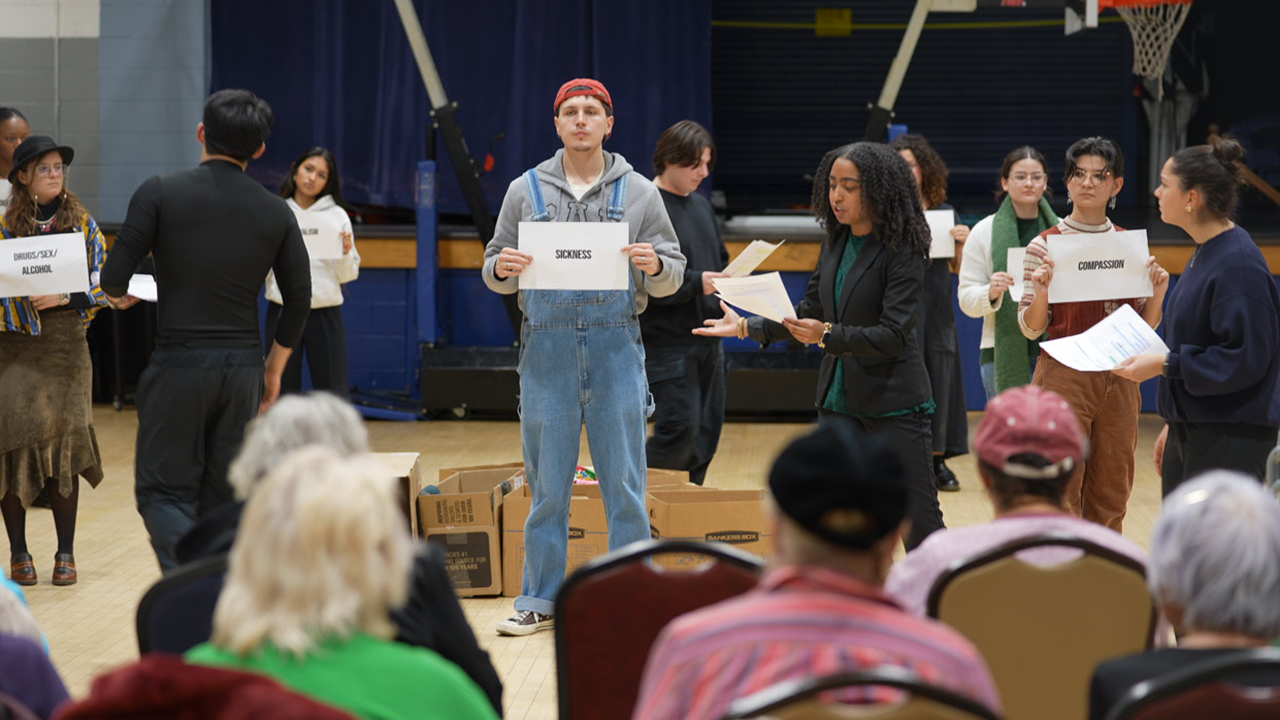
She and other students found it inspiring to perform for a diverse audience of the young and old.
“There are students who are much younger than us, as well as people who have lived through a lot of these experiences that we were talking about,” said another student, Brian Tong. “It became very enlightening to see what our language meant for different people.”
It also helped to be close to the audience, rather than being up on a stage, he said. “Being up close and hearing the words right in front of them … shows that we share the same world that we’re trying to describe,” he said.
New York Theater Opportunities
The students got more performance experience by presenting their scenes on Dec. 2 at Afrikana, a social center in Harlem, Skeiker said. And the in-class portion of the course includes visits by theater practitioners who talk about connecting their art to social justice, he said.
Virginia said that “New York is one of the most perfect places in the world to do any kind of theater that you want.”
“This was a really, really wonderful introduction to all of the different organizations and practices throughout the city and beyond.”