

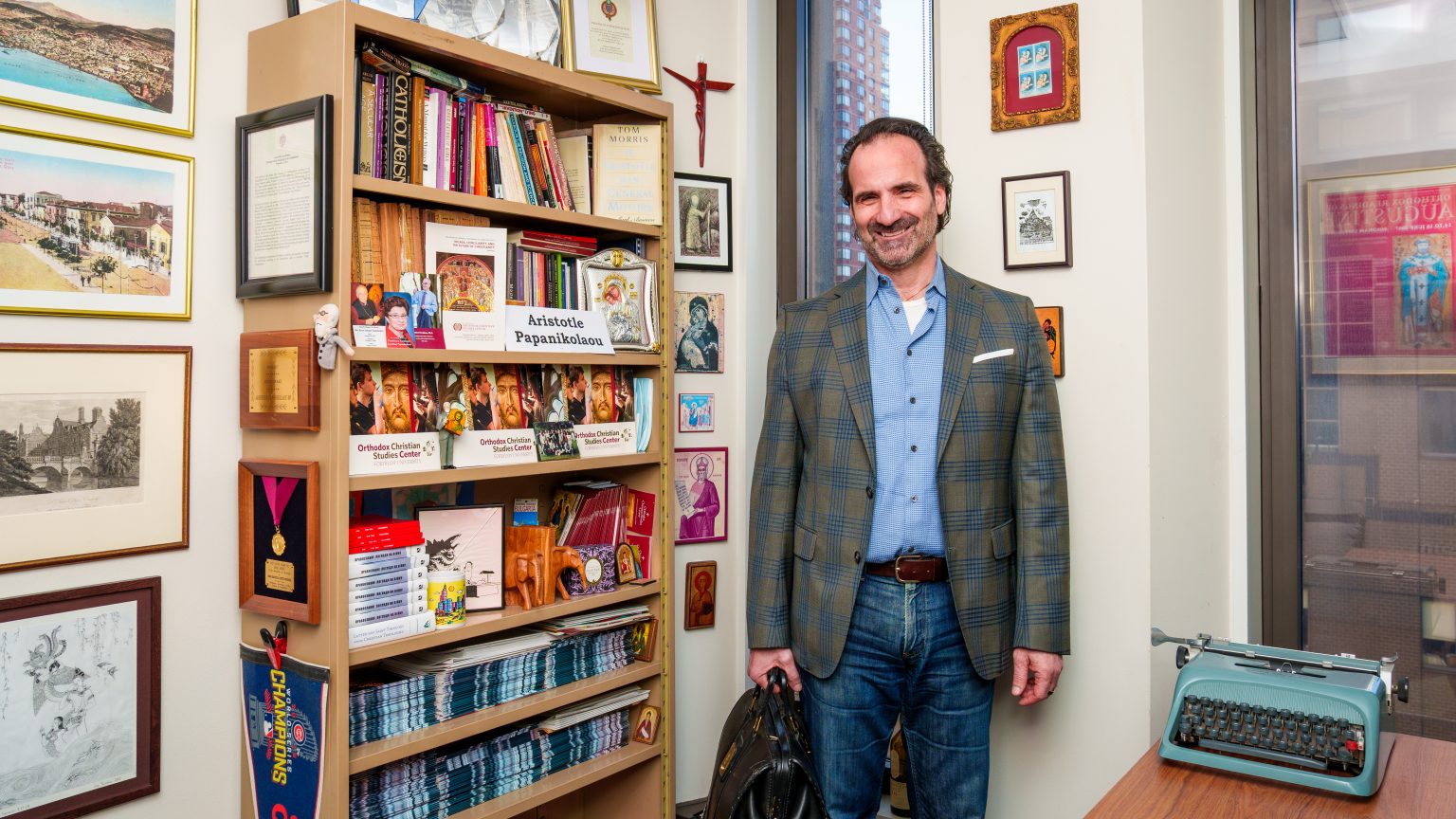
You may have guessed from his name that Professor Aristotle Papanikolaou, PhD, has Greek roots. But you might not know that he has a sweet spot for Greek chocolate, fond memories of his days as a Fordham undergraduate, and three decades of history with the University.
Step inside the office of Papanikolaou, professor of theology, Archbishop Demetrios Chair in Orthodox Theology and Culture, and co-founding director of the Orthodox Christian Studies Center, to discover the stories behind some of his favorite office keepsakes.
The Best Place for Chocolate
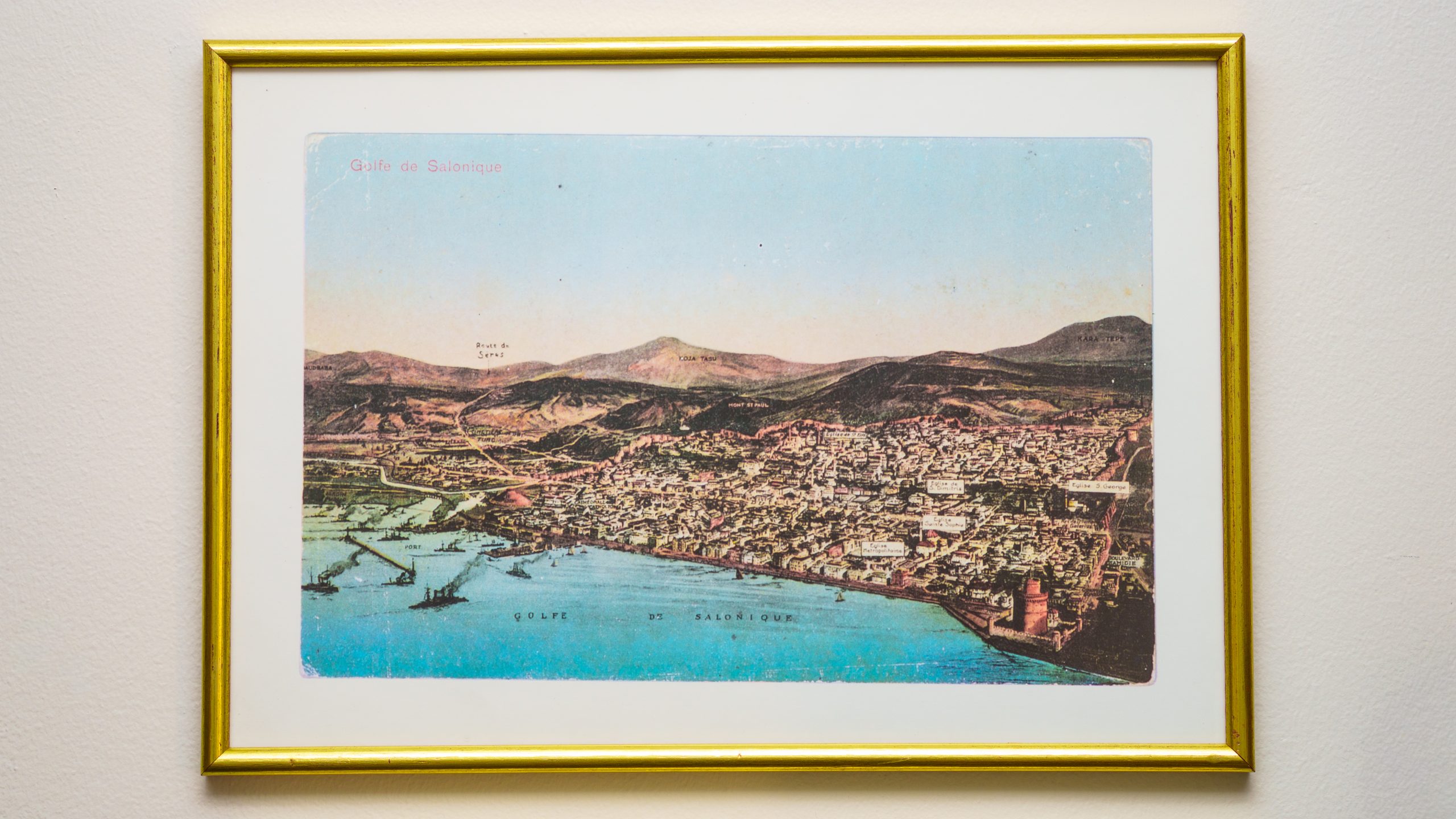
Hanging on a wall is a drawing of Thessaloniki, the hometown of Papanikolaou’s family and the country’s second-largest city. He first visited Greece at age four, when he discovered Greek chocolate—a treat he still keeps close at hand. Since then, Papanikolaou has returned to Greece more than 20 times, for business and family trips with his wife and their two children.
An Ancient Typewriter
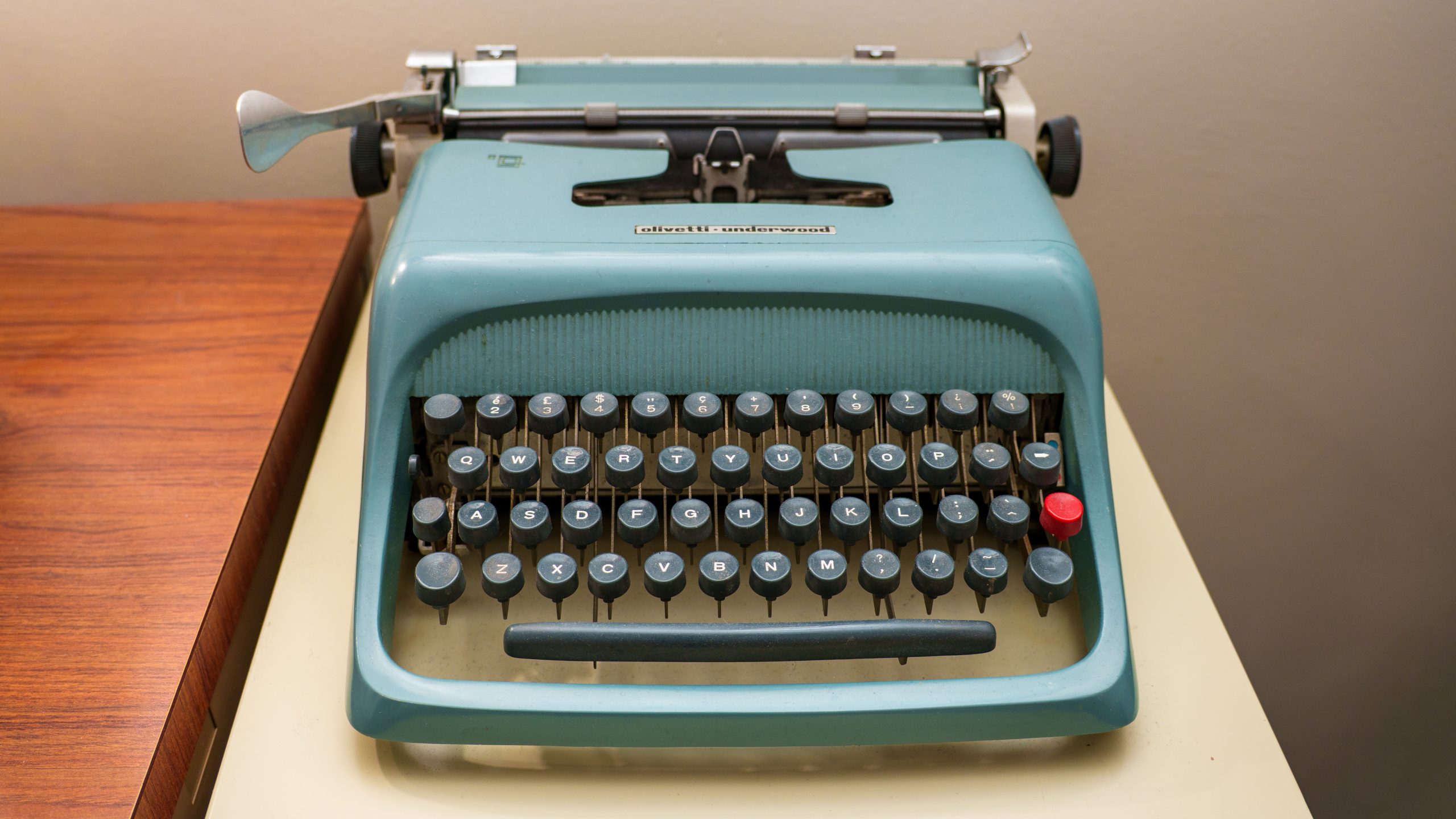
One of the most unusual objects in Papanikolaou’s office is a typewriter left behind by a colleague. It reminds him of his own days as a Fordham undergraduate in the 1980s, when writing an essay meant drafting it by hand before typing it up.
During his senior year, he transitioned from typewriter to computer. He didn’t own one himself, so he relied on the campus computer room, a space that was replaced by the Rose Hill Starbucks.
“The typewriter is old and cool, but I don’t miss it,” Papanikolaou said, chuckling.
The Irony of Sigmund Freud
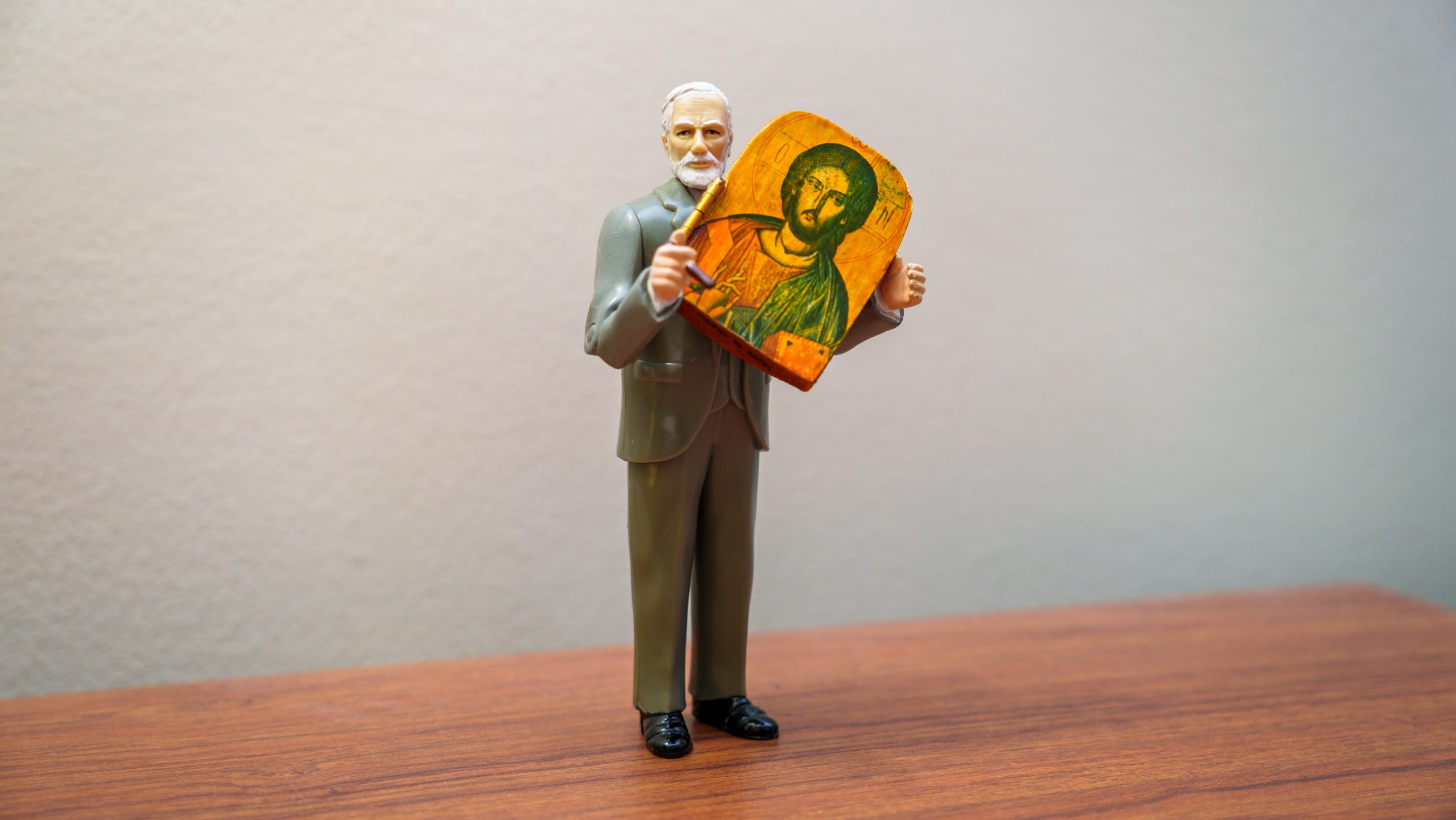
Perched on Papanikolaou’s desk is a miniature figurine of Sigmund Freud, neurologist and founder of psychoanalysis. There’s an unusual twist: Freud is holding an Orthodox religious icon, placed there deliberately by Papanikolaou.
“Freud did not like religion, but he taught things that can actually make us better at religion—for example, excavating consciousness and why we do certain things,” Papanikolaou explained. “The more we become aware of that, the more spiritual we can become. So I have him holding an Orthodox icon to stress the irony of it.”
The figurine also offers a glimpse into Papanikolaou’s approach to teaching. In a course for first-year students focused on faith and critical reasoning, he encourages students to question their assumptions about religion and consider why it plays such an important role in human life.
“I want them to walk away, opening up their horizons,” he said.
A Vintage Briefcase
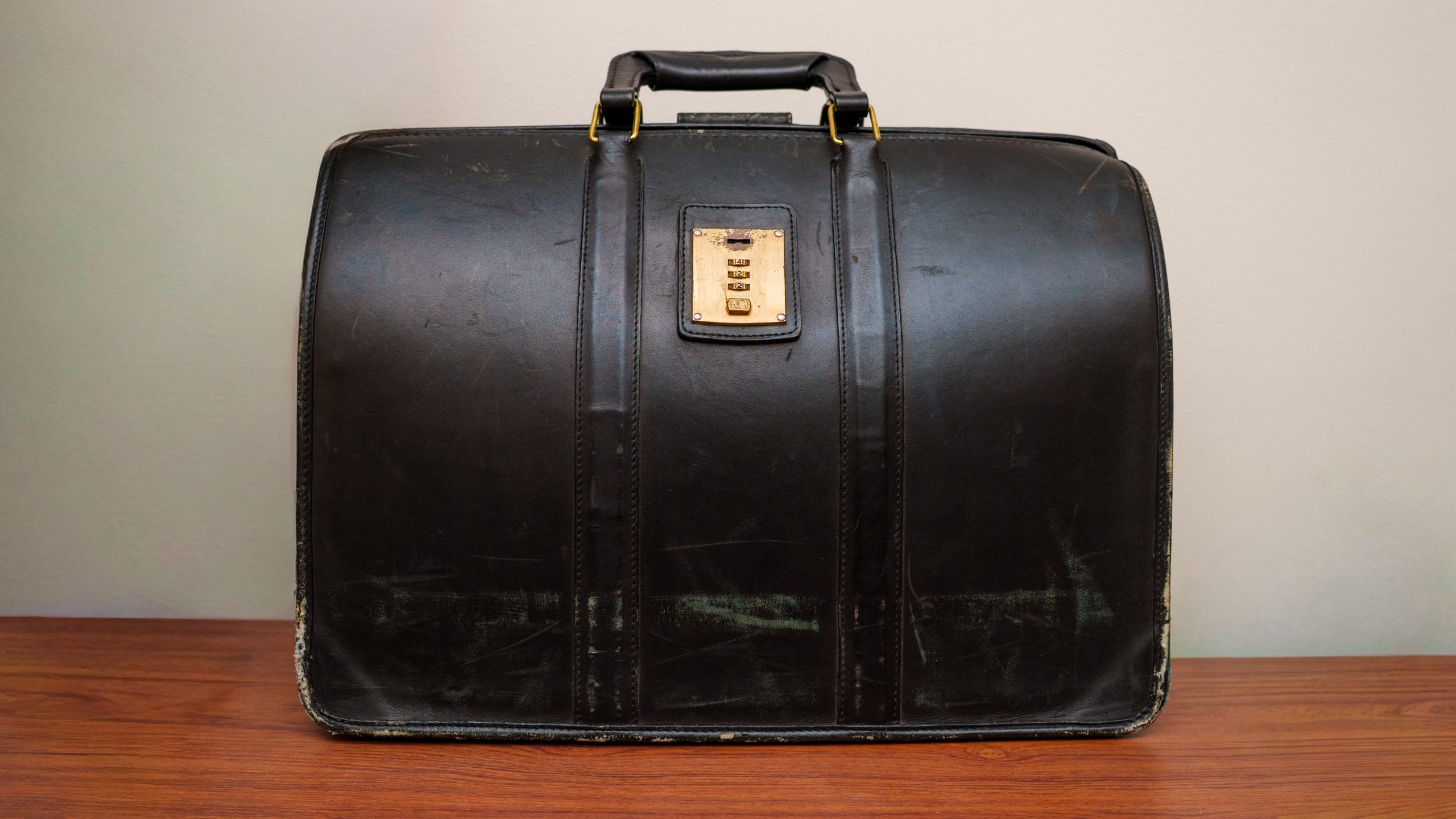
A classic leather briefcase accompanies Papanikolaou to the office. His wife gave it to him in 1998, when he earned his PhD from the University of Chicago. Inside are the everyday essentials of an academic: a journal, notepads, student exams, and, naturally, Ion chocolate.
“It’s not the most practical bag, but it turned out to be great for taking my stuff to class,” he said, acknowledging that it can get quite heavy.
After joining Fordham’s faculty in 2000, Papanikolaou added a roller bag to his daily commute to save his back.
“It’s kind of a little joke in my department. They can hear me from a mile away,” he said.
Rare Stamps
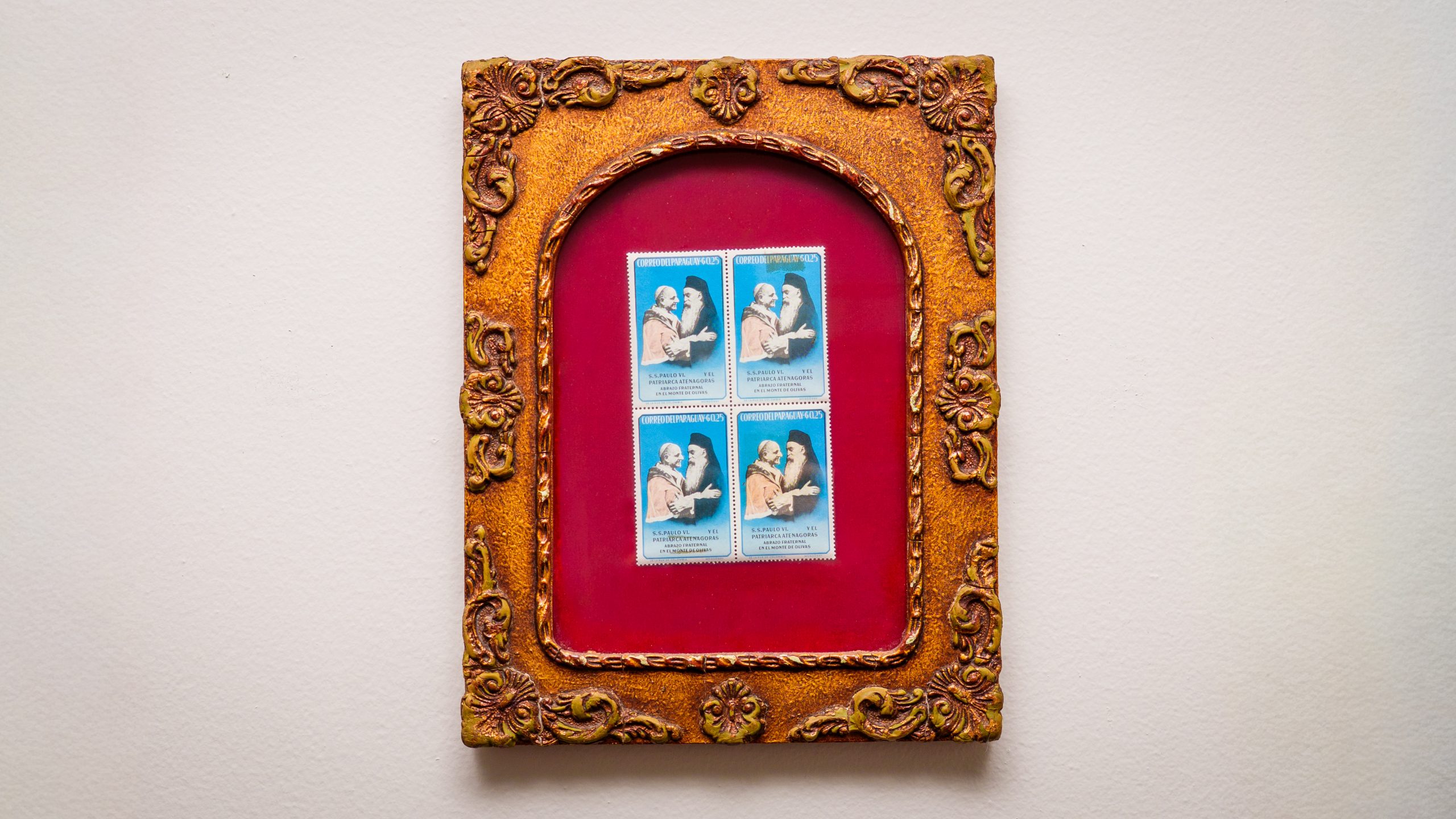
Framed on another wall are rare stamps once owned by Papanikolaou’s father, commemorating a milestone in Catholic-Orthodox relations: the 1960s meeting between Pope Paul VI and Ecumenical Patriarch Athenagoras I, which helped ease tensions between the two churches.
Fordham has since welcomed an ecumenical patriarch twice, in 2009 and 2025, Papanikolaou noted.
The stamps also hold personal significance. His father served as a Greek Orthodox priest in Chicago for more than five decades, shaping his son’s faith.
“He showed me by example what it meant to be a Christian, especially in times of conflict,” Papanikolaou said.
Commencement on Eddies
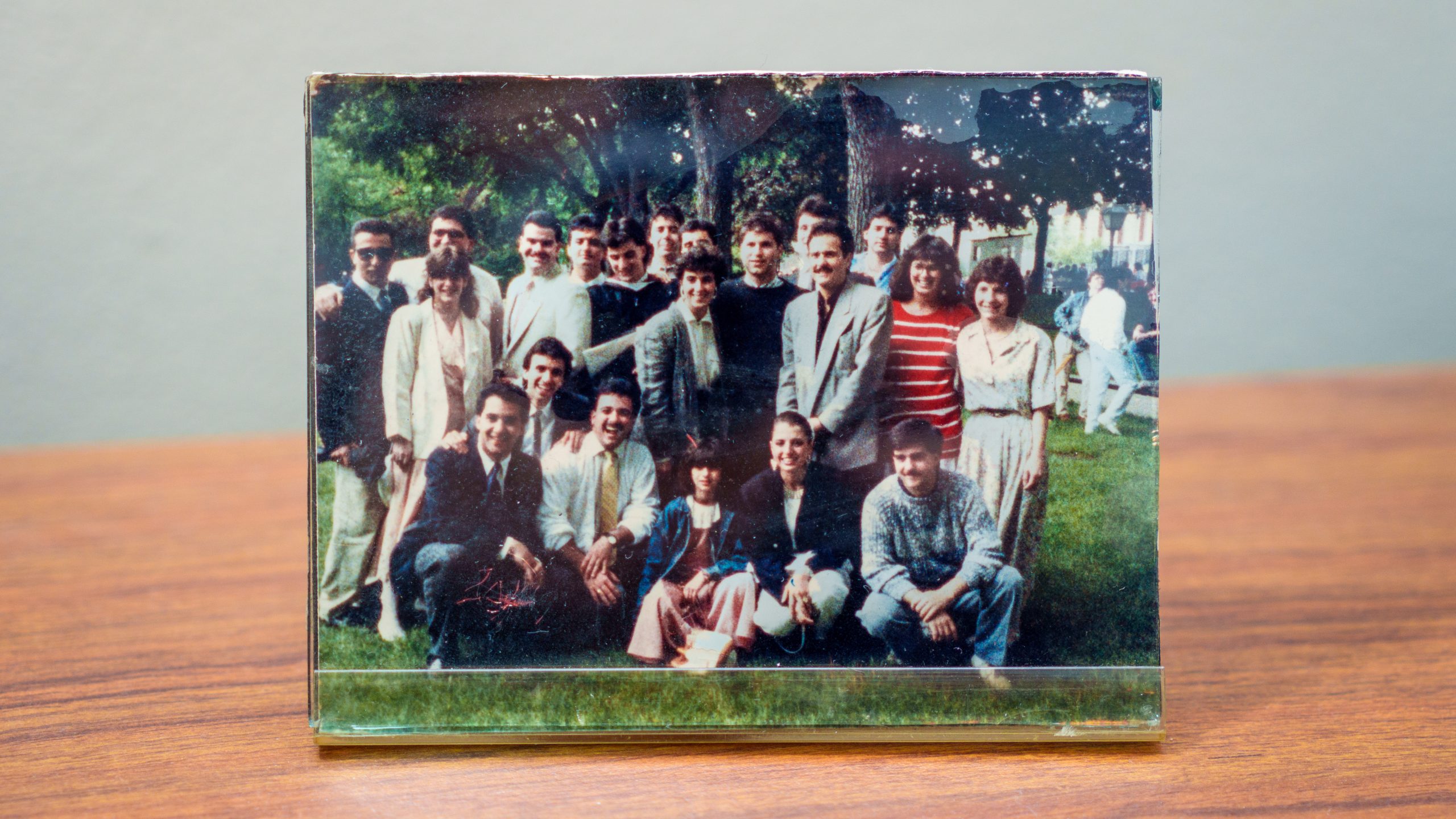
Propped on a shelf is a photograph from the day Papanikolaou graduated from Fordham with his bachelor’s degree in theology. He stands sixth from the left in the back row, surrounded by his siblings, cousins, and friends, some of whom had flown from his native Chicago to celebrate.
“Coming into Fordham, I used to be pretty conservative, but I became more open-minded in class, hearing different perspectives,” said Papanikolaou, now in his 27th year of teaching at the University.
A Mini Memorial
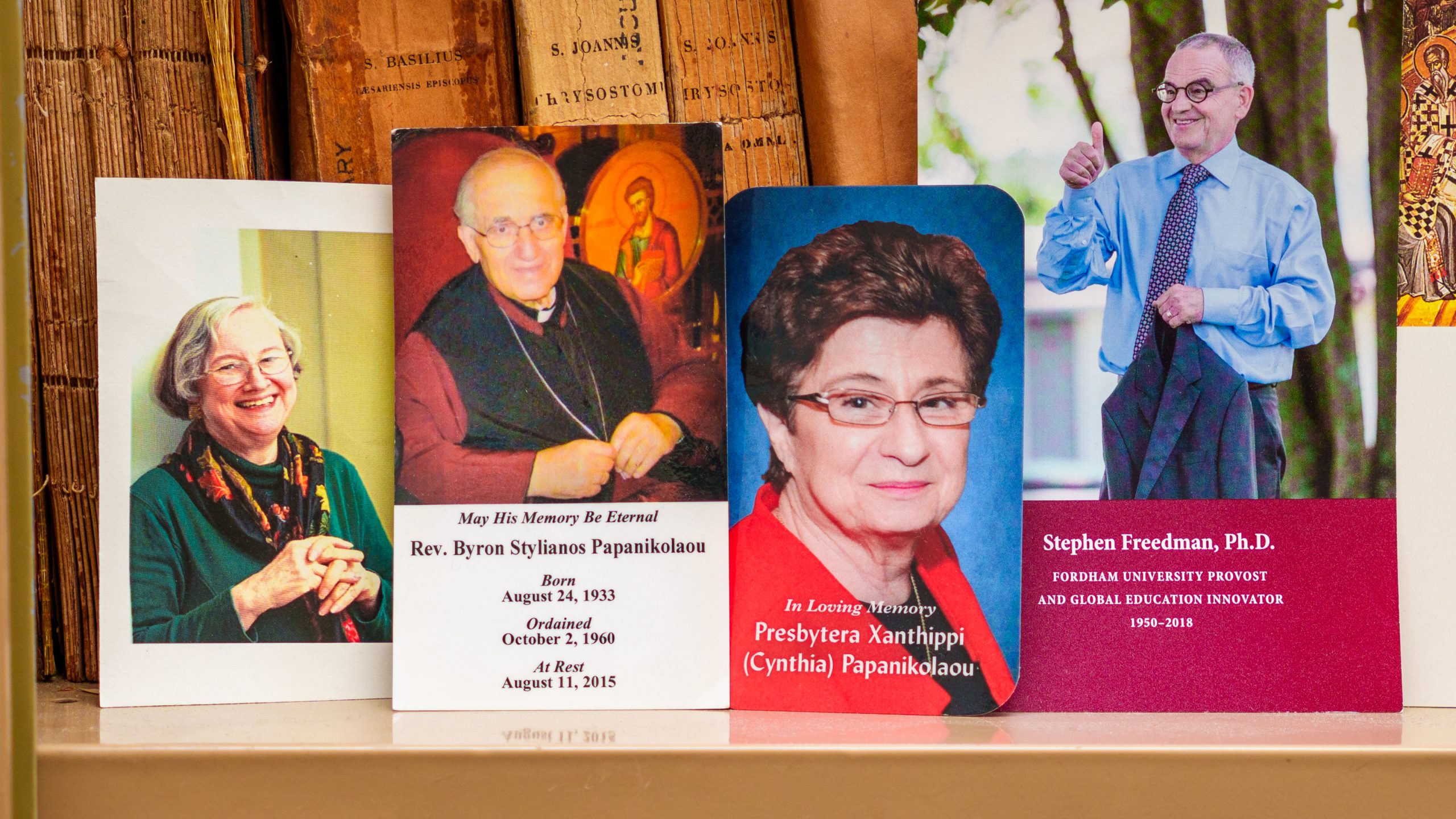
On a bookshelf, photographs of lost loved ones watch over Papanikolaou: his parents, former theology professor Mauren Tilley, PhD, and former provost Stephen Freedman, PhD.
Freedman played an important role in the early years of the Orthodox Christian Studies Center, which Papanikolaou co-founded in 2012. Now a leading North American institution for the study of Orthodox Christianity, the center benefited from Freedman’s support in its early days.
“I’m very grateful to him,” Papanikolaou said. “When you’re starting out, you’re trying to convince people that what you’re doing is worthwhile. And he really believed in us.”
