

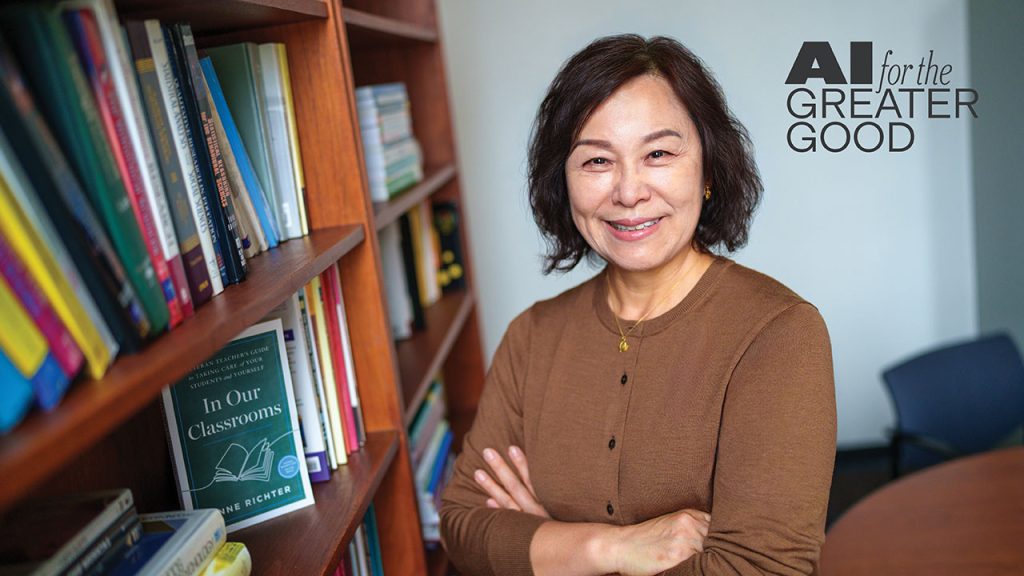
For our series, A Fordham Focus on AI, we’re speaking with faculty experts from a range of disciplines about the impact of this rapidly evolving technology and what to expect next.
In this installment, we sat down with Su-Je Cho, PhD, professor of curriculum and teaching at the Graduate School of Education.
A 23-year member of the GSE faculty who is chair of the Division of Curriculum and Teaching, Cho specializes in training educators and families in assessment and interventions for children with challenging behaviors.
She works extensively with graduate students who will use many techniques and classroom tools—including AI technology—to help shape young minds.
How are you helping to shape the use of AI in special education classes?
My research these days is conducted in collaboration with doctoral students, whom I guide in incorporating AI into their own research. It’s exciting because many teachers know AI is available but don’t know how to use it effectively in their lessons. For example, one of my doctoral students is interested in coaching other teachers on how to use the AI-enabled platform Merge Cube. Students are used to looking only at one-dimensional or two-dimensional examples, but this program shows them three-dimensional examples of the solar system or human anatomy.
How can AI help teachers prepare for classes?
I tell my students to use it to help them prepare lessons that are fun and engaging. For young children, when the lesson is fun, you don’t need to spend as much time on classroom management because they’re all focused on what they’re doing. AI can give you multiple examples, including images and videos you might need, to make a lesson fun.
Why is AI so useful when it comes to teaching students with special needs?
Differentiated instruction, which is when teachers customize their instruction to meet individual students’ needs, is something we expect all teachers to do. Many do not know how AI can help them. I tell students to share their lesson plans with ChatGPT and describe some of their students’ characteristics. So, for instance, Patrick has an attention problem, and Suzy has a problem with getting up out of her seat all the time. You’ll get several ideas about how to differentiate instruction for them, and you can pick and choose the ideas that may work for your students.
Do you think AI will ever take over teaching jobs?
No, and I’ll give you an example of why. Let’s say I’m going to talk about a topic in class tonight. I could ask ChatGPT to generate everything for me, but is that what I really want? No, because I have my own ideas about what I want to do, based on my experience and my knowledge.
But suppose I have a PowerPoint presentation that I don’t think I’ll have time to share because it’s way too long. I enter the information into Gemini or ChatGPT, and say, ‘Can you simplify this so that my students can get through it in 10 minutes?’ So it’s not creating the knowledge, it’s just rearranging it. And sometimes, if I’m not sure whether my students will understand a presentation, I’ll ask, ‘Can you make it clearer, adding examples?’ So it’s refining it.
Now, I already have knowledge in that area, so when ChatGPT reorders all that information, I can look at it and determine whether it makes sense. If it doesn’t, I’ll say, ‘That’s incorrect. Can you look at this issue again?’ So all those ideas come from me.
What’s one thing that makes you optimistic about AI in education?
I’m excited that AI is available because I feel like it’s made me a better educator. Teachers don’t always have enough time to put in as much class preparation as we’d like because we are wearing so many hats. You wish you could set aside more time for your classes, but often it’s not even possible. Because of AI, I now have more time to devote to a better classroom experience.
Learn more about AI for the greater good at Fordham.
