

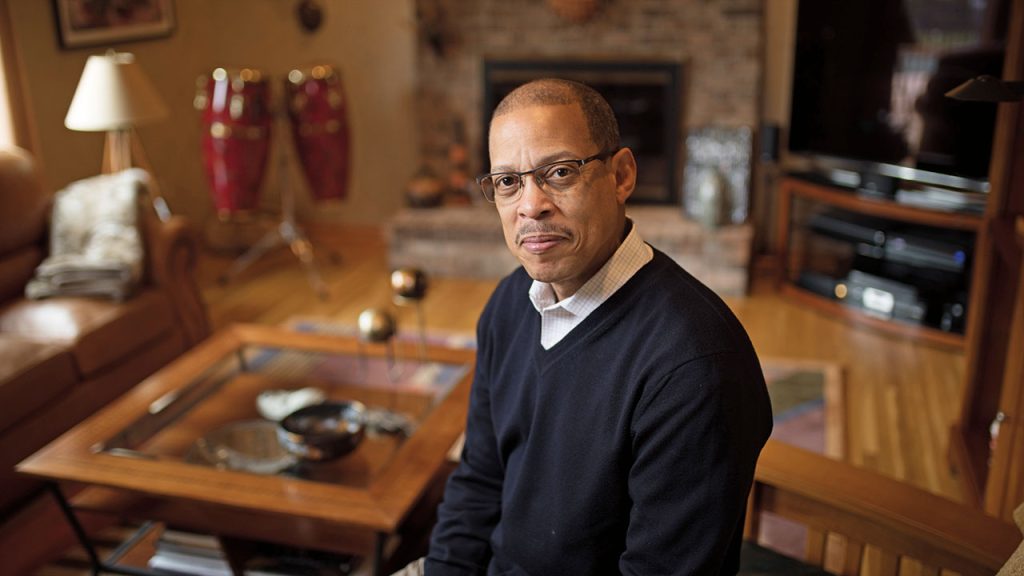
If there is such a thing as a quintessential Fordham story, Anthony Carter ’76 is living it.
A local kid from the Bronx, Carter lost his parents at an early age and eventually learned how to “hold deep faith and deep pain at the same time.” His intellectual curiosity launched him on a career as a writer and executive that began with a Fordham degree in communications.
He served as press secretary to trailblazing New York City Mayor David Dinkins and in the C-suite at Johnson & Johnson, where he retired in 2015 as vice president and chief diversity officer.
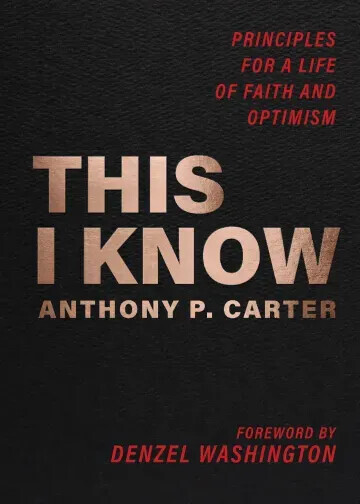
Now, Carter is sharing lessons both personal and professional in This I Know, a new memoir from Loyola Press featuring a foreword by his Fordham roommate and decades-long best friend, Denzel Washington ’77.
Carter sat down with Fordham Magazine to discuss the book, his career, and a lifelong pull to Fordham, where he is a trustee and longtime mentor to students.
The title of your book, This I Know, is inherently humble in that it implies there are things that you do not know. Do you feel you’re still learning?
You bring up a wonderful point, because I was uncomfortable with the title at first! I don’t like to pat myself on the back—if you do that too much, your arm breaks. It was intended to be honest. It’s about my experiences, my principles for faith and optimism.
Early in the book, you write very candidly about “the dichotomy of being Black and Catholic.” Why was that an important perspective for you to share?
I always talk honestly about my faith, and I’m quite proud of that. I grew up in the Catholic Church, and I reflect in the book on a time when a priest refused to shake my outstretched hand during the sign of peace. To feel [the sting of] that, then to read the history of Black Catholics in this country—not being able to come up to receive Communion, sitting up in the balcony because they couldn’t be with the main parishioners at Mass—that’s always bothered me.
In spite of all of that, I’ve seen things change, things that are really welcoming. And I’m proud to be part of this experience we’re having, particularly with Pope Leo and Pope Francis prior to him, bringing in clergy and representation that reflects our society. That’s powerful.
And you actually had an audience with Pope Francis before he passed.
The Board of Trustees had a retreat in Rome about a year and a half ago when we were trying to situate ourselves in Jesuit values. We had an opportunity to get grounded in what our commitment is as trustees of the University. Being in the presence of not only Pope Francis but a lot of folks who we had a chance to meet with was one of the most remarkable experiences I’ve ever had.
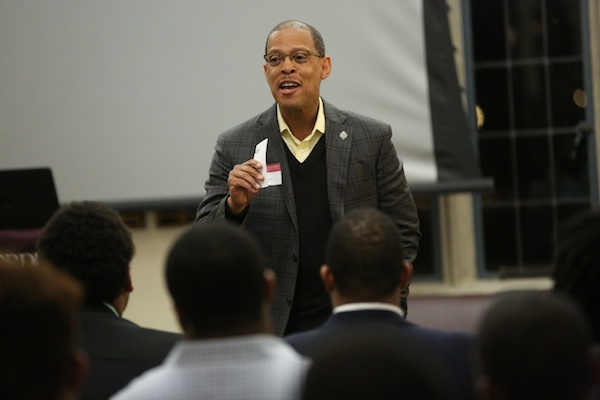
You built a distinguished career on your expertise and passion for diversity in and beyond the workplace. As attitudes and practices continue to change, do you feel you retired just in time or too soon?
There’s never an end to cultural diversity. It includes the differences, the thoughts, the perspectives, the ideas, the values of different people. When that is all harmonized together, it just makes beautiful music.
It is disturbing that we’re defining the context now as something that’s disruptive and not allowing other folks to exist. Diversity in itself is pure. It encompasses every one of us, and when you look at multiculturalism in a room, or “that gorgeous mosaic” that David Dinkins used to talk about, and you start tapping into different perspectives, it brings such richness and harmony to whatever that outcome is supposed to be.
“Diversity isn’t a challenge to overcome—it’s the very design of God, and a strength that makes us more whole.”
—Anthony P. Carter, from This I Know: Principles for a Life of Faith and Optimism
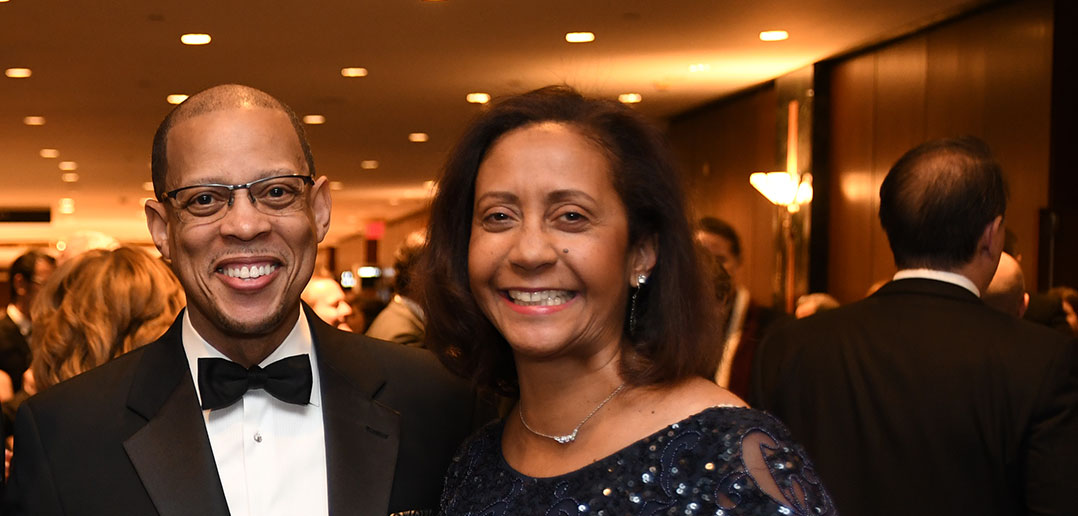
You’d be well within your rights to rest on your laurels. What keeps you coming back to spend your time working on behalf of Fordham?
Most leaders in corporate America, once they’re retired, like myself, there’s an emptiness. You want to be able to share those experiences and help someone continue to climb up the ladder.
I believe we’re preparing students for a world that they have yet to see, but they bring so much into it. And so I get a kick out of working with programs like CSTEP and Fordham’s very talented faculty. I know there are challenges, but it feels like with the support we provide students, we’re moving in the right direction. Not to be perfect, but to be impactful. And that’s what I feel we’re called to do.
I also learned from this book that you are a longtime player of African djembe drums.
Yes!
You participate in a weekly drum circle and you write about how it goes beyond making music—it’s a way to understand coexistence. Can you talk about that?
The essence and the beauty of what I feel about drumming is that it doesn’t matter what your rhythm or your beat is all about. It’s how you take in all that you hear and express who you are amidst a crowd of people playing music that is just to satisfy the moment and to make people feel free about what they have to express.
I use that whole metaphor around drumming to say that each of us has a talent, each of us has a heartbeat, right? And we’re trying to synchronize and put it together with all kinds of beats. And when you just sit back and listen to it, it makes sense. Shouldn’t we exist in that way?
This interview has been edited and condensed.
