

For many people, the term “robotics” conjures up a sci-fi world where humanoids clean our kitchens. Not so fast, says two-time Fordham grad Jason Hughes ‘20, ‘21 MS.
“You would need to spend 10,000 years tele-operating” such a robot for it to work autonomously, he says.
Hughes isn’t waiting 10,000 years to make an impact.
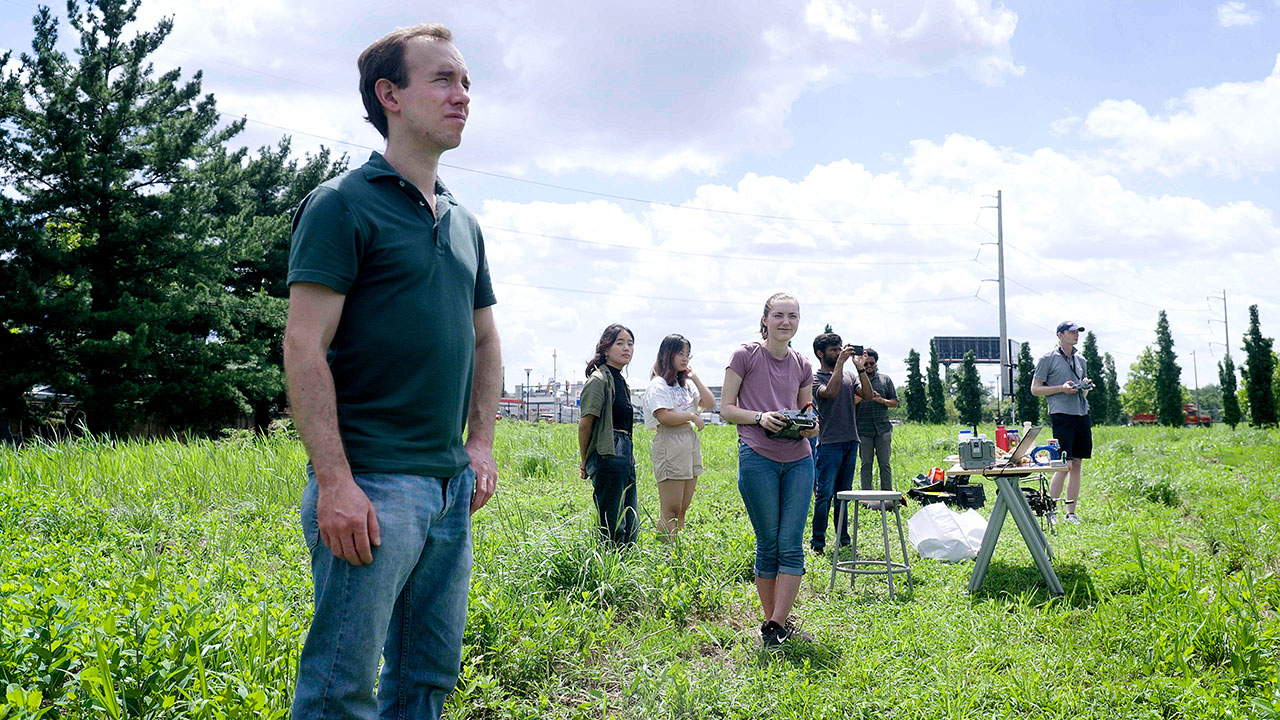
He’s pursuing a PhD in computer science at UPenn, where he’s the systems lead of a team programming robots to perform triage in disaster zones like earthquakes and battlefields.
Last fall, Hughes’ team advanced to the third round of the Triage Challenge sponsored by the Defense Advanced Research Projects Agency, better known as DARPA. The challenge kicked off in 2024 and ends with an awards ceremony later this year.
Pioneering Robotic Triage to Advance Trauma Medicine
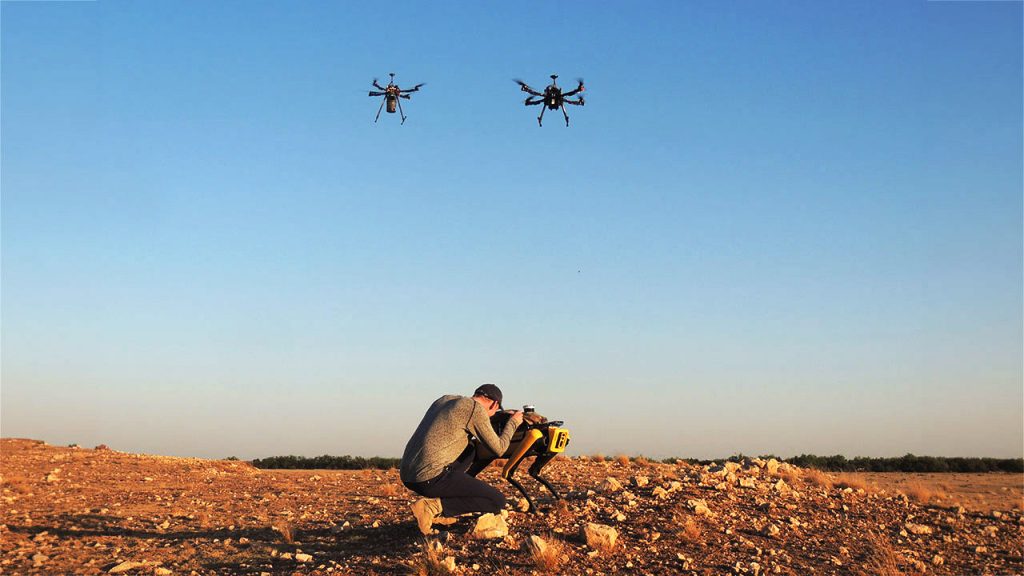
The concept is revolutionary: A drone scouts an area to tag locations, and ground robots navigate rubble to conduct primary triage—using radar, vision language models, and other technologies to locate casualties, check heart rates, classify injuries, and communicate with medics.
This process helps human first responders safely prioritize treatment, bypassing any immediate danger that might arise during an initial assessment.
“You might not want to send combat medics out to whatever situation that we triage in, but you can send a robot because you don’t really care [as much] if it blows up,” Hughes says.
As the systems lead, he designs software for the drone and ground robots, ensuring that the sensors function properly and that all robots can exchange information.
Combining STEM and the Humanities to Drive Impact
Hughes says he built his hardware and data science skills at Fordham, where he completed an accelerated dual-degree program in 2021, earning a bachelor’s degree in mathematics and a master’s in data science in just five years.
Growing up outside Boston, Hughes was drawn to Fordham for its traditional campus community in New York City. He decided to major in mathematics simply because he enjoyed it—a happy accident that’s become the bedrock of his career thus far.
It was at Fordham, working with Damian Lyons, the founding director of Fordham’s Robotics and Computer Vision Laboratory, that Hughes got his first taste of robotics. He credits his Fordham education—specifically the combination of a rigorous math curriculum and the liberal arts core—for his success in a field often dominated by pure engineering.
“Having that strong mathematical foundation makes understanding all the complex parts of the computer science and the control theory behind robotics much, much easier to grasp,” Hughes says. He adds that the core curriculum honed his ability to communicate technical concepts to nonexperts, a skill vital for bridging the gap between the lab and the real world.
“You might not want to send combat medics out to whatever situation that we triage in, but you can send a robot because you don’t really care [as much] if it blows up.”
From Disaster Zones to Tech-Connected Cars
After earning his doctorate, Hughes is eager to translate his expertise to the industry side of robotics, specifically autonomous and connected cars.
“If these cars can talk to each other and exchange data while they’re on similar parts of the road, you can help prevent crashes even if someone forgets to put on their turn signal,” he says.
While coding has been an essential part of his studies, Hughes says that a deep understanding of mathematics can help unlock the door to high-level research. So, for current and future Rams eyeing a similar path, he shares some advice: Prioritize the fundamentals of a liberal arts education.
After all, it’s that blend of theory and skill with a humanitarian focus that defines Hughes’ work—proving that the best robots aren’t ones that look like us, but the ones that can help save us.
