

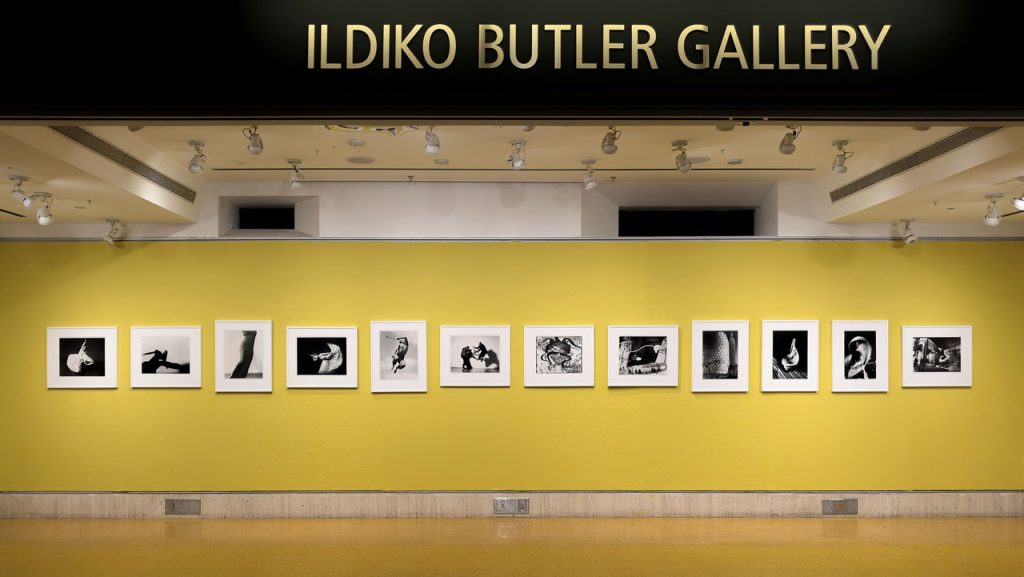
Now that the world has gone digital, analog materials have become even more precious to Stephan Apicella-Hitchcock.
“There’s no substitute for holding an actual thing in your hand,” said the head of Fordham’s visual arts program, who has been mining Fordham’s Walsh Family Library for archival gold over the past 13 years.
“Every time you go into an archive, you find something new and unexpected and exciting,” he said. He has turned his many visits to Walsh Library’s Archives and Special Collections into three exhibitions at Fordham to date, and has another planned for the upcoming academic year, all with the help of Fordham Libraries’ staff.
“I really have tremendous respect for our librarians and our archivists,” he said, who manage thousands of physical photographs, slides, and artifacts in the University’s archives, in addition to its digital materials. As Apicella-Hitchcock continues his deep dives into Fordham’s collection, he shared some of his favorite finds and a preview of his next archival project.
The Seismologist Behind the Camera
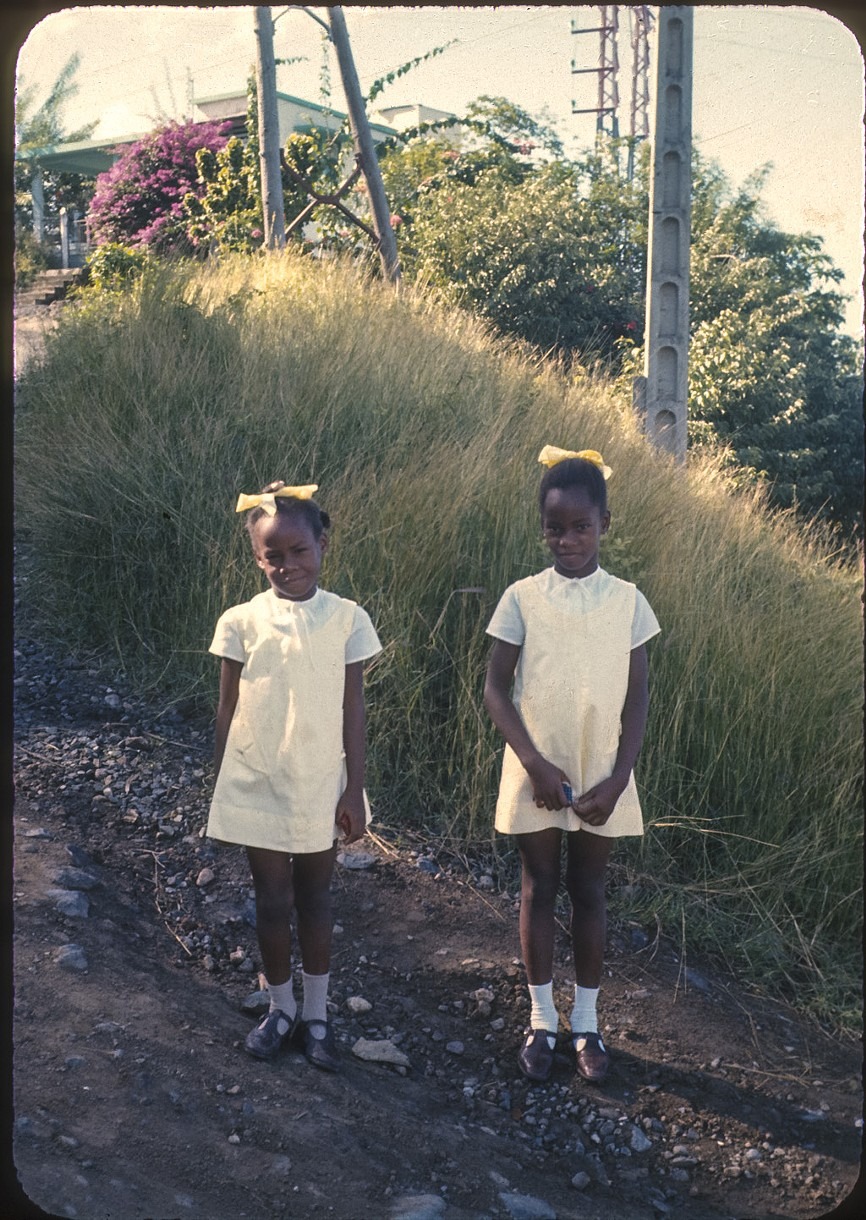
Apicella-Hitchcock teamed up with Anibal Pella-Woo, adjunct professor in the visual arts program, to curate his first archival exhibit, “Half Frames,” in 2013. Together they combed through the personal photographs of J. Joseph Lynch, SJ, who directed Fordham’s seismic observatory station—the oldest in New York City and still in use today. Father Lynch documented his travels, people, and events using a “half-frame” camera, which doubled the pictures you could take by using half the frame on a roll of film. This picture still stands out to Apicella-Hitchcock for its gentle lighting and the identically dressed girls whose facial expressions differ. The girl on the left looks at the camera quizzically, the other appears more open. “I like that delicate dichotomy,” he said.
The Beauty in Film’s Imperfections
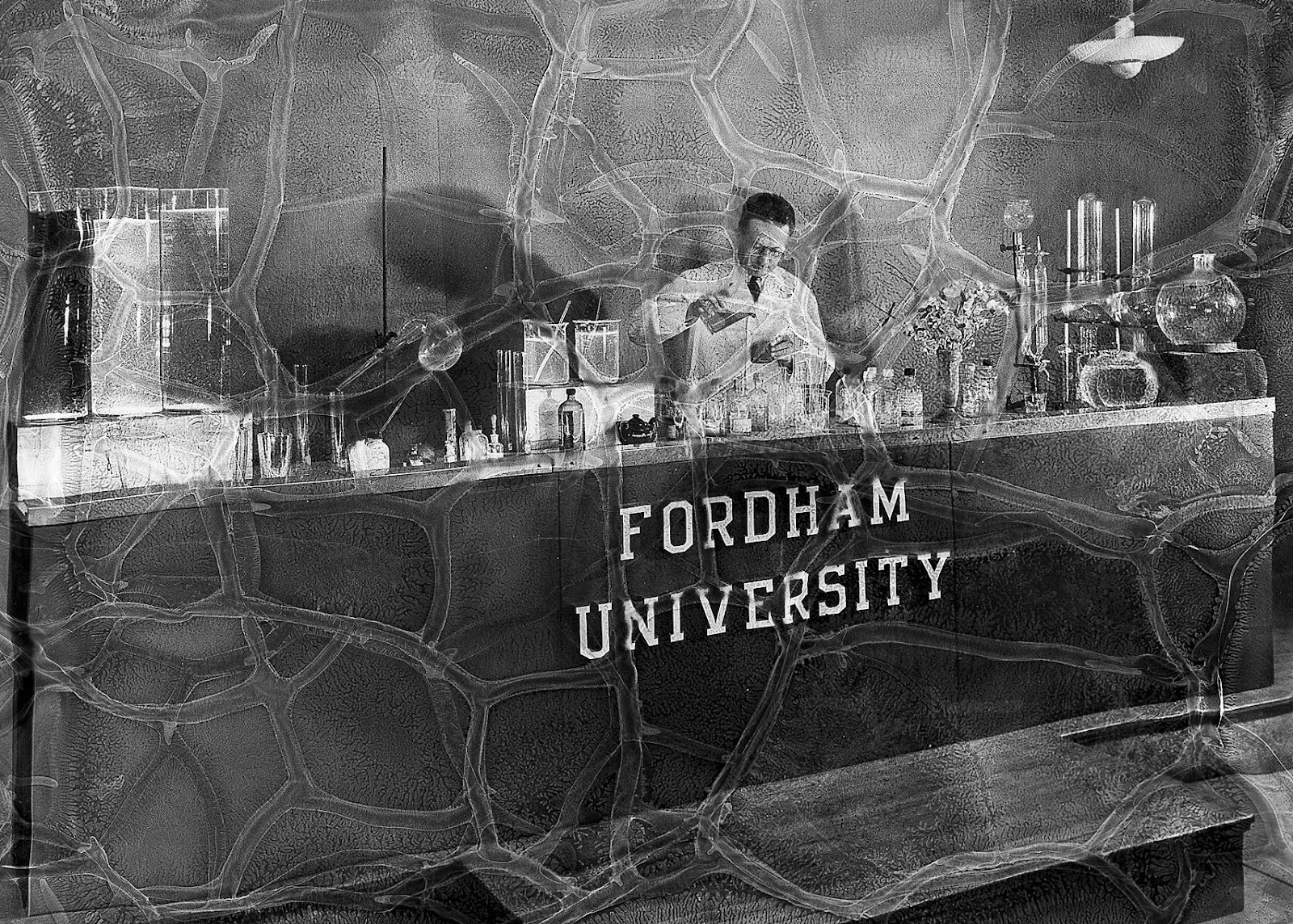
Fordham has been capturing campus beauty shots for its marketing materials at least as far back as the 1930s, when freelance photographer William Fox was hired to photograph the University, student life, and special events like commencement. Some of his negatives degraded over time, giving them a surreal quality that appealed to Apicella-Hitchcock. He chose 17 of Fox’s altered images for his 2014 exhibit to contrast the mysterious and beautiful flaws of the analog process with the perfection of the digital age. In the above image, “it appears that the Fordham professor conducting experiments has had their chemical process leak out of the lab and literally onto the film itself,” he said, “causing a practically psychedelic rupture and patterning to the photograph.”
A Martha Graham Museum Piece
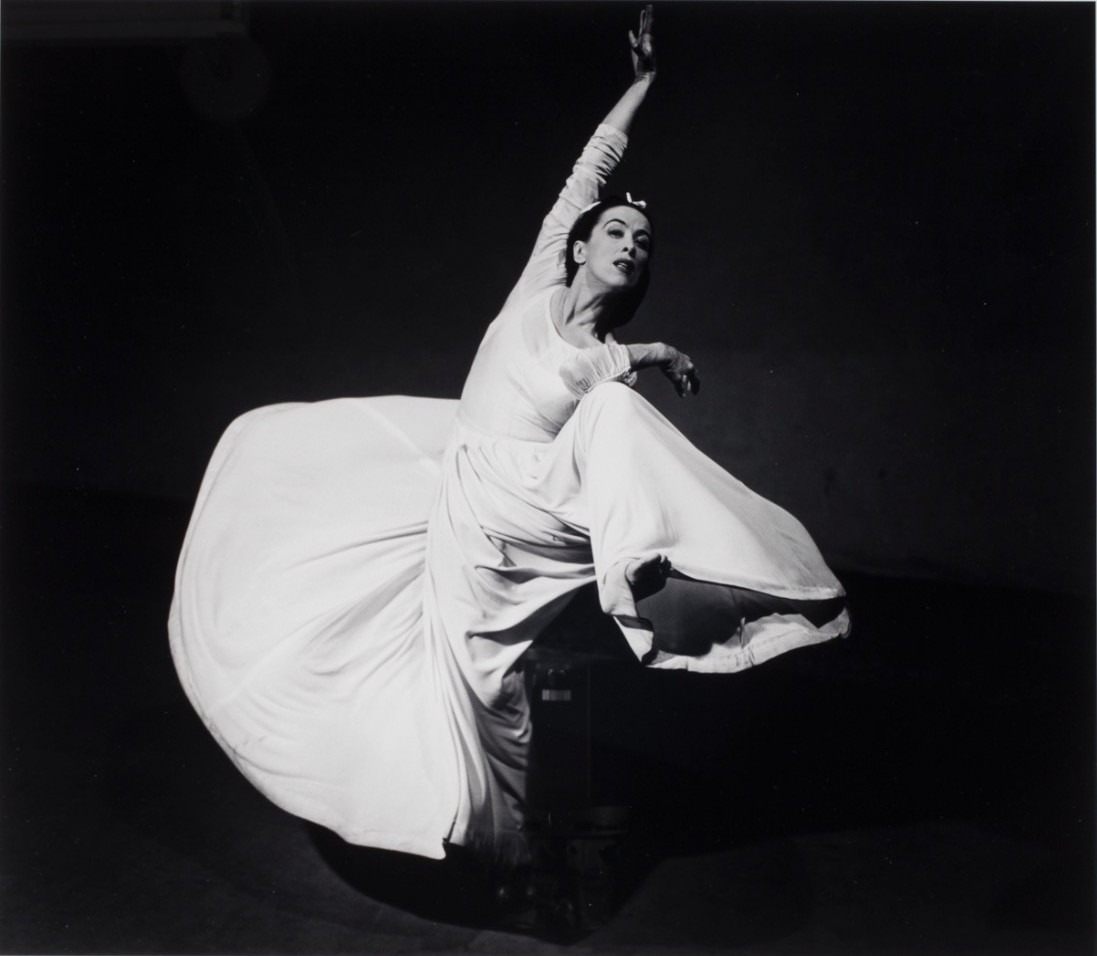
In his third “From the Archives” exhibition, Apicella-Hitchcock featured the work of dance photographer Barbara Morgan, whose prints were donated to Marymount College, which Fordham later acquired. He said he was stunned to find a print of this “super famous” picture of choreographer and dancer Martha Graham, a copy of which is also in MoMA’s permanent collection. He recently brought two of his classes to the museum in January, he said, “and there was the picture that Fordham has in our collection.”
Fordham’s Experimental College
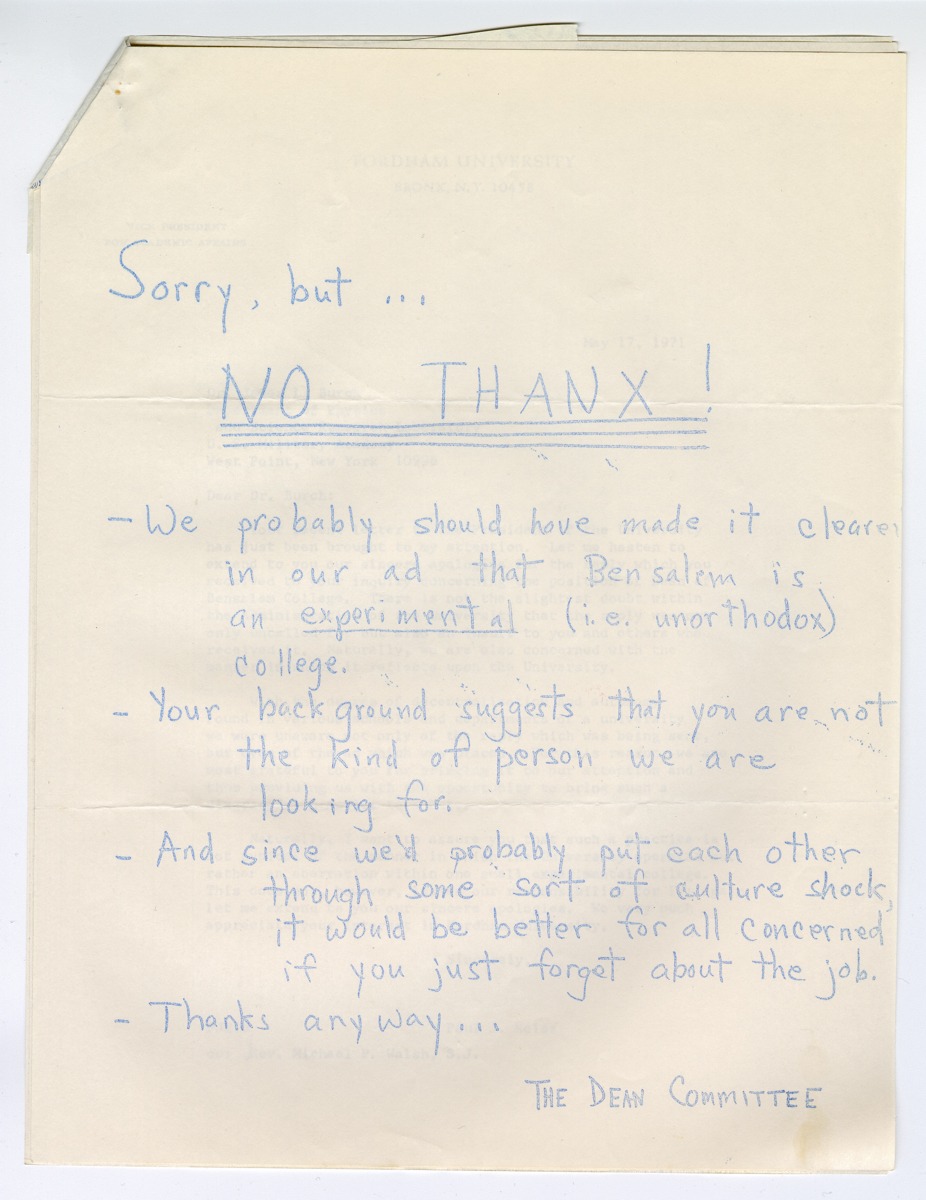
For his newest archival project, Apicella-Hitchcock is digging into the history of Fordham’s experimental Bensalem College that opened in 1967 near Rose Hill.
“We hope to make life so interesting that the students won’t need LSD,” its director, Elizabeth Sewell, told The New York Times.
Looking at the initial correspondence between school officials and students, “it’s such a beautiful dream you could see that these people had,” said Apicella-Hitchcock. “They were really thinking very carefully about what education can be and how Fordham can change with the times.”
The experiment was short-lived. Students threw out the school’s only language requirement—Urdu—and tried to hire their own dean even though Fordham was not looking for one. (The rejection letter above offers a window into their interview process.) By 1971, a campus council voted to phase the school out.
“I’m scanning documents and I’m going to put them in sequence as a book,” said Apicella-Hitchcock. “It doesn’t need anything else—the facts will tell the story.”
