

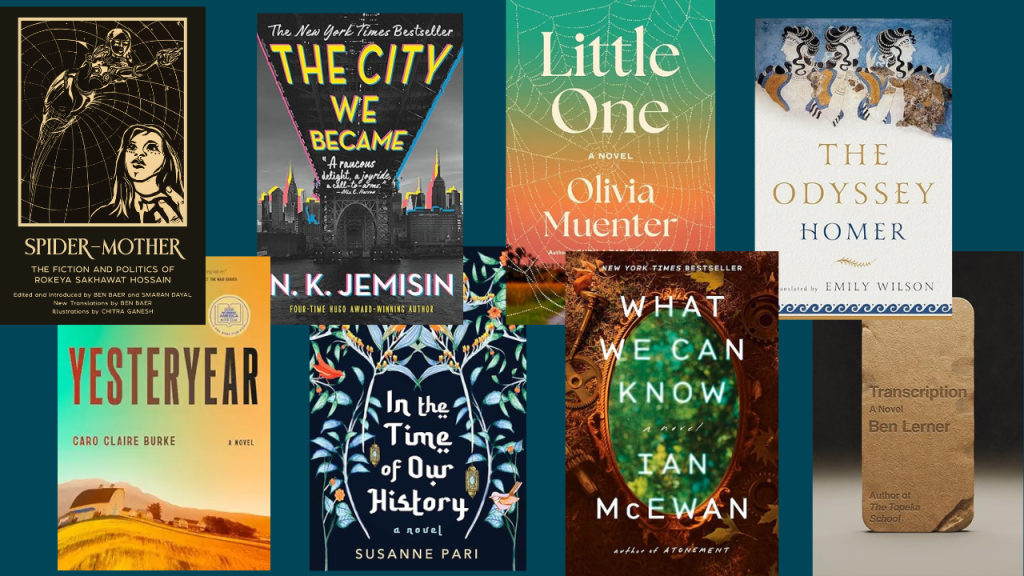
There are two summer Fridays left on the calendar—plenty of time to immerse yourself in a fictional world. Below, faculty and staff share their favorite novels and short stories for the beach (or the most air-conditioned room of your home).
Put Your Phone Down
The opening scene of Ben Lerner’s new 144-page novel Transcription is a journalist’s nightmare. A man drops and breaks his smartphone, leaving him no way to record the interview he planned with his mentor. From there, the novel explores our relationship with technology, a topic that resonated with Olivier Sylvain, author of Reclaiming the Internet: How Big Tech Took Control—and How We Can Take It Back. “It is a deeply affecting story about love, parenting, and the ways in which our smart devices innocuously transform personal and collective memory,” said the Law School professor.
A Trip Across the Wine-Dark Sea
On a trip to Greece last summer, Josh Friedland, editorial director at the School of Law, picked up Emily Wilson’s translation of The Odyssey—the version the new film is based upon. “I’m a diehard Christopher Nolan fan, so I was inspired to revisit the source before his film adaptation,” said Friedland. “I thought it might be a slog, but Wilson’s translation is surprisingly accessible and contemporary. Plus, the short chapters kept me turning pages.” Reading it with the sun blazing over the Ionian Sea, he called it “the ultimate beach read.”
Little House on the Instagrammable Prairie
Donna LaJoux had fun reading the buzzy book Yesteryear, about a “tradwife” Instagram influencer who glorifies 1800s-style homesteading on social media as her perfect life unravels off camera. “The novel touches on themes such as traditional gender roles, mental health, politics, and religion,” said the Campus Ministry senior department associate. She is currently reading and enjoying the Fordham University Association Summer Book Club pick, Theo of Golden. Read along and sign up for one of the group discussions on Wednesday, Sept. 2, at Rose Hill or Thursday, Sept. 3, at Lincoln Center.
In Search of Lost Poems
When readers enter the literary mystery What We Can Know, by Ian McEwan, the year is 2119, and climate disaster and nuclear war have upended the world. A literature professor is trying to track down the lost poem of a famous 21st-century writer, but discovers a richer story instead. “I’m always drawn to stories about the elusiveness of the past,” said English professor Vlasta Vranjes, PhD. In this novel, “our present is the past, studied by literary scholars in a post-apocalyptic future, which makes for a powerful meditation on the limits of historical knowledge.”
Seeing the Feminine Future a Century Ago
English professor Sneha Khaund’s recommendation comes from the syllabus of her course Reading the Urban Woman: Literature, Art, and Cinema from South Asia. Spider-Mother is a collection from Bengali writer Rokeya Sakhawat Hossain, and the 1905 short story at the heart of it, “Sultana’s Dream,” is one of the first-ever radical feminist science fiction stories. It’s set in a utopian kingdom where women have more power than men and use it to develop advanced technological solutions for a better society, she said. “Students were impressed by how much the story’s themes resonate … more than 100 years after it was first published.”
A Novel for New Yorkers
N. K. Jemisin’s The City We Became is both a “great and weird” science fiction novel and “one of the great New York City novels,” said English professor Glenn Hendler, PhD. Five human avatars of each of New York City’s boroughs face off against an entity that is out to destroy the city. This evil force, said Hendler, is modeled on the “fascinating but often explicitly racist, anti-immigrant, and anti-New-York-City work of H.P. Lovecraft.” It’s a captivating and fun read, he said, that is filled with local details. One scene is even set in Hendler’s upper Manhattan neighborhood at Shorakkopoch Rock, where the Lenape purportedly sold Manhattan to the Dutch for $24.
An Iranian-American Family’s Struggles
With Iran in the news, journalism professor Beth Knobel, PhD, said she has been thinking a lot about In the Time of Our History, by Susanne Pari. In this Iranian-American family saga, daughter Mitra Jahani returns to her parents’ New Jersey home on the one-year anniversary of her sister’s tragic death. There, the family members face their secrets and issues. “From the iconoclastic daughter to her long-suffering mother to the powerful family patriarch, Pari imbues the novel with vivid characters and gorgeous language,” Knobel said.
A Cult Classic
The Girls by Emma Cline and Waco: The Aftermath on Showtime got Summer Lily Egan hooked on stories about cults. This fascination led her to the mystery thriller Little One by Olivia Muenter. Its protagonist, Catharine, grows up in a modern-day cult led by her father, and comes to realize that she has blocked out her childhood trauma when a journalist begins reporting her story. The fast-paced plot and short chapters make it a true page-turner, said the communications officer for the Institute of International Humanitarian Affairs.
