

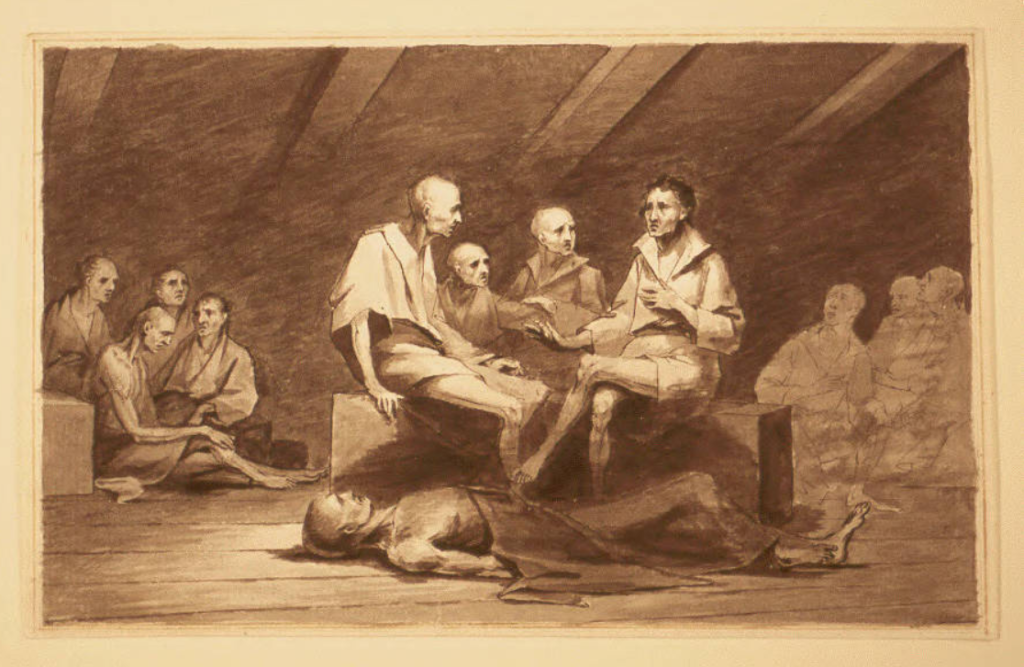
It’s been over 80 years since this 18th-century drawing by John Trumbull was gifted to the University as part of a collection of Trumbull artifacts and images, and to this day it remains the most-requested image in Fordham’s archives, said Linda LoSchiavo, director of University Libraries. The artist, a Revolutionary War veteran, is most famous for his iconic painting of the founding fathers presenting the first draft of the Declaration of Independence, which hangs in the U.S. Capitol Rotunda.
LoSchiavo said she receives requests for this drawing at Fordham as often as a few times a year—but its subject is still up for debate. First described in an 1896 catalogue of Trumbull’s works as “Subject unknown, prisoners starving to death,” the image has inspired two schools of thought. The late Irma Jaffe, Ph.D., a Trumbull expert and the founder of Fordham’s music and art history department, believed it depicted prisoners starving aboard a British prison ship, in line with another Trumbull scholar, Yale art historian Theodore Sizer. Breaking with these two, Helen Cooper, former curator of the Yale University Art Gallery, suggested instead that the men were in a mental hospital.
“The half-naked emaciated men, their heads shaved, listening to one whose full head of hair and healthier mien imply he is a more recent arrival, are perhaps the inmates of an insane asylum,” Cooper wrote in John Trumbull: The Hand and Spirit of a Painter that accompanied her 1982 Trumbull exhibition at Yale’s gallery.
So who is right? Scholarship tells us to embrace ambiguity. “It’s better historical practice to acknowledge the uncertainty than to impose certainty where the historical record does not support the claim,” said Claire Gherini, Ph.D., associate professor of history.

Still, LoSchiavo remains firmly in the Jaffe camp. “I haven’t read anything that supports the idea of an insane asylum,” she said. And when compared to actual drawings of 18th-century mental institutions such as the ones above, they “look nothing like Trumbull’s prison ship image.”
Major anniversaries of American independence spark a resurgence of interest in Trumbull and this image, said LoSchiavo, a Fordham alumna. Around the bicentennial in 1976, she was working at the Frick Art Reference Library and researchers often asked to borrow Trumball’s drawing from Fordham.
“I got a kick out of people asking for things from my alma mater,” she said, referring to the pre-internet days of interlibrary loans. “Now, decades later, people are still asking for it”—most recently Ken Burns.
In advance of the 250th anniversary of the United States in 2026, Burns’ team recently asked permission to reprint the image for a book that will accompany his new documentary, The American Revolution, airing November 16 on PBS.
“It is the most human and the most natural of all the Trumbull drawings,” said LoSchiavo, which is why she believes it is so often requested in the connection to the American Revolution. “It is a genuine image of the suffering of war, with all the glory stripped away.”
