

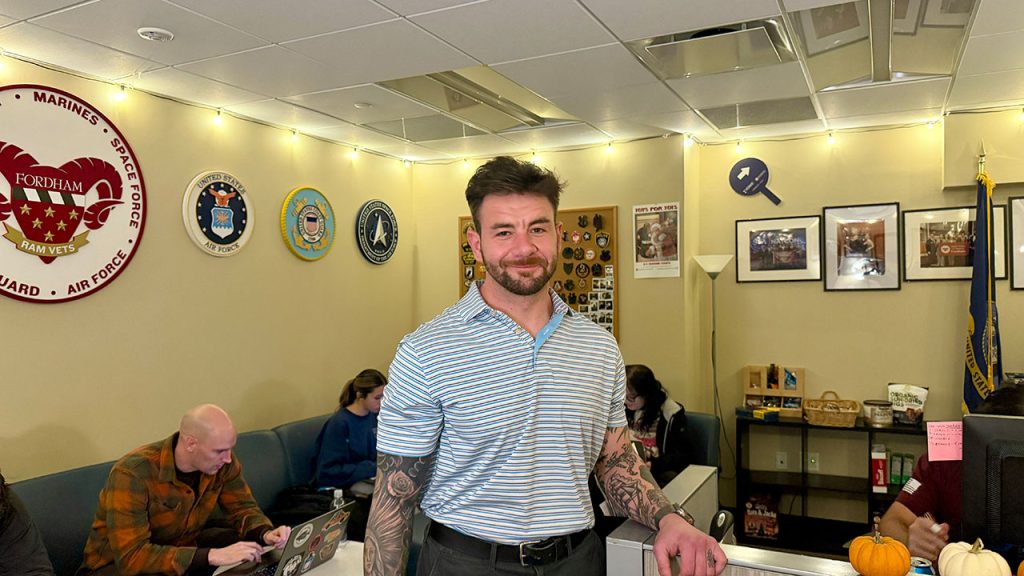
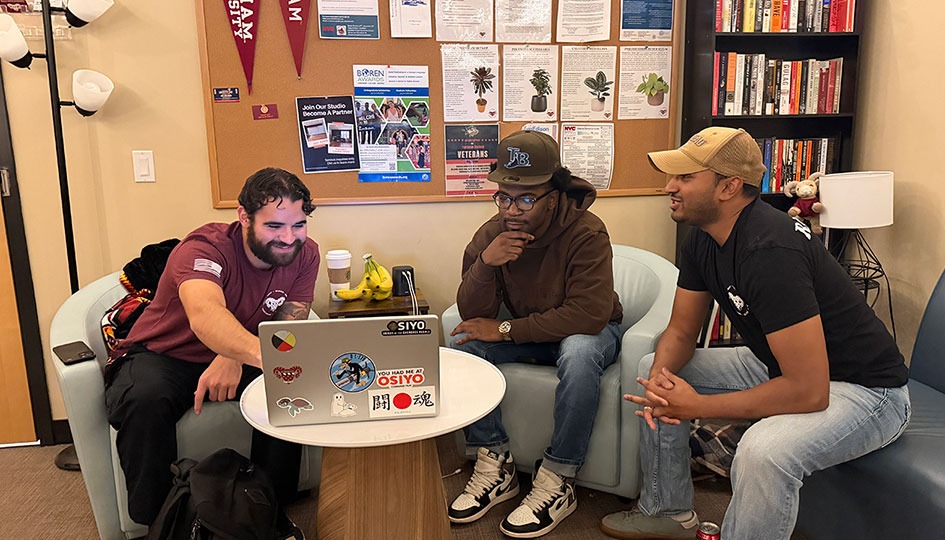
Sixteen pounds of bananas a week: That’s how much fruit Adrian Kochanowicz purchases for the student veterans who visit the Office of Military and Veterans’ Services at Lincoln Center. Dozens stop by each day, ready for a snack and a chance to catch up with peers.
“I make sure that it’s a cozy space that people are attracted to and would like to spend time in,” said the assistant director of Military and Veterans’ Services, an office that supports over 600 student veterans and their dependents. “When people open up to me and talk about personal things, I know they’re comfortable, and that’s a good sign,” he said. (Fordham, consistently ranked as a top school for veterans, also has a student veterans office at Rose Hill that will be fully operational in January.)
Kochanowicz emigrated with his family from Poland to New York City at age 14. He served in the U.S. Marine Corps for five years, deploying twice—once to Afghanistan and once to Romania. Ahead of Veterans Day, Kochanowicz shared what it’s like to make the transition from military service to college life and why he loves the student veteran community.
You used your GI Bill benefits to earn a bachelor’s in political science from Columbia University, a master’s in public administration from Baruch, and a master’s in history at Fordham, currently underway. What historical period are you studying?
World War II and anything post-World War I, 1918 to 1945, is really my bread and butter. I did my undergrad studies in political science with a focus on U.S. history, democracy, and legislative issues. At some point I do want to teach.
What did it feel like for you to enter college as a veteran?
I always felt that people next to me in the classroom were smarter. I was sitting next to 18-, 19-year-olds who were very eloquent. And the ideas that they had—I didn’t understand those ideas until I was 26. I felt very intimidated and anxious. I lacked confidence and kept attributing my success to luck. It was a terrible feeling that made me miss out on the college experience—I spent all my time studying.
My role is to ensure that student veterans don’t face the same challenges by encouraging them to be active members of the college community. I push them to participate in clubs and networking events and engage in volunteer work.
How does your office help student veterans?
When you get out [of the military], there is a shock. You’re gonna take classes that you don’t like. You’re gonna be exposed to ideas you may disagree with. So we try to help people and show them how to be a civilian, so to speak.
We tell them about resources, scholarships, anything that can help them with their academic journey. If a person is struggling in school, we help them come up with a plan and reach out to a dean.
We help with career paths, too. We prepare them for things like the Bloomberg Veteran Career Day—what to expect, what questions to ask, what to bring, how to dress.
What do you love about working with veterans?
I love the community. It’s people who are intellectually curious, people I can relate to easily. Even though I separated [from the service] 10 years ago, we can still joke about things because some things never change. Your bootcamp experience is terrible whether you were in the 1990s, 2000s, or 2010s.
Being here feels like home. I feel like I’m making a difference in people’s lives.
