

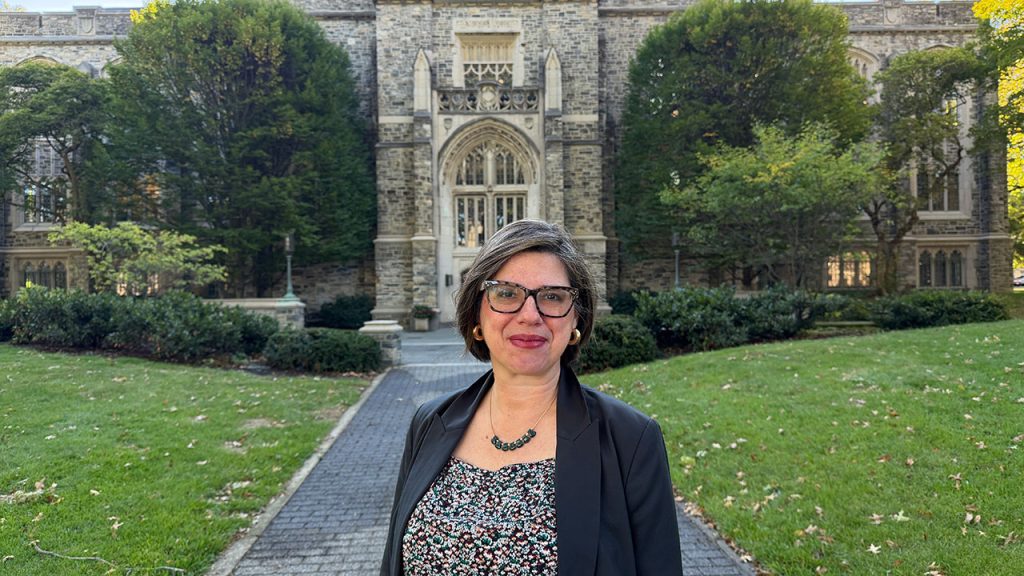
When Natalia Imperatori-Lee, Ph.D., began teaching at Rose Hill this fall, it was a homecoming. The Bronx resident first set foot on campus 30 years ago as an undergrad, and returned this semester as associate professor of theology, following two decades as a faculty member at Manhattan University. She studies the Catholic Church through a feminist lens and is often featured in the media and on academic panels for her expertise. Her third book, currently in progress, is about credibility within the church.
At Fordham, she joins her husband, Michael Lee, Ph.D., a theology professor and director of the Francis and Ann Curran Center for American Catholic Studies, and their eldest child, who is a junior at the Lincoln Center campus.
“I am so over the moon about coming back,” said Imperatori-Lee, who will lead a retreat on Oct. 25 for All Saints’ Day and All Souls’ Day. “Fordham has been super good to this family.”
Below she shares how Fordham shaped her career and what it’s like to be back on campus.
What’s it like to teach at your alma mater?
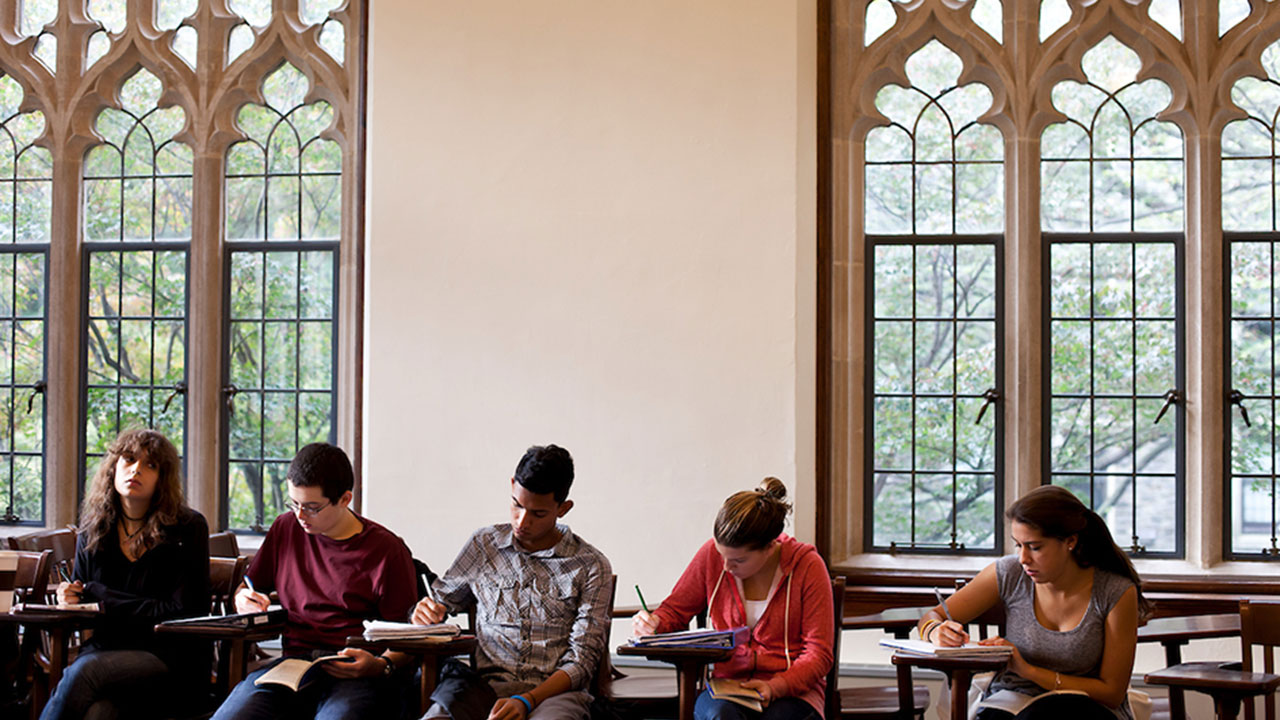
I feel intuitively connected to these students. I actually took the Faith and Critical Reasoning class that I’m teaching, which is a bizarre feeling. I feel invested in their success and in their experience of theology. I’m also just really impressed by them. I set the bar really high and they continue to meet it. And I have the prettiest classroom on campus, on the third floor of Duane. It looks like something out of a movie.
How did you first come to Fordham as an undergrad?
I grew up in Miami, Florida, and I applied to Fordham because I wanted to go somewhere far, and my parents trusted the Jesuits because my brother went to a Jesuit high school. I lived at Rose Hill for four years, and it was a life-changing experience that I’ll never recover from, apparently!
What is your area of scholarship?
I specialize in Latina theology and feminist theology largely because I took classes at Fordham with Elizabeth Johnson, C.S.J., a premier feminist theologian. And my life growing up Cuban American in Miami colors the way I view everything. We’re all coming from a context; your life experience affects the way that you understand the world.
Have you had any full-circle moments with your students?
One student said that Fordham was her dream school, and Fordham was my dream school, too. I met with this group of Cuban American kids from Miami, and one of them lives in Walsh, where I lived for two years. Somebody’s got to get me into my old room, because I have to see that view one more time, preferably in the fall.
How has Fordham changed?
It’s more international and it’s far more diverse. Fordham’s profile has really grown since I was an undergraduate; it has more of a presence on the global stage. And the level of the students, in terms of academic preparedness, is really great. Having that along with the University’s increased ethnic, racial, and socioeconomic diversity—that’s what makes a good learning environment.
How is your child doing at Fordham?
Our older child is a junior at Lincoln Center, but they are studying abroad in Bilbao. They’re studying comparative literature and international political economy, and taking incredible lit classes in Bilbao and a Basque language course—and just thriving.
You enjoy cross-stitching—why?
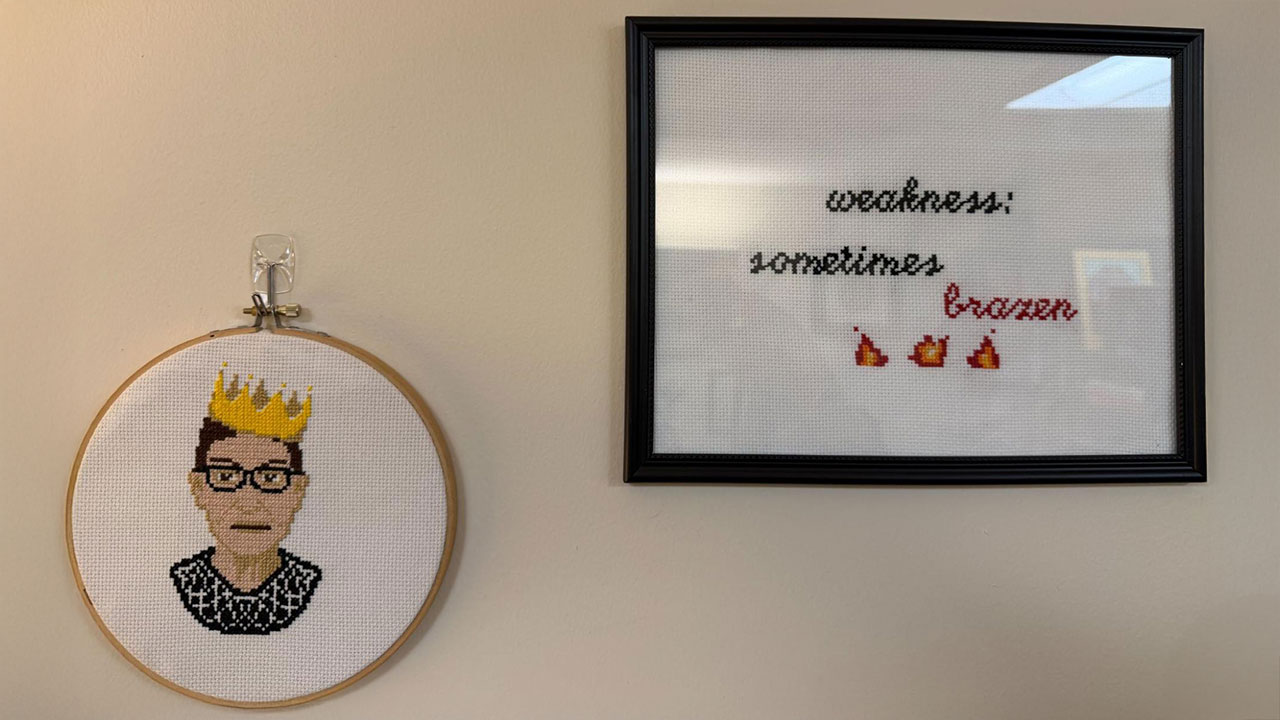
It’s meditative. It occupies my hands so I’m not scrolling. I also really like it because machine embroidery is what my grandmother did for work when she moved to this country.
A student once wrote “sometimes brazen” as one of my weaknesses in a course evaluation. I cross-stiched it, and I look at it every day to remind myself to be a little bit ungovernable in the classroom.
