

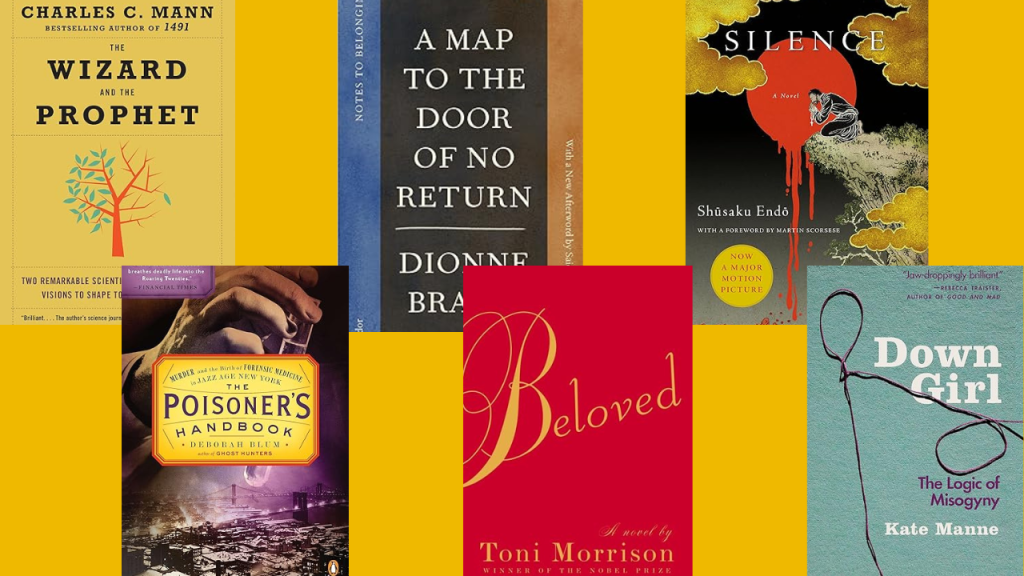
Feeling inspired by the back-to-school spirit on campus, we asked faculty members to share the books they’re excited to teach this year. Here are a few of their proven winners—student-tested, beloved texts that all of us can learn from this semester.
The Poisoner’s Handbook, Deborah Blum
Real-life murder cases from 1920s New York City and details on deadly chemicals are peppered throughout this history of the city, told through the eyes of poisoners and their victims. “It can’t get more New York,” says Uponita Mukherjee, Ph.D., assistant professor of history, who assigns it to her Global Histories of Forensic Science class. Students love it because it has something for everyone, from true crime stories to the birth of the FDA. “So far, I have taught it three times and it almost always turns out to be their favorite assignment,” she said.
Silence, Shūsaku Endō
In Fordham’s introduction to theology class, Faith and Critical Reason, Marie-Ange Rakotoniaina, Ph.D., lecturer of theology, assigns this novel because she believes literature can be a very “affective” means of understanding faith—better than doctrinal essays and theological treatises. “I wanted something beautiful,” she said of the book, which Martin Scorsese made into a film. It follows two 17th-century Jesuit priests who travel to Japan upon learning that their mentor, a missionary, has renounced his faith. The reality that they encounter is beyond what they were prepared for. “I really try to invite my students to enter the religious experience of others with empathy,” said Rakotoniaina, “and I think this is a wonderful book to do that with.”
A Map to the Door of No Return, Dionne Brand
Sasha Ann Panaram, Ph.D., assistant professor of English and affiliated faculty in African and African American studies, says Dionne Brand’s poetry and novels have been crucial to her research on transatlantic slavery. She teaches this nonfiction book “at every opportunity I get,” both in a Text and Contexts course and an upper division English class, The Middle Passage. “I like introducing students to A Map to the Door of No Return because it provides an occasion to consider … how the forced migration of Africans from Africa to the Americas continues to haunt our contemporary moment.”

The Wizard and the Prophet: Two Remarkable Scientists and Their Dueling Visions to Shape Tomorrow’s World, Charles C. Mann
Two opposing worldviews on our environmental challenges are at the heart of this book that Andrew M. Simons, Ph.D., associate professor of economics, calls his “favorite book to teach.” The wizard—plant breeder Norman Borlaug, who won the 1970 Nobel Peace Prize for developing disease-resistant wheat strains that reduced starvation in developing countries—believes technology can overcome the planet’s limits. Early environmentalist William Vogt, meanwhile, is the “reduce-consumption prophet” who sees the need to respect those limits. Simons uses it in two classes—one on food systems, and one on food insecurity—to examine both sides of agricultural productivity.
Beloved, Toni Morrison
In the class How Fiction Works, an upper-division English literature elective that English professor Edward Cahill, Ph.D., has taught for over a decade, this 1988 Pulitzer Prize winner by Toni Morrison is a longstanding favorite. “To many students, it can seem like a forbidding, even impenetrable postmodern novel about slavery and suffering,” Cahill said. “But when we approach it through questions of fictional form, like narration and point of view, plot and story, pattern and rhythm, and characterization, it becomes much more accessible. Most of my students find they can not only follow its dense, enigmatic style, but also enjoy its mysteries … and savor its astonishingly beautiful prose.”
Down Girl: The Logic of Misogyny, Kate Manne
Shiloh Whitney, Ph.D., associate professor of philosophy, loves discussing the content of this book by feminist philosopher Kate Manne, because it applies the “conceptual craft of philosophy” to reexamine how misogyny functions in the world—not as a general hatred toward women, but a more systemic set of beliefs and actions. “I also find the book to be a valuable tool for teaching the skills and methods of philosophy in a way that makes clear how relevant they can be in important, real-world conversations,” said Whitney.
