


How do we confront online abuse and threats in a digital world that is borderless, profit-focused, and increasingly polarized?
This was the timely question that academics, policymakers, tech experts, and lawyers unpacked at Fordham London’s State of Hate symposium on March 18.
The event grew out of a conversation between Fordham London senior director Matthew Holland and Anthony Davidson, dean of Fordham’s School of Professional and Continuing Studies, whose College at 60 program is coming to Fordham London this May. Together with the symposium’s partners—Signify, a UK company that monitors online abuse, and the British American Project, a networking nonprofit—the theme emerged.
“Indifference is quickly leading to hate in a way that it didn’t previously,” said Holland. “Social media, algorithms, everything incentivizes polarization and hatred.”
As a Jesuit institution that often talks about being people for others, Fordham has a responsibility to think about the social justice element of tackling online hate, he said. “It is critical to replenish our appreciation for the human dignity of others and rediscover the ability to respect those we disagree with,” said Holland.
Who Draws the Digital Line?
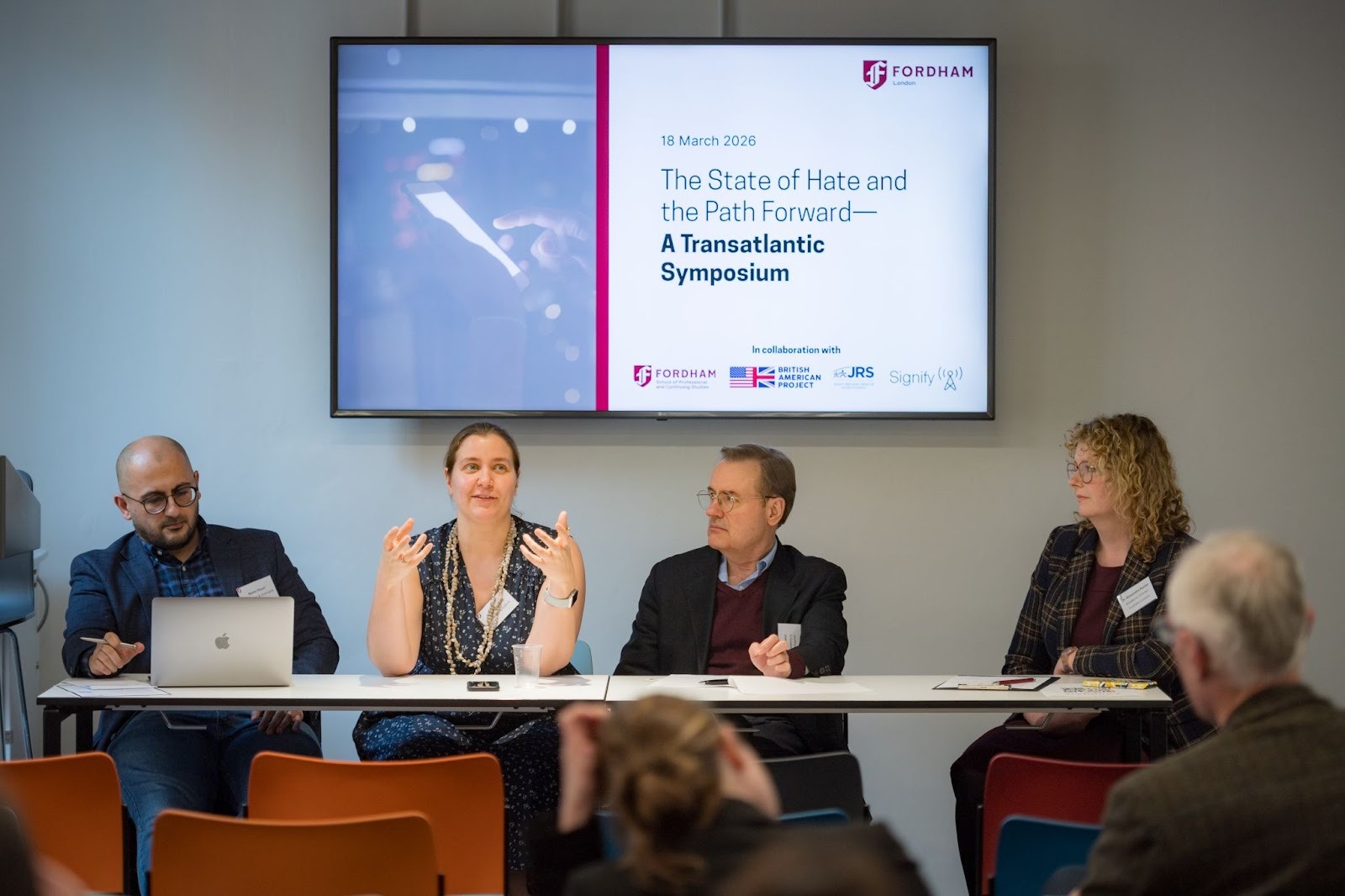
The event’s first panel examined online power structures. Who defines harm, and whose speech is protected, in a space that transcends borders but carries real-world consequences?
What emerged is that free speech online is no longer equal. Algorithms amplify divisive and emotive content, while systems of attention and profit actively incentivize it.
This creates a defining paradox: the internet democratizes speech, yet simultaneously industrializes the way it’s distributed and manipulated.
When Hate Goes Beyond the Screen

How online hate spills into the real world—shaping political discourse, and sometimes inciting violence—was the subject of the second panel, led by two members of Jesuit Refugee Services UK (JRS UK). Anti-refugee rhetoric, once confined to the fringes, has become embedded in mainstream narratives, they said. From disparaging language to policies that hurt asylum seekers, the panel showed how this dehumanizing discourse is constructed and sustained.
To counter these narratives, JRS UK emphasized the importance of community-based approaches grounded in lived experience.
The Data Behind Abuse

The third session shifted the conversation from experience to evidence, and challenged the idea that online hate is random.
Jonathan Hirshler, co-founder and CEO of Signify, a company that supports athletes by detecting and protecting against online abuse, used large-scale datasets to show that abuse is measurable and increasingly predictable. And if abuse can be measured, it can be mitigated.
Interventions that identify perpetrators and pass their details to football clubs have already produced tangible results, he said, such as banning abusive fans from sporting events.
The Human Cost of Digital Hate
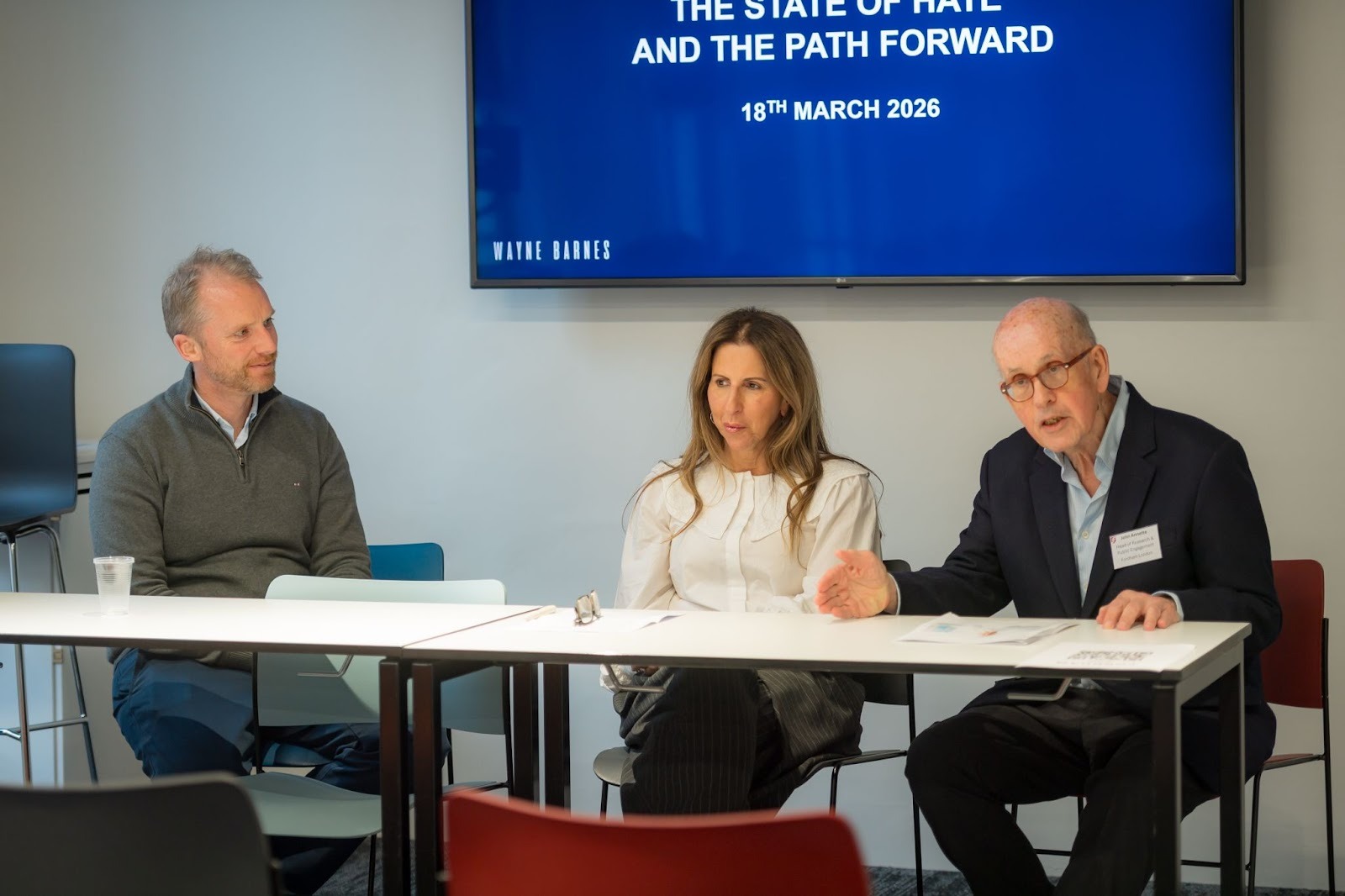
In a powerful fireside discussion, Wayne Barnes, former international rugby referee and now partner at law firm Squire Patton Boggs, and Laura Wolfe, founder of the marketing and media relations firm Road3, brought lived experience into sharp focus.
Online hate, they made clear, does not stay online. It enters homes, affects families, and reshapes lives.
Barnes, one of the most targeted referees during the 2023 Rugby World Cup, spoke about efforts to identify and hold abusers accountable. Wolfe detailed the deeply personal nature of abuse she faced as a Jewish woman working in football—including death threats, attempts at cancellation, and the targeting of her family.
The Hate Economy
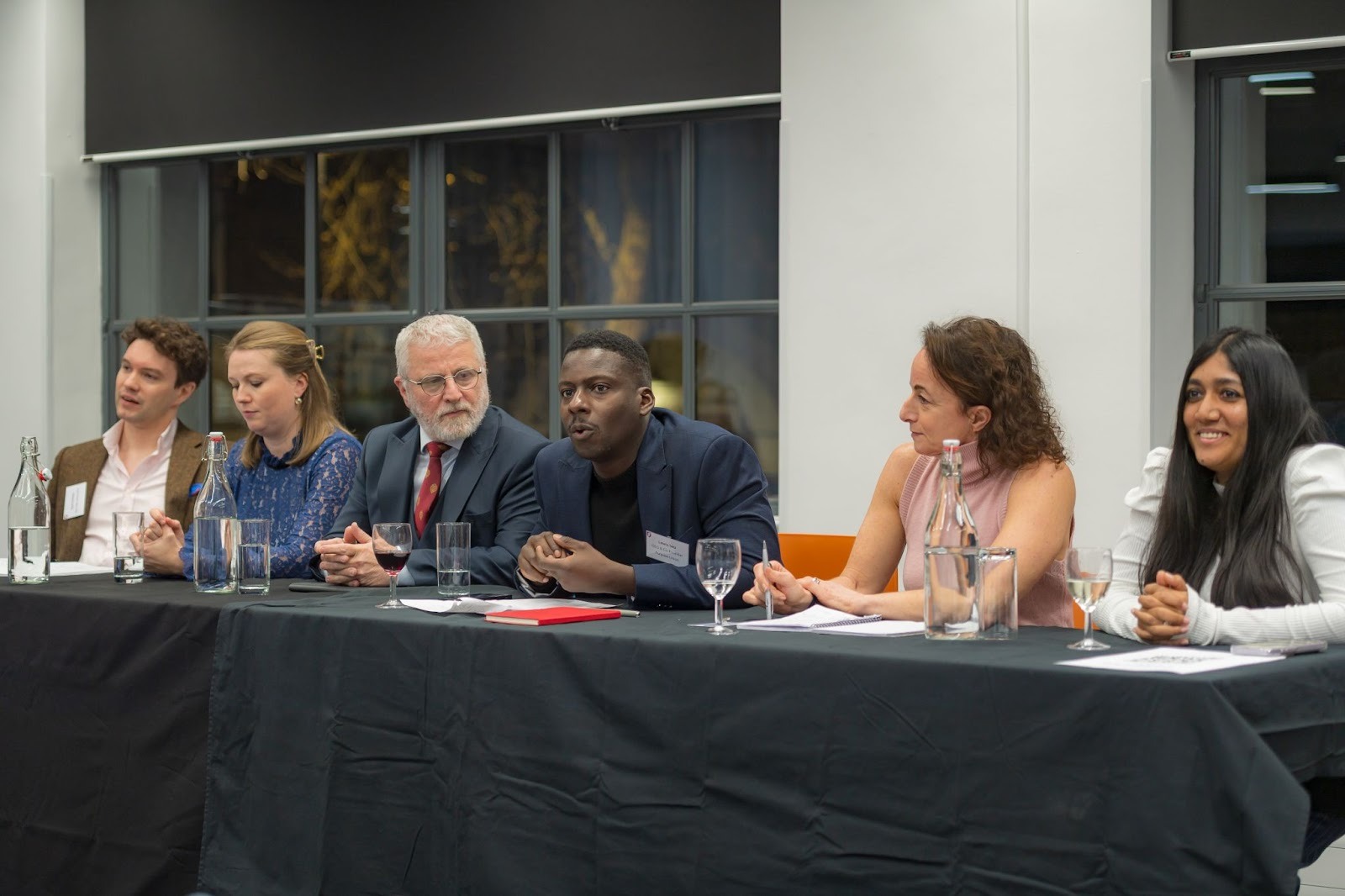
The final discussion centered on the social, political, and economic systems that online hate operates within. Platforms are not passive hosts, panelists said; they are active participants in an ecosystem where outrage drives engagement, and engagement drives revenue.
The panel rejected simplistic solutions. Hate does not affect all groups equally, they said, and responses must reflect structural inequalities.
From Insight to Action
The symposium revealed that online hate is systemic—embedded in platforms, politics, and profit. The response, then, must also be a coordinated effort across institutions, sectors, and societies.
Fordham, said Davidson, “is committed to moving the needle, transforming awareness into the decisive, collective action required to safeguard human dignity and protect those vulnerable in our digital world.”
—Written by Bamo Nouri with additional reporting by Nicole Davis
