


After fluctuating for several years, progress in combating extreme poverty worldwide has largely stalled, according to the 10th annual Fordham Pope Francis Global Poverty Index.
Compiled by students in Fordham’s Graduate Program in International Political Economy and Development (IPED), the index shows that for the third consecutive year, the global poverty gap stands at 25.5%. The flattening follows a modest recovery in 2023 that began after pandemic-related reversals.
Poverty Indicators
The poverty gap, which represents the percentage of the global population lacking access to basic needs, is a key part of the index launched by Fordham in 2016. The report relies on seven measures of global poverty: access to water, housing, food, employment, education, gender equity, and religious freedom.
The index was inspired by a 2015 address to the United Nations General Assembly in which Pope Francis cited these needs as fundamental to human dignity.
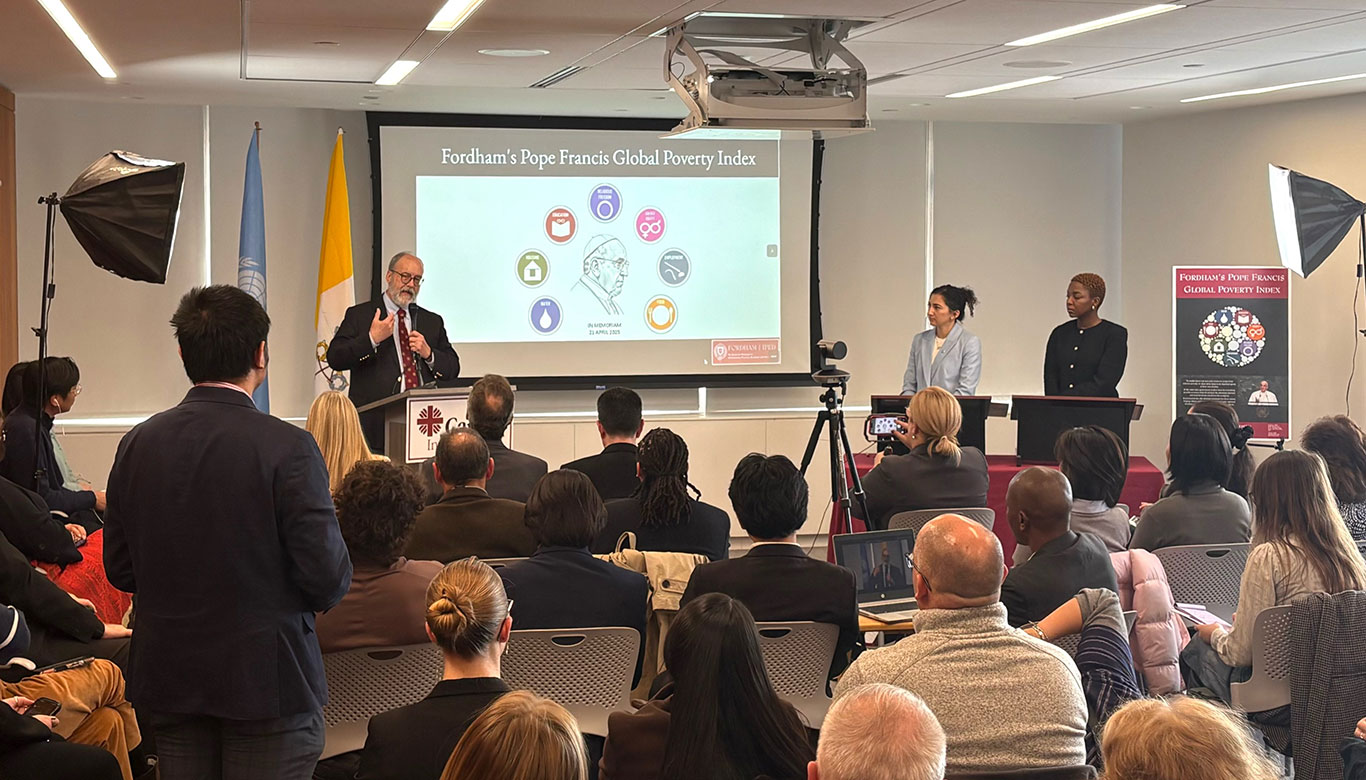
Food Security and Religious Freedom Slipping
The indicators showing the greatest areas of concern in this year’s report were food insecurity and religious freedom. The most recent statistics indicate that in 2022, 9.1% of the global population—an estimated 730 million people—were undernourished, up from 8.9% the previous year. Fifty-nine percent of the population—more than 4.7 billion people—lived under regimes that severely limit religious expression, up from 58.4%.
The losses in these areas were offset by modest gains in access to drinking water, education, and employment, according to statistics collected between 2022 and 2024.
IPED Director Henry Schwalbenberg, PhD, stated that both hunger and a lack of religious freedom were major concerns for Pope Francis.
“At a fundamental level, they go hand in hand,” he said. “One is measuring a shackle of poverty. The other measures the things that enable them to break those shackles and take charge of their own lives, like religious freedom and civil liberties. Pope Francis connected these elements because you need one to deal with the other.”
The Need for International Cooperation
Schwalbenberg said he’s concerned that global poverty has receded from the public consciousness, with wealthy nations distracted by wars in Ukraine and Gaza and focused more on themselves and less on global needs.
“We’re in the same situation Franklin Roosevelt was at the end of World War II when he was trying to argue for the U.N. and international collaboration,” he said. “The idea was ‘We don’t want this war to ever happen again, so we need to build up structures of international cooperation and foreign aid.’”
Honoring Pope Francis
Schwalbenberg said this year’s report, which was assembled by nine master’s students over the course of the spring semester and reviewed over the summer by IPED staff, is notable because it’s the 10th anniversary of the index and the first to come out since Pope Francis’ death in April.
He compared the nations of the world to families living in one neighborhood, and said he hoped the results of the index would spur them to act accordingly.
“Think of a family that only thinks about itself and doesn’t care about anyone else. They go nowhere,” he said. “It’s the ones that are a little more altruistic and look out for other people on the block who are more prominent and successful.”
