


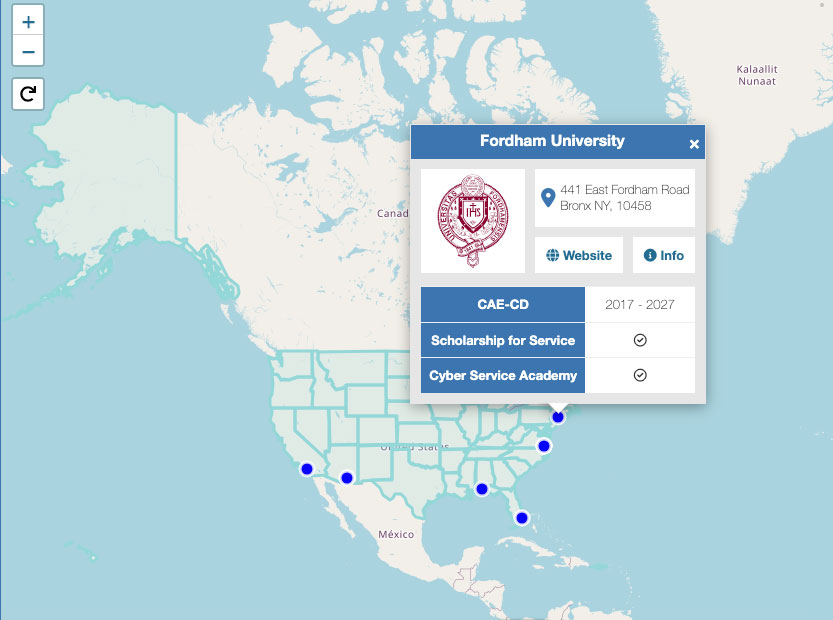
Fordham has been designated by the National Security Agency to be one of the country’s seven National Centers of Academic Excellence in cyber AI.
With the designation, the University joins six other universities nationwide. It’s the third academic designation the NSA has conferred on Fordham.
A Competitive Edge in the Job Market
Thaier Hayajneh, Ph.D., director of Fordham’s Center for Cybersecurity, said the new designation will carry significant weight in the job market for graduates of Fordham’s cybersecurity programs. Fordham students will receive preferential treatment from the federal government, he said, adding that the designation is also appealing to private sector employers.
“The CAE designation is a testament to our students’ qualifications,” he said.
He said the NSA’s creation of the new designation demonstrates how AI and cybersecurity are now inseparable.
That’s because the technology known as generative AI has dramatically accelerated cyber threats. A hacker who was previously attempting to find weaknesses in a computer system might have been able to scan 1,000 ports, or entry points, into the system in a minute. With AI, that number has increased to 1 million per minute.
“If you don’t use AI in your defense, you’ll never be able to catch up to the speed of these hackers,” Hayajneh said.
Cutting Edge Classes and Research
Hayajneh said one of the reasons Fordham was chosen is that it offers multiple ways to pursue the field, including a master’s degree in cybersecurity, a minor in cybersecurity, and a new advanced certificate in artificial intelligence for cybersecurity.
Students can take innovative classes such as Data Science for Cybersecurity, Artificial Intelligence for Cybersecurity, and Secure AI, which was offered for the first time last year. They take these classes with faculty who are engaged in cutting-edge research into the ways AI can be used for cybersecurity.
This is how Fordham graduates will succeed in a rapidly evolving cybersecurity field, Hayajneh said, where AI touches every part of data protection efforts and could reduce the number of available jobs.
“The way [cybersecurity professionals]do open testing, the way we do intrusion detection, the way we protect our digital assets like our networks and information, will be way more efficient with AI,” he said.
“If big companies needed 20 cyber analysts in one room in the past, now they need four or five who are leveraging AI like their own assistants.”
A Strong Partnership
When the NSA began work last year on creating its new AI-focused designation, Fordham was among the experts in academia it consulted, along with those from the government and the private sector.
It’s one of many ways Fordham has partnered with the federal government in the area of cybersecurity. In 2009, it co-hosted the first International Cyber Security Conference (ICCS) with the FBI. The University has continued to host the conference every 18 months, including last July. That partnership has been strengthened through many collaborations and grants over the years, including a grant to fund teaching tools and a $4.1 million grant for scholarships for students who commit to work for the federal government after graduation.
