During her annual State of the University address, President Tania Tetlow framed the University’s future around a central challenge: how to prepare students for a world being rapidly reshaped by artificial intelligence and profound social change.
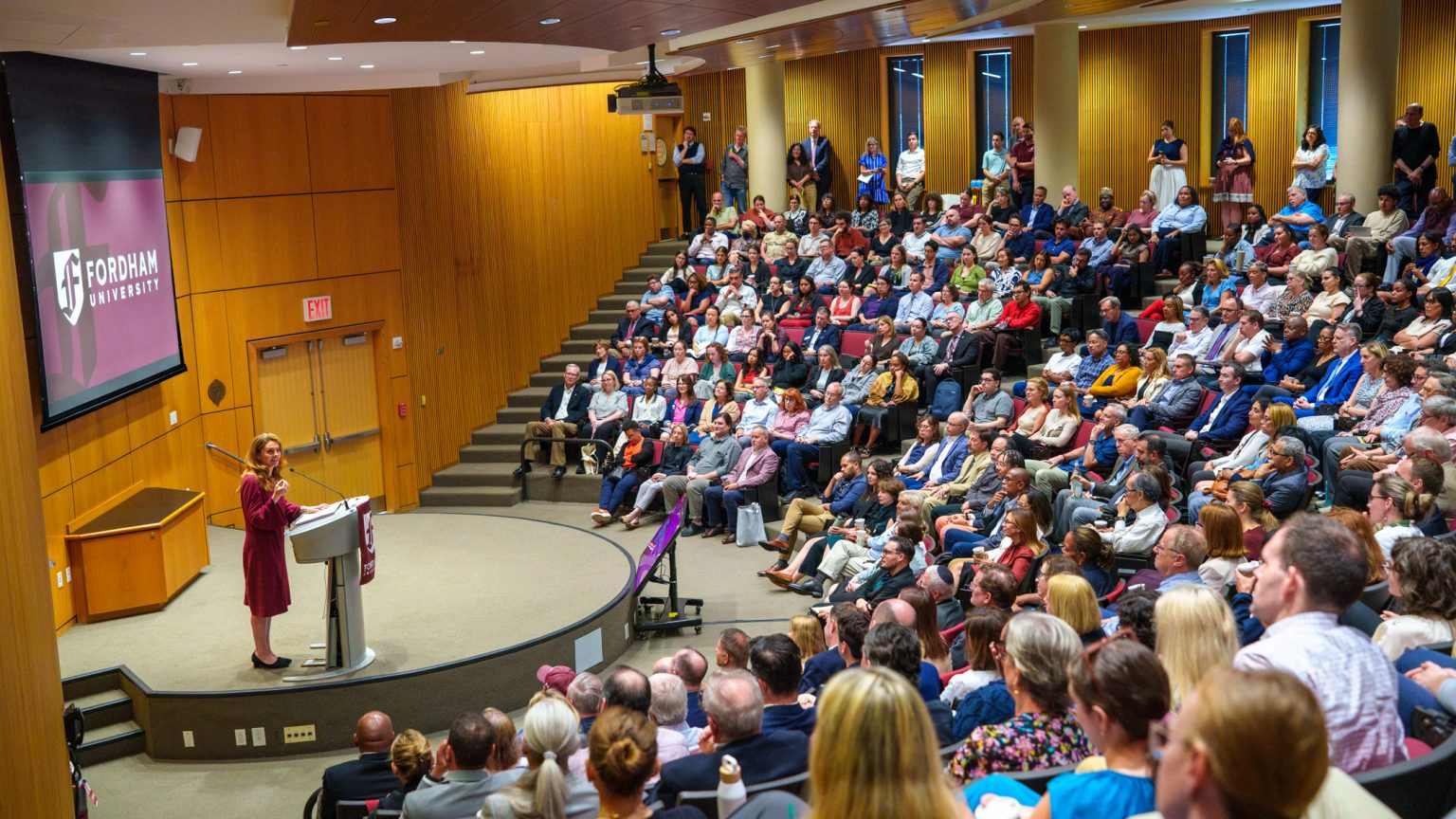
Speaking to the Fordham community in the McNally Amphitheatre on Sept. 17, Tetlow acknowledged the uncertainty facing humanity while noting that the University’s Jesuit values give Fordham an important role to play in what comes next.
Preparing Students for an Age of AI
Tetlow devoted much of her address to the opportunities and risks presented by artificial intelligence. She emphasized that Fordham should not cling to the past as the future barrels toward us, but rather face what is coming and prepare for it.
She said she’s been reading history books for inspiration, particularly stories of people who were forced to face difficult realities and make hard choices.
“The first act of heroism is not what you’d expect. It starts with the willingness to see what is coming and resist the temptation of denial,” said Tetlow. “Let’s be the university with the courage to look at the future with clear eyes and get ready.”
She noted that AI has the potential to transform professions and alter the future of work, but said Fordham should respond by emphasizing qualities that technology cannot easily replicate, like critical thinking, creativity, emotional intelligence, resilience, and ethical judgment. She said these longstanding pillars of a Fordham education are becoming increasingly important, and emphasized the role of the humanities in developing those abilities.
“We build empathy by asking [our students]to walk in the shoes of characters in novels and plays … We reinforce values as we examine history honestly,” said Tetlow. “We ask profound questions in every subject—What is justice? Who created us and what do we owe our creator? Why do we matter?” Tetlow said.
Fordham reinforces its values not only with our students, she said, but with the world at large, especially because of our platform in NYC. “We trumpet our collective moral voice from a university that sits in the center of the global economy, walking distance from the United Nations,” she said, noting that in two weeks, Professor Stephen Grimm will be bringing together a conference on Ignatian AI, to be held at Fordham.
A University Ready to Change
Tetlow also addressed the pressures facing Fordham and higher education more broadly, including demographic changes, financial pressures, changing patterns of enrollment, and uncertainty surrounding federal support for higher education. “Fordham has been able to absorb these hits without feeling them as keenly as most of our colleagues across higher ed,” she said, but noted the University must stay vigilant and be open to change.
She asked the community to imagine looking back from 2031. “What will we wish we had done today?” she asked.
Tetlow described Fordham as a large institution that cannot change course overnight, but said every member of the community can contribute to making the University more responsive. She highlighted efforts already underway to use data more effectively, reorganize units, improve technology systems, test new approaches, and break down organizational silos.
She also called for a willingness to let go of practices simply because they have always been done a certain way.
“Let’s fight for our mission,” Tetlow said. “To do that well, we’ll have to let go of our attachment to the way we’ve always done things.”
Grounded in Jesuit Values
Throughout the address, Tetlow returned to Fordham’s Jesuit and Catholic identity as a source of direction amid uncertainty, describing the University’s mission as centered on human dignity, wisdom, discernment, service, and the formation of students who can contribute meaningfully to the world.
That mission, she said, also requires a stronger sense of community across Fordham’s campuses and schools. She emphasized the importance of assuming good intentions, listening, and learning from mistakes.
She also called on members of the Fordham community to maintain hope and to create it for the students in their care, drawing a distinction between hope and optimism.
“Optimism is a state of mind, a guess at how the world will turn out. This is a difficult moment to be optimistic and perhaps a dangerous moment,” said Tetlow. “But hope is the work we do to make the world a better place. Fordham, we have the gift of the work of hope right in front of us. We have the opportunity to matter.”