

Fordham University has launched a new research hub to get professors from different specialties working together on tough problems facing society.
The Transdisciplinary Research Incubator brings together faculty and students from diverse fields of study to work on innovative research projects in areas such as biodiversity, artificial intelligence, migration, criminal justice, and more.
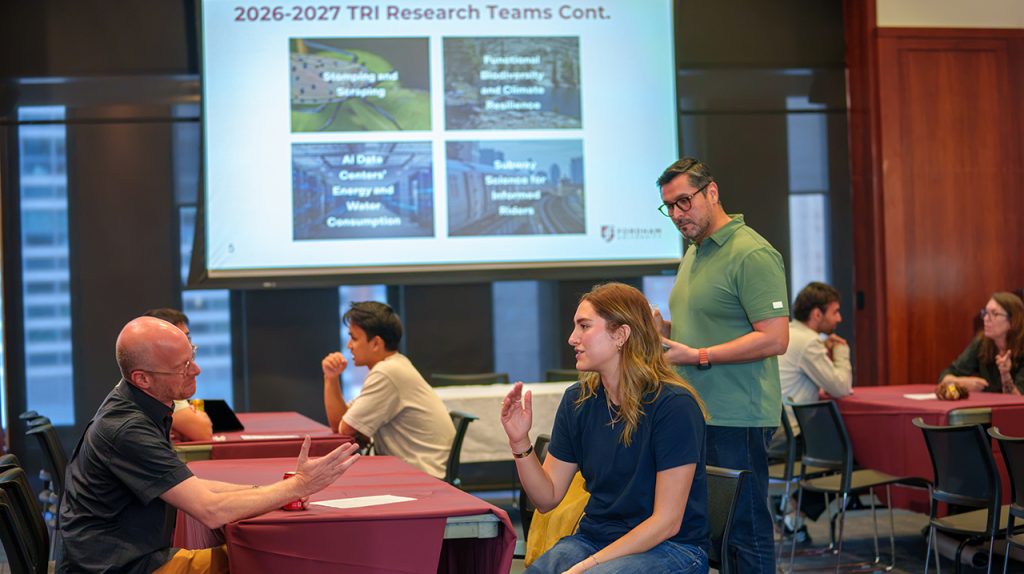
At an on-campus launch event on Sept. 10, professors explained their projects and fielded questions from interested students. Students—undergraduate and graduate—can apply to participate in one of the eight research projects; applications are due this Friday, Sept. 18.
The incubator is key to Fordham’s strategic priority of promoting more research across disciplines, said KerryAnn O’Meara, PhD, Fordham’s provost and senior vice president for academic affairs.
Meeting Complex Challenges
“As a society, we face the kind of complex challenges that require experts across academic fields to collaborate and pool their expertise,” said O’Meara. “Innovation has always happened at the intersection of different disciplines. The Transdisciplinary Research Incubator will engage teams of faculty and students in creative thinking and problem-solving. I am excited to see what these teams develop and build together.”
One project, Functional Biodiversity and Climate Resilience, is focused on biodiversity and climate change—specifically, chipmunks who play a key role in the health of Lake Tahoe forests. The project brings biology, economics, law, and communications professors together to examine the biological aspects but other issues too—like updating laws to reflect new science and helping the public understand the species’ value.
No More ‘Ships Passing in the Night’
More of this type of research is needed so experts have a shared understanding of an issue, said one of the faculty members on that project, biology professor Evon Hekkala, PhD. “It’s hard to move something forward if all the different people understand it in a different way and they’re not talking to each other,” as if they’re “ships passing in the night,” she said at the launch event.
Their project, she said, “allows people to sort of look behind the curtain into the natural world, but also how that natural world links to all these goods and services that are really important to us in all different aspects of our lives.”
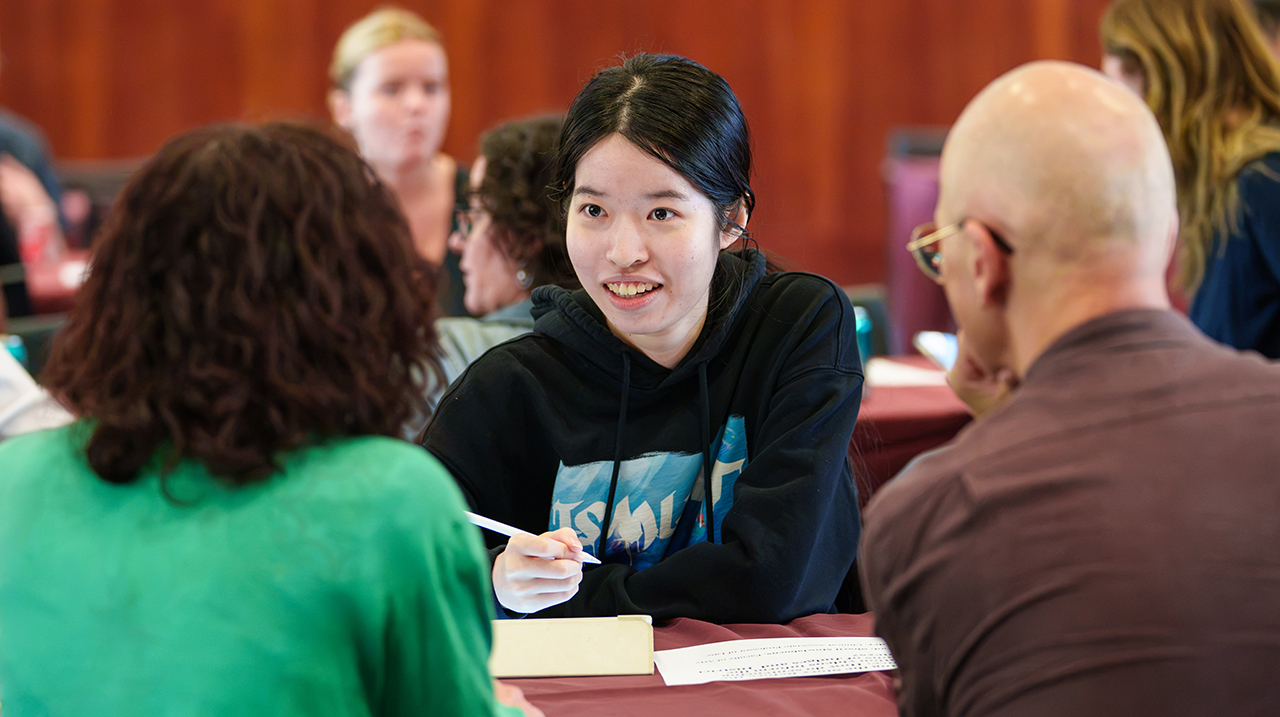
A junior majoring in natural science, Eva Markan, appreciated being able to meet face-to-face with professors and learn about research opportunities. She liked that they involve different disciplines, because “it helps you expand past your major,” she said.
‘Fascinating’ Research
The research incubator is supported by a gift from investor and finance executive Peter Zangari ’89, an instructor at the Gabelli School of Business and at Fordham College at Lincoln Center who is participating in one of the projects. The projects are meant to mix different levels of students, with graduate students mentoring undergraduates, said Beth Semaya, PhD, associate provost for graduate programs. Students chosen for the projects will receive stipends. (First-year undergraduate students aren’t eligible to apply.)
A senior majoring in international studies and aiming for law school, Ana Gonzalez, showed up to explore the projects. “It’s so much innovation,” said Gonzalez, who planned to apply for one project she found “absolutely fascinating.”
That project, Putting the Story Before the Sentence, involves communications and law professors as well as the New York Legal Aid Society, judges, prosecutors, and video producers. The team is studying the effects of videos about criminal defendants’ personal backgrounds that are sometimes played in court to show mitigating factors—like trauma or mental health troubles—during sentencing.
“Anecdotally, it’s really powerful” when prosecutors or judges see these, but “there’s not a single piece of research that exists about it,” said one of the team members, communications professor Sharif Mowlabocus, PhD.
Societal Impacts of Communication and Technology
Other projects focused on topics including the societal impacts of technology and mass communication of science:
Math Learning and Teaching with Generative AI: Faculty in business, computer science, and psychology will examine the effectiveness of immediate, personalized feedback provided by AI tools during math instruction.
The Language Justice Lab: Psychology and languages faculty, along with Fordham Law School’s Feerick Center for Social Justice, will run a pilot project on addressing the shortage of qualified translators and interpreters in legal and clinical services.
AI Data Centers’ Energy and Water Consumption: Economics and law professors will examine policy solutions to the environmental and social effects of data centers that support generative AI.
Co-Designing the Migrant Accompaniment Lab: This project will develop a holistic model for supporting migrants by drawing on faculty expertise in political science, theology, natural science, communications, and languages and cultures.
Stomping and Scraping: Professors in communications and natural science will study how information about controlling spotted lanternfly populations has been communicated to, and interpreted by, the public.
Subway Science for Informed Riders: Professors of education and social work, along with the director of Quinn Library, will create research-backed public service messages, to be posted in New York City subway cars, about how digital media affects young people’s development.
More detailed information on all eight projects can be found on the Transdisciplinary Research Incubator webpage.
