

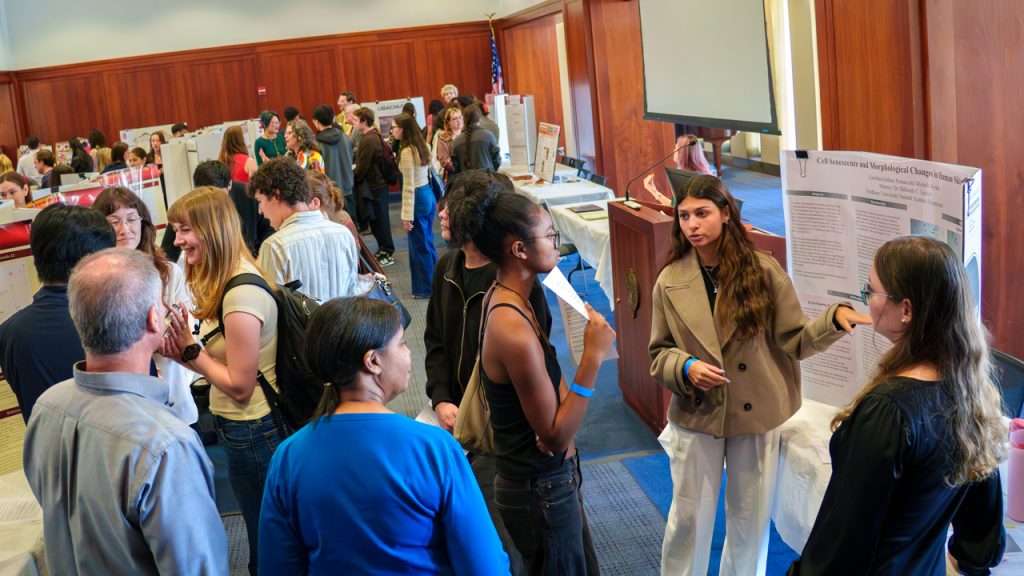
Students at Fordham’s campuses put their curiosity on display at two undergraduate research fairs this month, showcasing their explorations of everything from the power of art to the workings of the human mind, the natural world, neglected history, and the challenges posed by AI. Many were supported by research grants from Fordham. And many were just getting warmed up, preparing to launch careers related to their projects.
Tracking the ManhattAnt from NYC to Europe
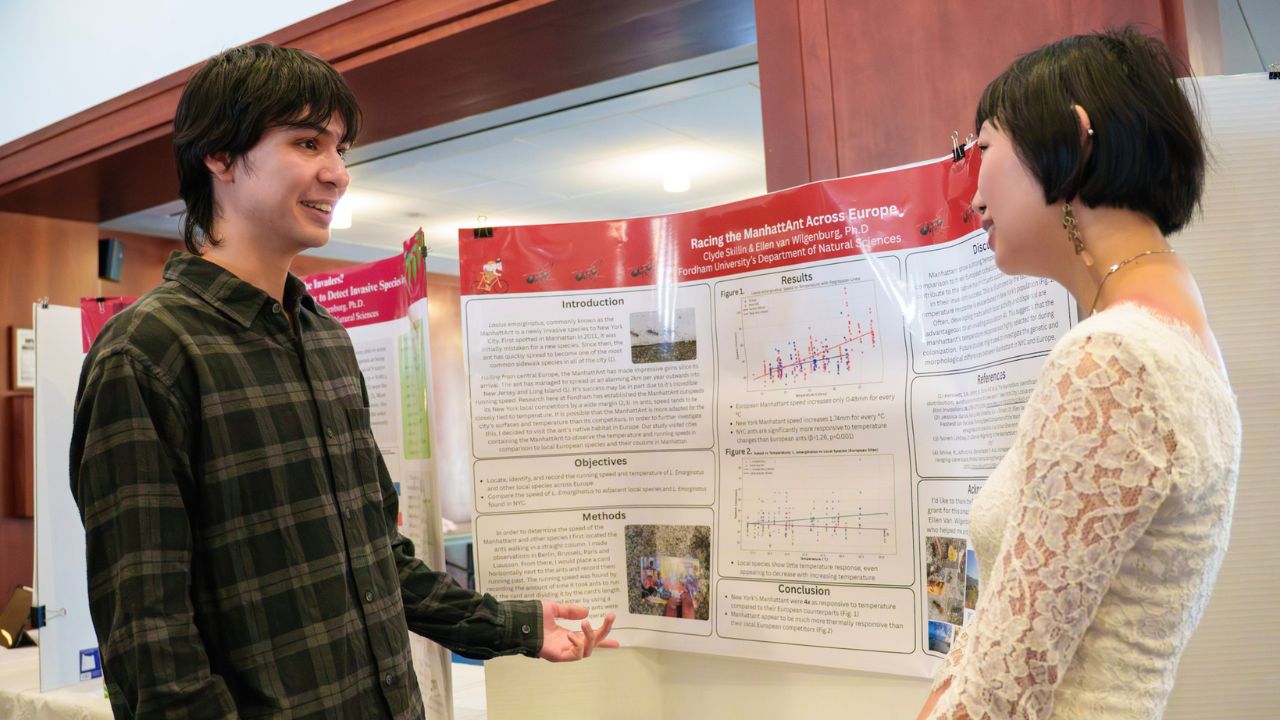
Seniors Soren Lindsay and Clyde Skillin, both natural science majors, researched a tiny invasive insect: the “ManhattAnt,” a species that has rapidly spread across New York City since it was first spotted by biologists there in 2012.
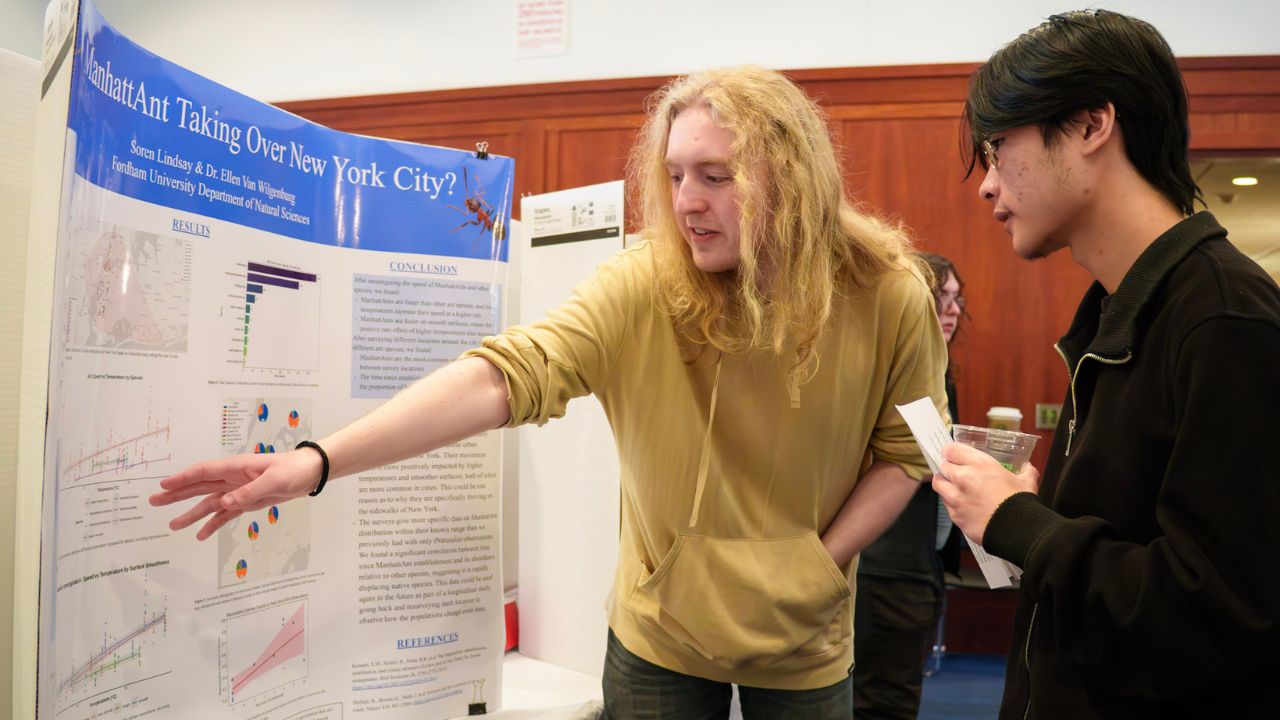
Lindsay spent months observing ManhattAnt colonies in the city, measuring their speed at different temperatures and on different surfaces. Meanwhile, Skillin spent two months biking around Europe, collecting the same data for the ant species in cities like Berlin, Brussels, and Paris.
They found that the ManhattAnts’ speed was four times more responsive to heat than their European counterparts, causing the insects to move significantly faster at higher temperatures.
“They’ve only been in New York for a little over 10 years, so for there to be such a great distinction in that short span of time is really impressive,” Skillin said at the ARS Nova showcase at the Lincoln Center campus on April 23.
As they prepare to graduate, Lindsay is considering medical school and Skillin is planning to enter a physician assistant program.
Dancing ‘In, Out, and Around’
Seniors Alaire Galloway and Beatrice Miller, students in the Ailey/Fordham BFA program, collaborated on In, Out, and Around, a performance blending dance, animation, and text, with music by 2025 graduate Valerie Tauro. Presented at ARS Nova, the project was supported by the FCLC Dean’s Senior Thesis and Capstone Project Grant.
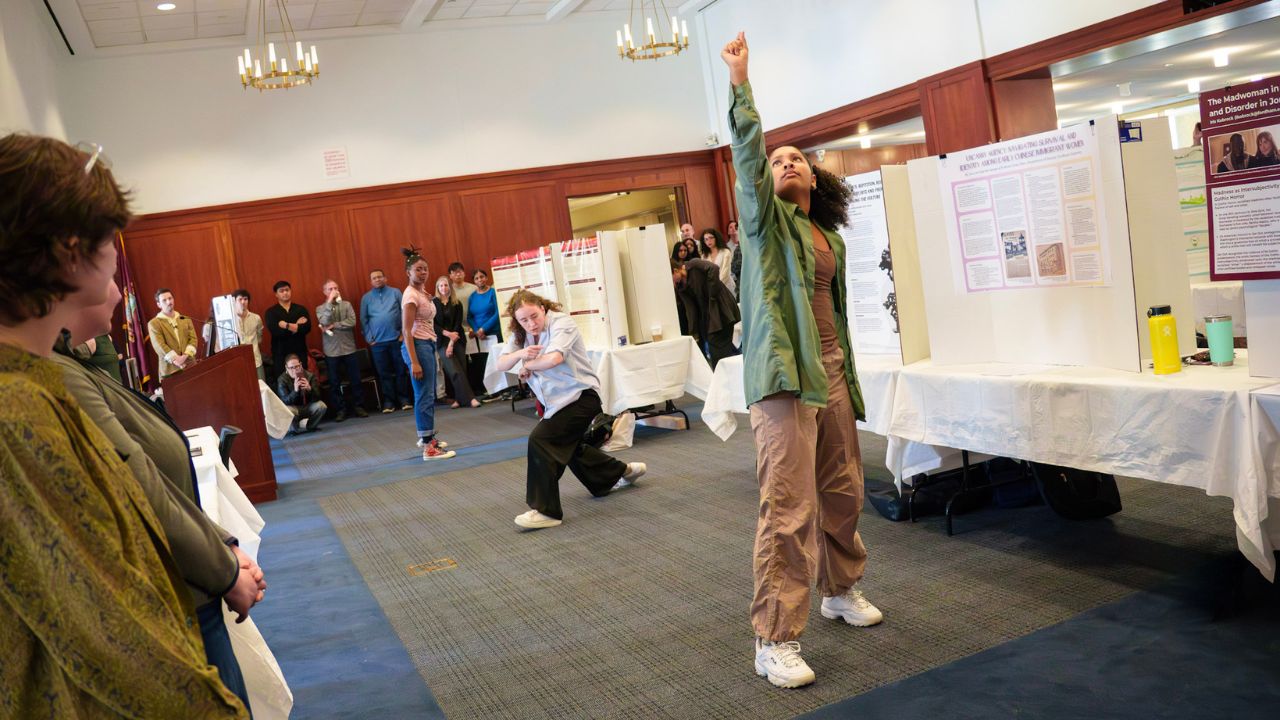
Galloway, double-majoring in dance and design and technology, developed the work’s stop-motion animation and visual aesthetic. Miller, a dance major and music minor, shaped its structure and narrative. Together, they created a looping universe inhabited by archetypal characters, each grappling with their different fears in the same repeating reality.
A group of Ailey/Fordham students performed the piece at the ARS Nova research fair.
The play creates “something physical to explain something you can’t touch,” said Miller, adding that she drew upon existential philosophy for inspiration. “Sometimes we can explain the unexplainable by embodying it, through touch and through physical movement, which is why dance is so important.”
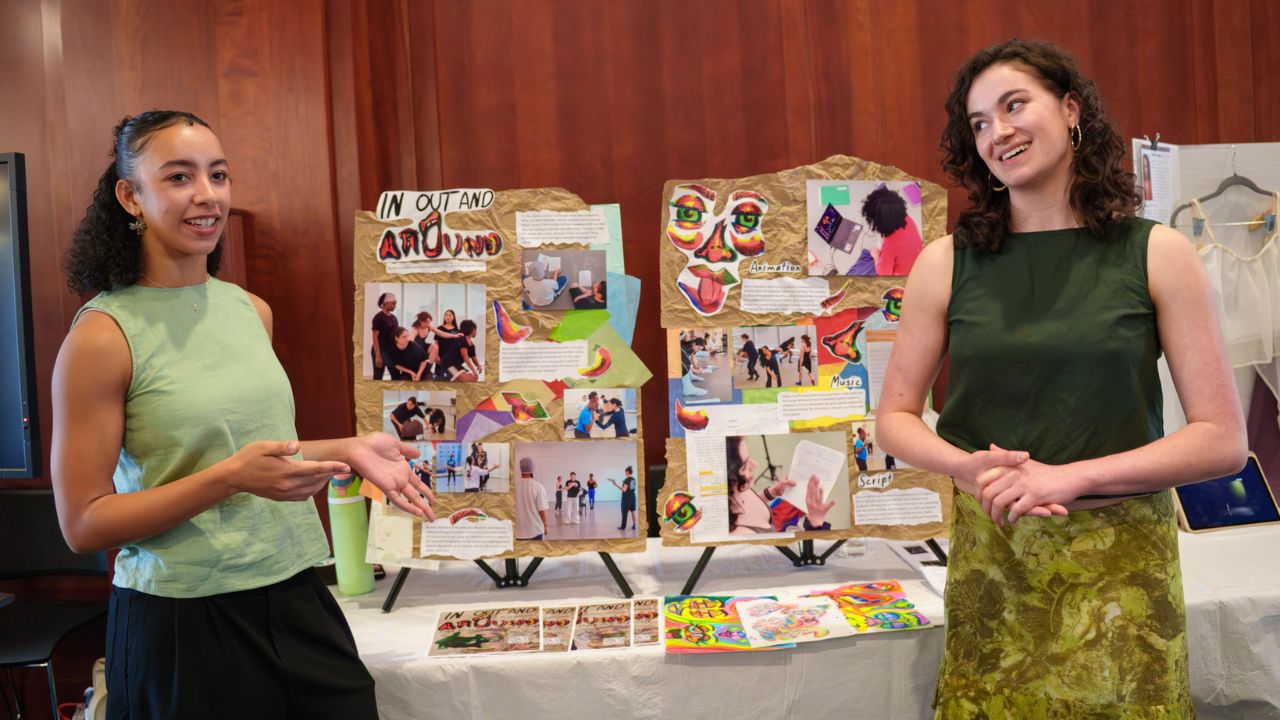
After graduation, Galloway hopes to launch a collaborative artist collective with other members of her Ailey/Fordham class. Miller plans to audition for dance companies and pursue fellowships and research.
Uncovering Chinese Women’s History
Eva Lee, a junior majoring in international political economy, researched the history of Chinese women who immigrated to the United States during the Gold Rush era, an overlooked group whose experiences have largely been told through secondhand accounts. Her research was supported by the Dean’s Undergraduate Research and Creative Practice Grant.
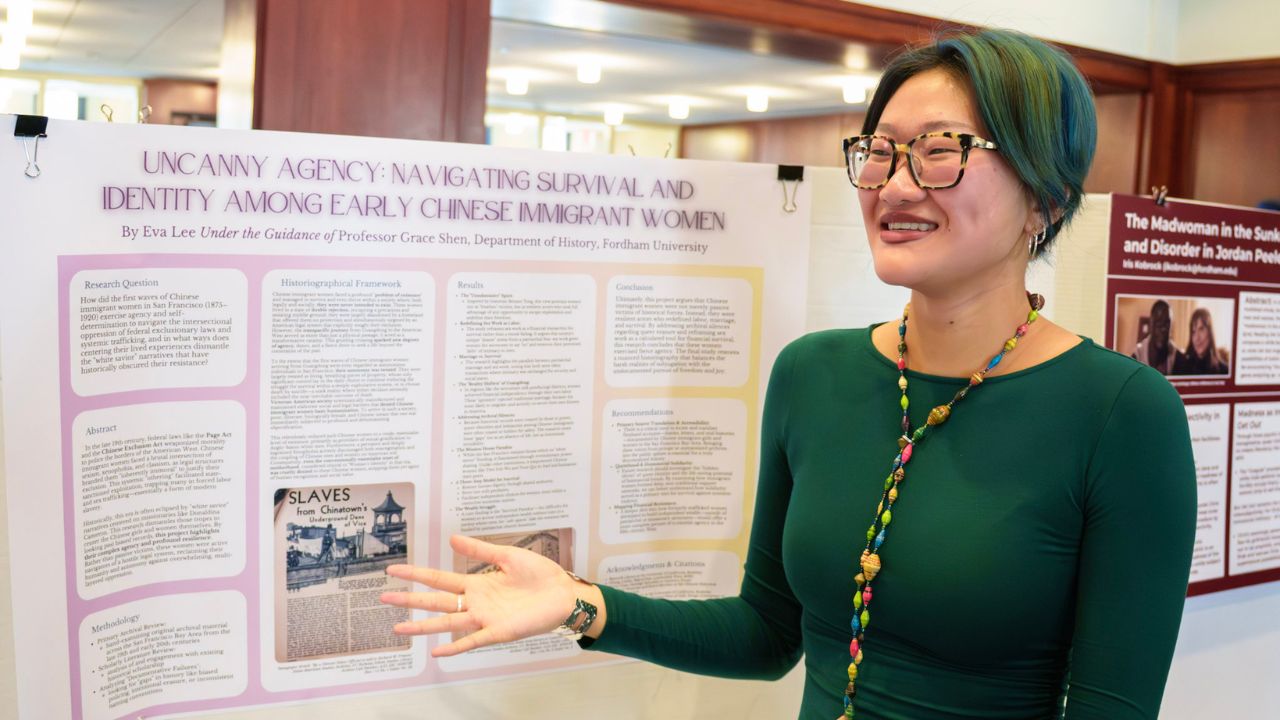
Lee examined what life might have looked like for these women, including the few paths open to them—from forced prostitution, to marriage, to refuge in Protestant mission homes. She investigated how these women have been portrayed in culture, and how they were impacted by laws like the Page Act of 1875, which restricted their immigration and cast them as “immoral.”
“There is so much more recovering of firsthand accounts that needs to be done,” Lee said at ARS Nova. “These women and girls were mostly illiterate, so they could not record their own stories.”
Exploring Human Perception of AI-Generated Images
Nicolas Savino, a senior majoring in psychology with a computer science minor, studied the human tendencies and biases that come into play when people are trying to determine whether an image is real or generated by AI. He and his two co-authors—fellow student Patch Shields, a junior, and Fordham graduate Emre Kuraner—also examined people’s ability to tell the difference. They presented their findings at the Fordham College at Rose Hill Undergraduate Research Symposium on April 29.
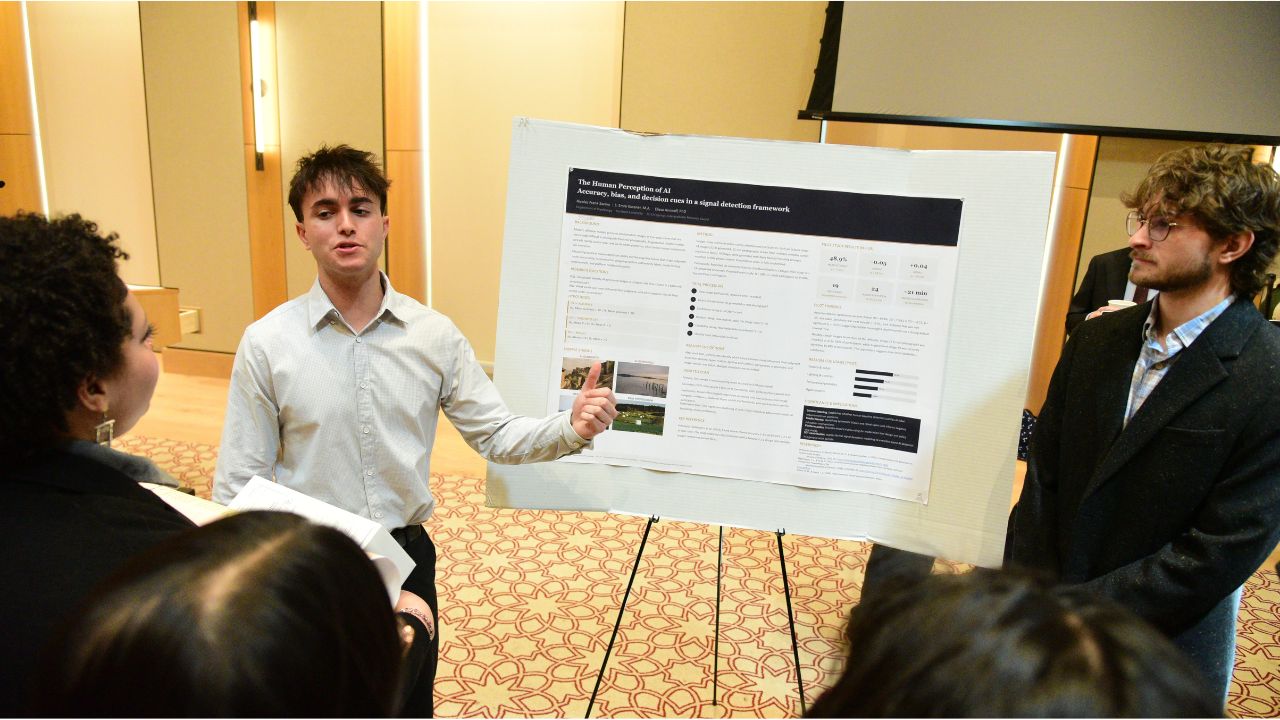
They showed people dozens of images, both fake and real, and found they guessed right only about half the time. They also found that in making their call, people were swayed less by a photo’s polished, hyperrealistic appearance and more by its level of texture and detail. “[That] was interesting to me because I thought it would be the other way around,” Savino said.
They also measured participants’ confidence in their guesses. They’re planning a follow-up study, hoping to publish research that could inform media literacy efforts. As models improve, “it’s more difficult for people to tell what’s AI and what’s not,” Savino said. After graduation, he plans to earn a doctorate and an officer’s commission so he can be a clinical psychologist in the U.S. military.
Pointing the Way to New Treatments for Alzheimer’s, Schizophrenia
Olivia Lanford, a senior, presented a study that brought her computer science major and biology minor together to show how a particular brain receptor is important for separating similar experiences into distinct memories.
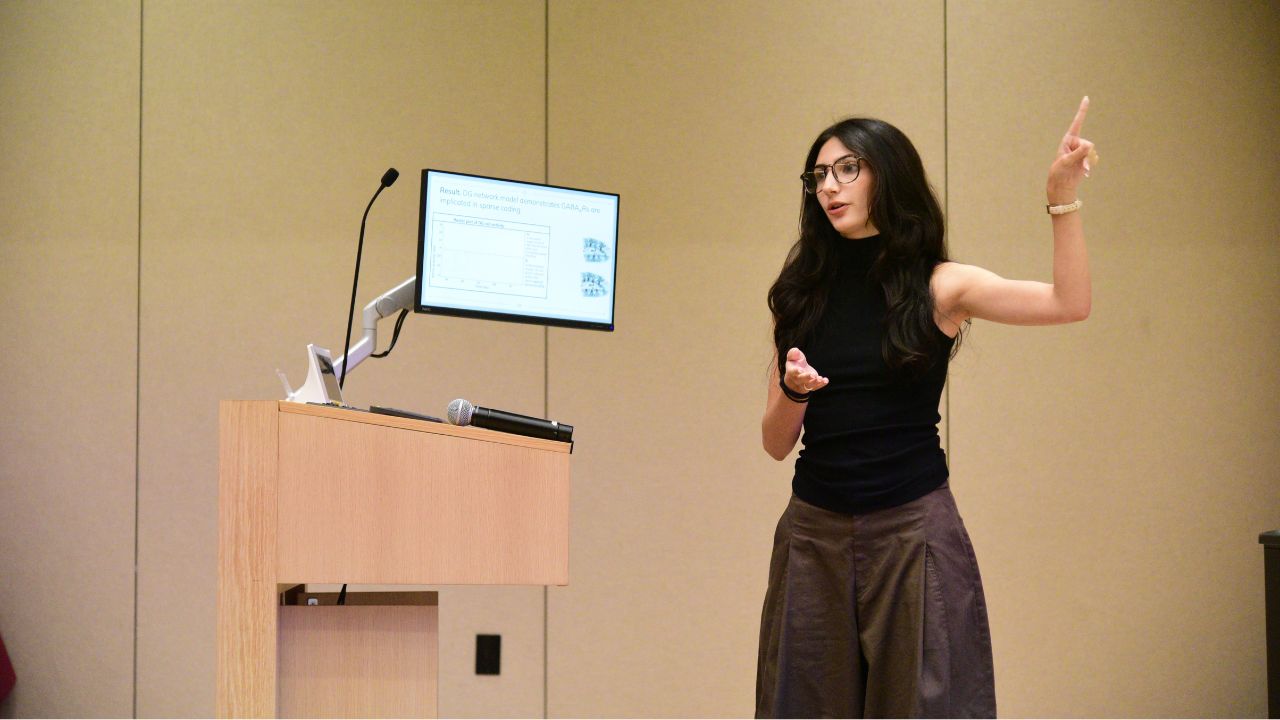
An example, she said, is a child distinguishing between things that happened at two similar settings—a playground and an amusement park. This is the kind of computational work “our brains do all the time that we aren’t really aware of,” she said at the Rose Hill symposium.
Memory separation is impaired in people with schizophrenia, Alzheimer’s disease, epilepsy, and other disorders, and greater understanding of the brain receptor she studied can help with developing new therapies, she said. In the fall, she’ll be pursuing a doctorate in neuroscience at Mount Sinai’s Icahn School of Medicine.
A New Approach to Body Dysmorphic Disorder
Anna Joszczyk, a junior with a biology major and philosophy minor, presented research at the Rose Hill event that grew out of one of her classes, Philosophy of Imagination.
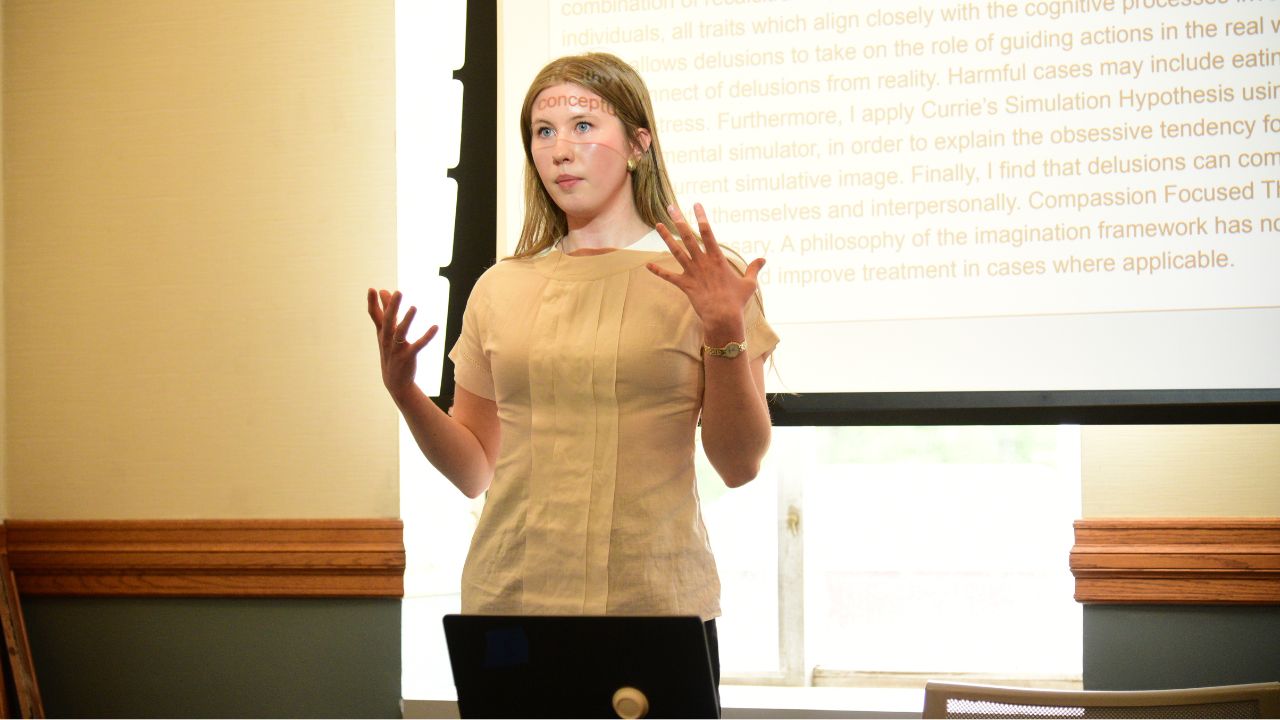
She proposed to augment the medical definition for body dysmorphic disorder, or preoccupation with perceived defects in one’s appearance: Rather than calling the perceived defects “imaginary,” she said, they are better defined as delusions, or mistaken beliefs about oneself.
This view could open the door to compassion-focused therapy, which is focused on “[rebuilding] the empathy within the individual so they can help themselves, reframe their mindset, and reframe their perspective about how they see themselves,” she said.
By Chris Gosier and Alex Williamson
