


An event at Fordham highlighted the opportunities that artificial intelligence presents for society—as well as environmental concerns that must be addressed, experts said, as AI scales up nationwide.
“Obviously, there’s lots of technological innovation and potential associated with AI, but I think this is an important trade-off for us to think about,” said Fordham economics professor Marc Conte, Ph.D.
He was one presenter at the event, which highlighted the benefits of AI and ways to avoid the potential pitfalls for organizations and communities. The Symposium on Responsible AI took place at Fordham on Oct. 16 and 17, co-sponsored with IBM, New York University, and the AI Alliance, of which Fordham is a member.
Growth of Data Centers
Conte noted that data centers are projected to drive a massive increase in energy demand over the next decade—and that connecting new sources to the grid is a notoriously slow process.
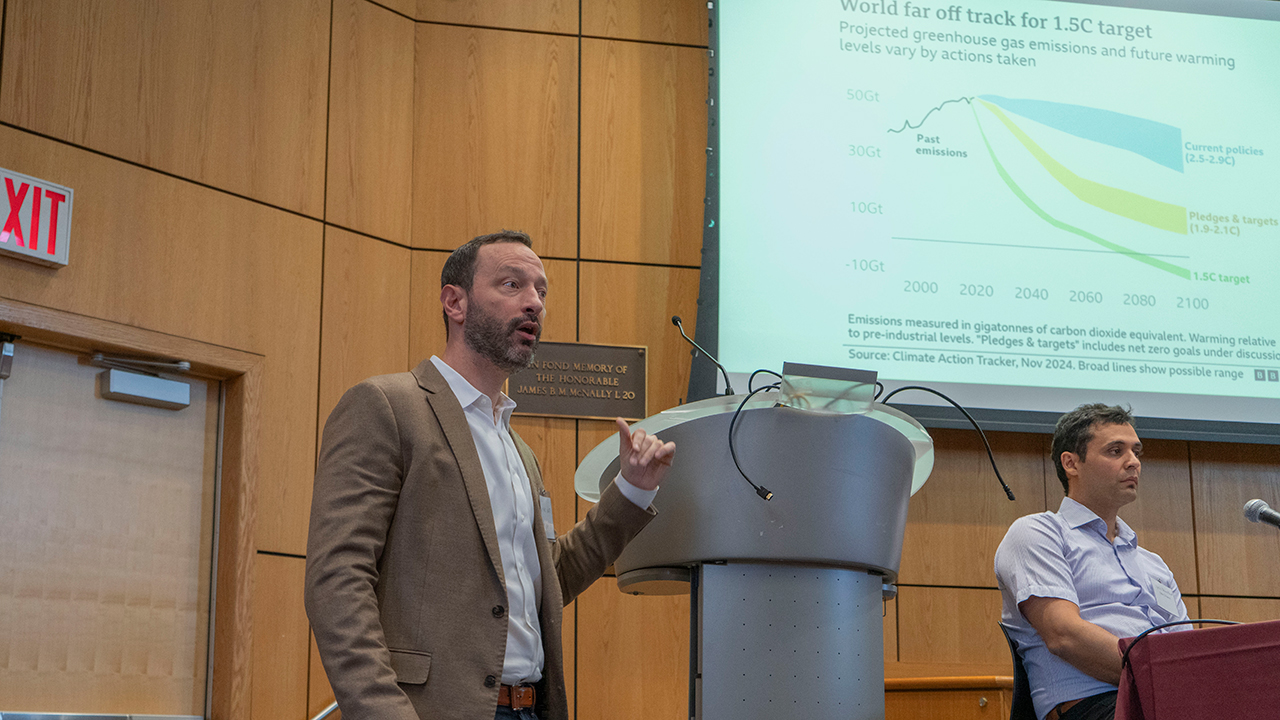
Because of their need for consistent power, any dips in the supply from the electrical grid could prompt data centers to use their on-site backup sources—which tend to rely on fossil fuels, Conte said.
“There is a need to pretty dramatically change behavior in our systems” in order to restrain the growth of greenhouse gas emissions, he said, citing a shift toward sustainable energy as one solution.
Another presenter, Fordham economics lecturer Giacomo Santangelo, Ph.D., noted that the infrastructure for new technologies tends to be built in lower-income areas—in the case of data centers, bringing environmental harms such as heat island effects and degraded air and water quality. “The environmental costs are socialized to local communities, while benefits are privatized somewhere else,” he said.
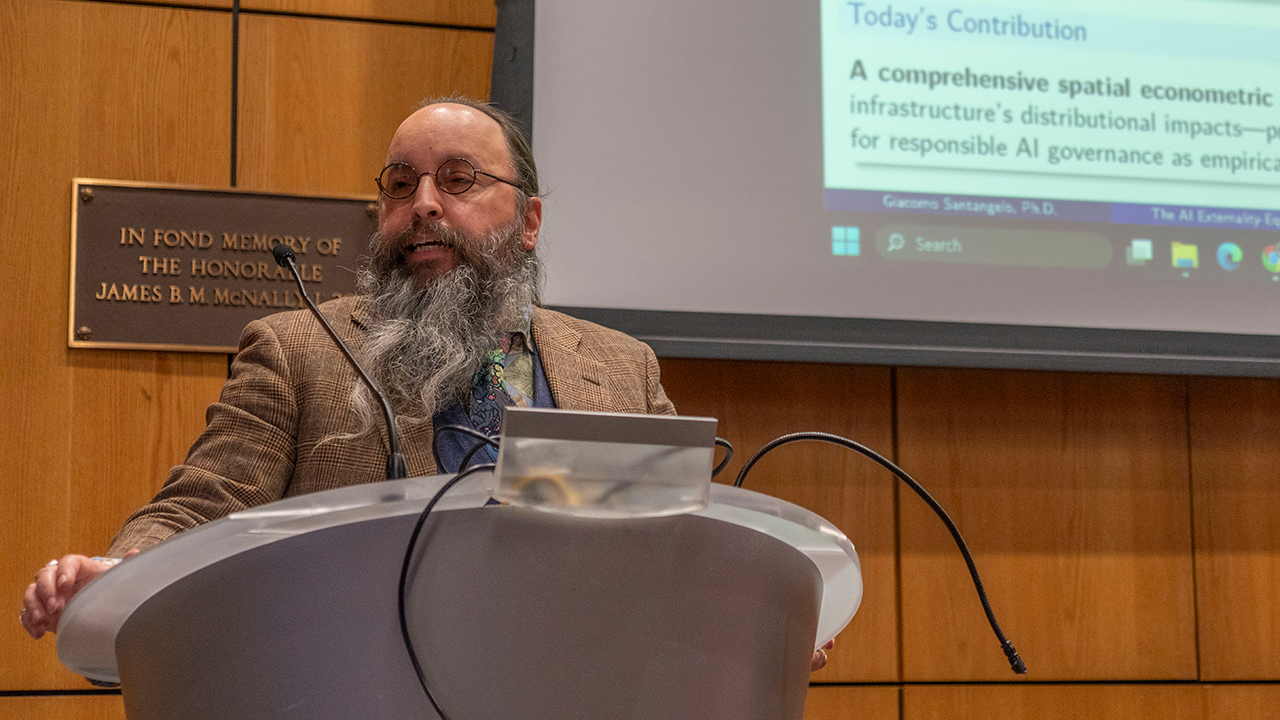
He said he’s devising an economic framework to guide policy makers as they seek to address these inequities. History offers incentives, he said—“[it] teaches that the technological revolutions that don’t address distributional consequences generate political backlash and social instability.”
‘Unimaginable Pace of Change’
The AI Alliance is devoted to open collaborations that create better AI systems—ones that protect privacy, avoid baked-in biases, and help with challenging projects like better climate models or drug development processes.
In prerecorded remarks that kicked off the event, Fordham President Tania Tetlow noted the “unimaginable pace of change, an exponential growth in the capacity of technology.”
“In so many ways, AI is a world-changing tool for good,” she said. “But it is also a tool with unintended consequences that are the stuff of science fiction.” Proposing ethical boundaries for AI and finding ways to enforce them “has never been more crucial and more urgent,” she said.
The alliance seeks to ensure that every person or business can control and customize AI systems as they want, according to a presentation by Anthony Annunziata, director of AI open innovation at IBM and co-founder of the AI Alliance.
Customizing AI
An open model was used to create an “assistant” that can help with semiconductor manufacturing because it understands the unique lingo and limitations of the field, he said.
Another model was created that understands the nuances of maritime navigation, and looks up information in real time to help prevent collisions.
Both tools “deeply rely on interacting with expert humans,” he said, calling that “extremely important.”
“The only way we’re going to continue to make progress and address hard problems that we really want AI to help with is [through] human and machine working hand in hand,” he said.
Asked about the power consumption of AI systems, he said the development of smaller AI models tailored to particular uses—instead of being big enough to “answer any question imaginable”—could create efficiencies. “The alliance … is a big proponent in trying to push towards a more efficient view,” he said.
