

What does AI have to do with the teachings of a religious order founded in the 16th century? Plenty, according to a group of industry leaders at a Fordham event who showed how the Jesuit ethics can steer AI toward uses that benefit humanity.
Fordham philosophy professor Stephen Grimm, PhD, addressed this idea in opening remarks last week at the University’s Ignatian AI Conference, which he organized. ”The question we need to be asking ourselves,” he said, “is … how can we labor with God and one another to design systems and processes that create a hope-filled future for the youth, that help show the way to God, that care for our common home, and help us walk with the excluded?”
Amplifying Human Capability with AI
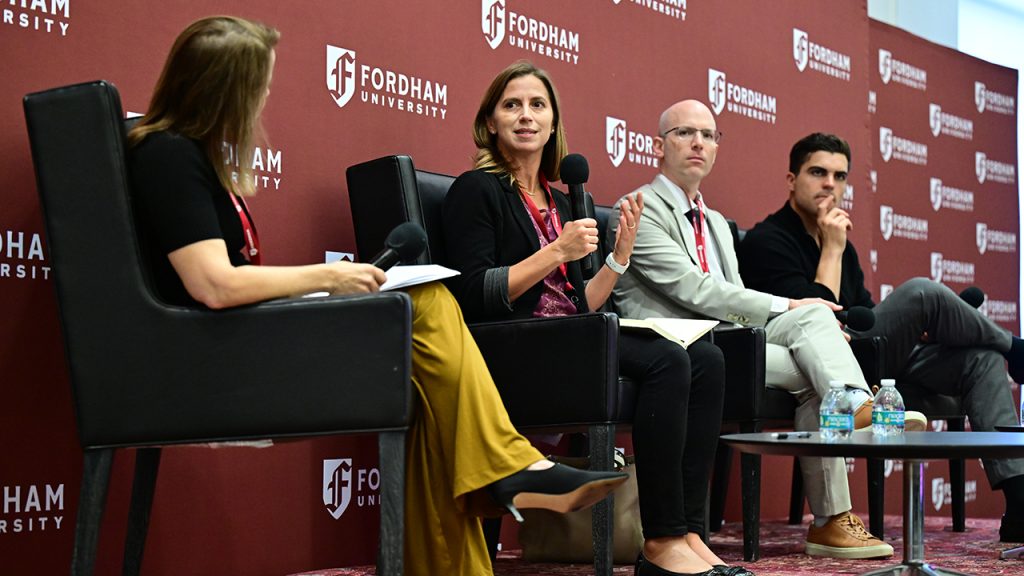
One of the event’s panel discussions focused on those questions of how to advance the greater good, particularly in industry. Guided by moderator Jessica Lang, PhD, dean of Arts and Sciences at Fordham, it featured Jesuit-educated professionals.
To one panelist, AI’s inherent value is not just in its speed or power, but in “how many people get lifted up because of it.”
“We have this great opening to give more capability to more people” because of AI, said panelist Kristen Grauman, PhD, a research director in Meta’s Fundamental AI Research lab and a professor in the computer science department at the University of Texas at Austin.
She spoke of the potential for new assistive technologies stemming from computer vision and augmented reality that, for instance, give the visually impaired new tools for navigating the world.
“What’s so exciting to me, and so important, is being able to move from perception by machines to perception by machines to amplify human capability,” said Grauman, a Boston College graduate.
Expanding Health Care Access
Panelist Eric Oermann, M.D., a practicing neurosurgeon, pointed to another social good: expanding access to health care through the use of AI. The technology is seen as a tool for automating routine tasks, leading to reduced costs, and for developing new technologies to expand health care to underserved areas.
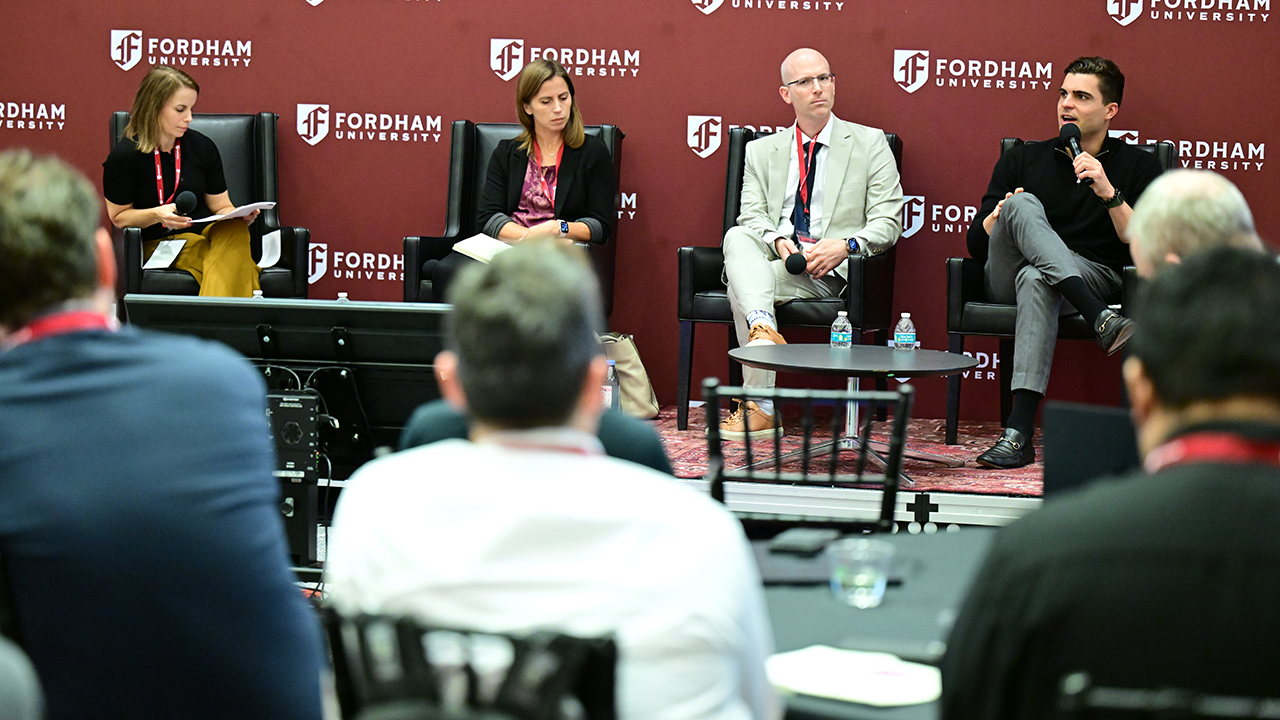
He noted the millions around the world and in the U.S. who have to do without healthcare. “If AI can somehow bridge that chasm, I think that’s such a clear win for the technology,” said Oermann, an associate professor of neurosurgery, radiology, and data science at the NYU Grossman School of Medicine who graduated from Georgetown University.
Putting the Greater Good First
Panelist George Sivulka, founder and CEO of New York-based AI firm Hebbia, said it’s important to introduce new AI technologies mindfully, knowing when to put the social good ahead of profit, as the leaders of AI firms seemed to do with their recent calls for slowing down their products’ rollout because of AI’s potential dangers.
“There’s some very non-capitalistic things that I’m very proud of other CEOs for doing,” said Sivulka, a Regis High School graduate.
When AI Is Uncertain
Sivulka said he sees “better types of human work to come” as AI takes care of dull, repetitive tasks. Oermann related how AI has improved human connection in at least one setting—the doctor’s office, where automated dictation frees doctors to fully focus on the patient in front of them.
“I think that has such a profound impact on your ability to form a relationship with your physician,” he said.
Asked what makes AI “good,” Grauman said “this means having models that can represent their own uncertainty, and can reveal that uncertainty,” at least in the field of computer vision.
While technically challenging, she said, this is “very important to have what we would call good, responsible, trustworthy AI.”
