

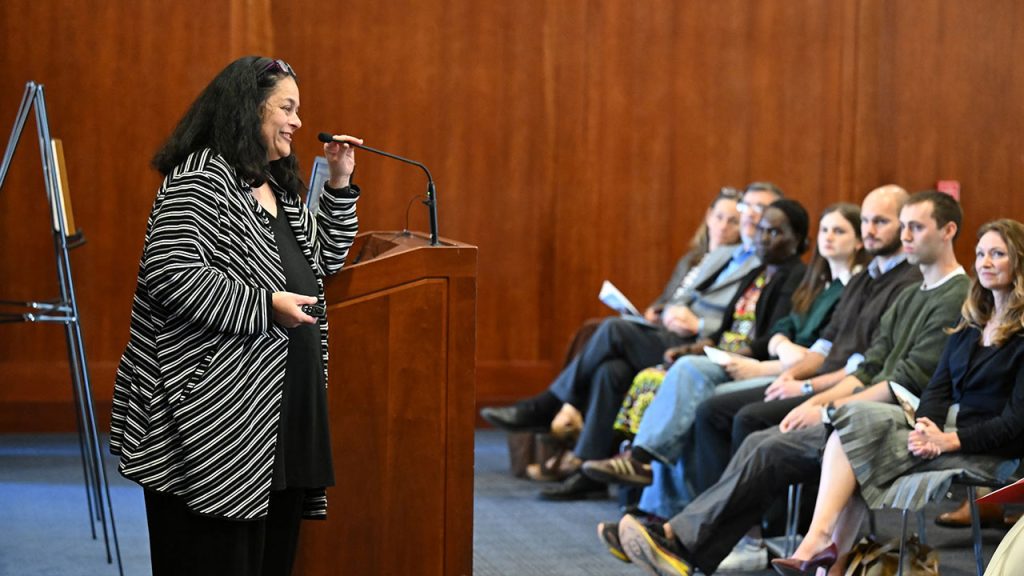
Three faculty members named to endowed chairs were honored this week at a joint event celebrating their achievements at Fordham and within their fields.
Provost KerryAnn O’Meara, PhD, welcomed the students, colleagues, and family members who gathered at the Oct. 6 chair installation ceremony to celebrate Psychology Professor Besty McCoach, PhD, the Anne Anastasi Professor of Psychometrics and Quantitative Psychology; History Professor Amir Idris, PhD, the Margaret Peil Chair in African and African American Studies; and Philosophy Professor Stephen Grimm, PhD, the Robert Southwell, SJ, Distinguished Professor in Philosophy and the Humanities.
The highlight of the event was the brief lectures delivered by each honoree, spotlighting the scholarly inquiries at the heart of their work.
Measuring the Immeasurable
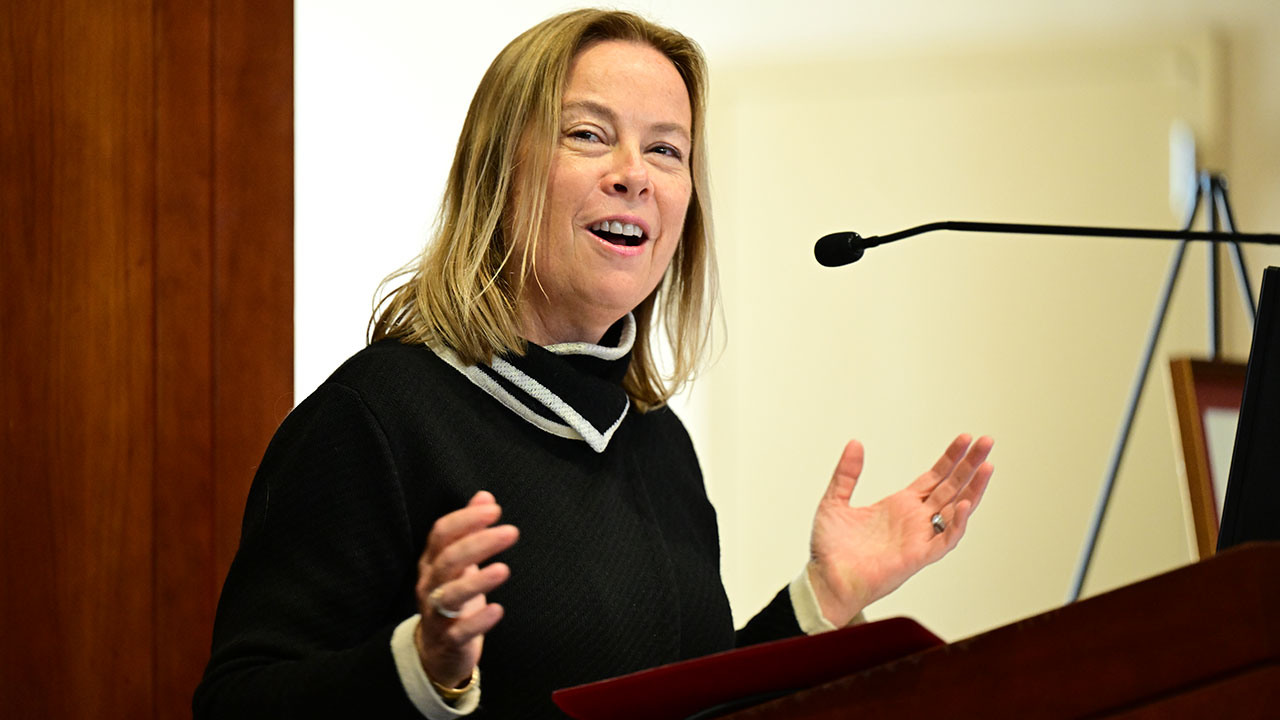
McCoach, the founder and program chair of the Modern Modeling Methods conference, recalled using a textbook of Anastasi’s in her first graduate measurement course. Upon learning that Fordham had an endowed chair in honor of this pioneering psychometrics scholar who received her PhD at age 21 and taught at Fordham for more than 30 years, McCoach told her husband, “Could you imagine being able to say that you’re the Anne Anastasi endowed chair?”
McCoach then turned to a favorite topic of hers: latent constructs, or invisible, hard-to-quantify attributes such as creativity. “Some of the most interesting things to measure are the most difficult,” she said at the event, held at the Lincoln Center campus. Further complicating this work is the imprecise language of academic research, she pointed out. “Vague quantifiers” like the words “sometimes” and “occasionally” can carry variable meanings—even for the same person.
“Measurement is hard and messy, but we can’t shy away from the important measurement problems that we want to solve. That’s why the world needs more psychometricians!” she said, ending on a slide featuring some of her favorite scholars in the field, including her Fordham colleagues Leah Feuerstahler, PhD; Alfonso Martinez, PhD; and Heining Cham, PhD.
Centering Africa in the History of Race
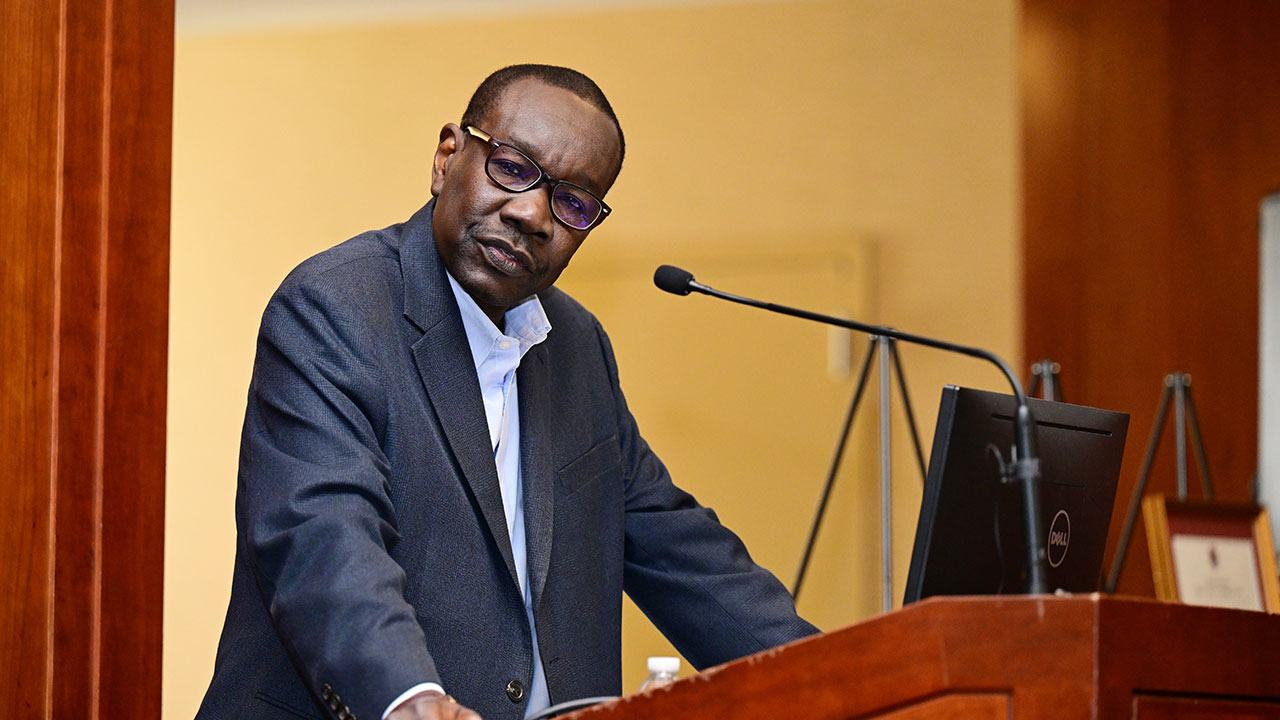
Idris, a historian of race, empire, and political thought in Africa, is the inaugural holder of the Margaret Peil Chair. Its namesake was a scholar of West Africa who earned her master’s degree from Fordham in 1961. She died in 2021 at age 90, and her bequest established the chair.
In his lecture, drawn in part from his forthcoming Cambridge Companion to Race in African History, Idris challenged common assumptions about the history of race. The concept cannot be traced only to the trans-Atlantic slave trade, European colonization, scientific racism, and modern ideas of Blackness and whiteness, he said. Africa is also central to the origins of race, which he defines as a historical process in which difference becomes hierarchical, inherited, and institutionalized, affecting access to land, labor, property, political authority, citizenship, and social dignity.
“To place Africa at the center of racial theory is not simply to correct an omission,” he said in conclusion. “It is to recognize that no adequate global history of race can be written without taking seriously Africa’s historical experiences, intellectual traditions, and political struggles.”
Questioning Philosophy’s Connection to the Humanities
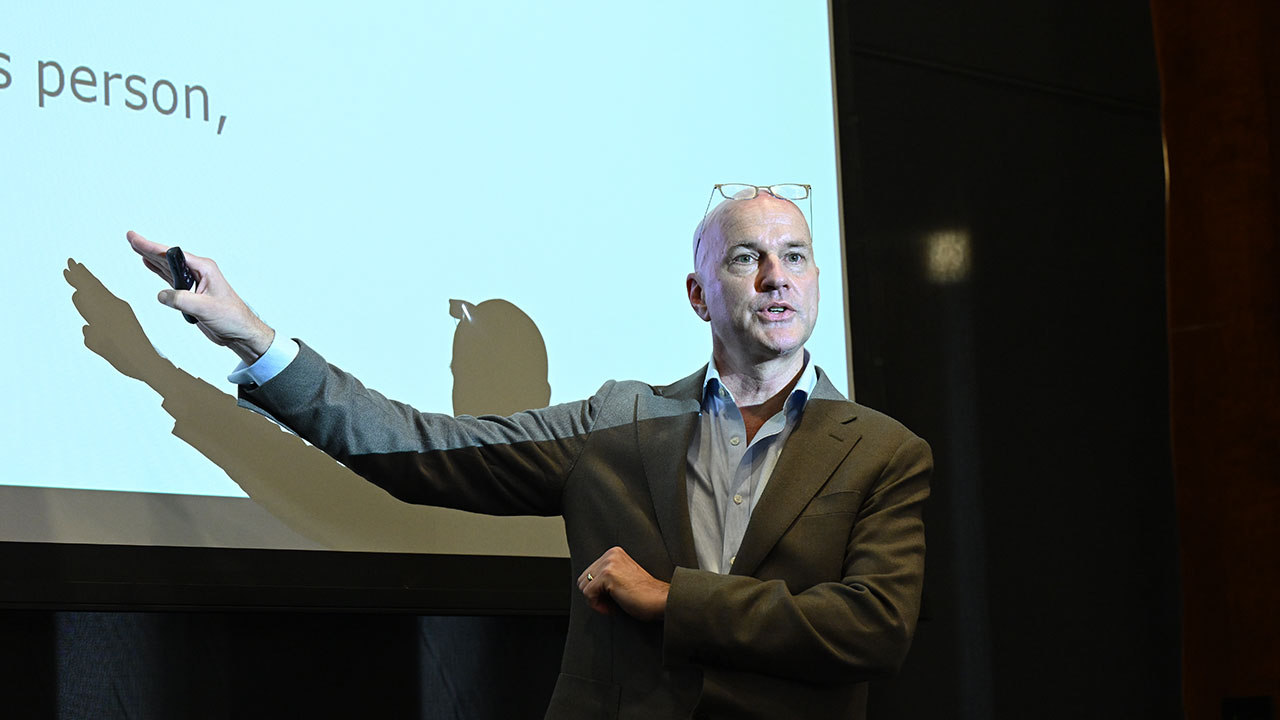
Grimm’s research in human understanding has expanded to the philosophy of AI, which informed the recent Ignatian AI Conference he organized. As the new Southwell chair—named after the 16th-century English poet and martyr Robert Southwell—he noted that his title, Distinguished Professor in Philosophy and the Humanities, brings up a question he has long pondered: Does philosophy belong in the humanities?
Grimm pointed out some incongruities: logic, a fundamental branch of philosophy, looks and operates like math. Philosophy also veers from two origin stories for the study of the humanities: In 14th- and 15th-century Italy, figures such as Petrarch placed the study of moral philosophy alongside grammar, poetry, history, and rhetoric in their vision of the humanities; in 19th-century Germany, the philosopher Wilhelm Dilthey defined the humanities as the study of human creativity and works of art. Yet, Grimm said, neither vision captures the full breadth and diversity of philosophy, whose disparate fields seem far removed from the study of human creativity and formation.
So does it belong in the humanities? Grimm didn’t offer a conclusive answer.
“Philosophers, we’re good at raising problems,” he said with a laugh. “Give us 100 years, and we’ll keep thinking about it.”
