

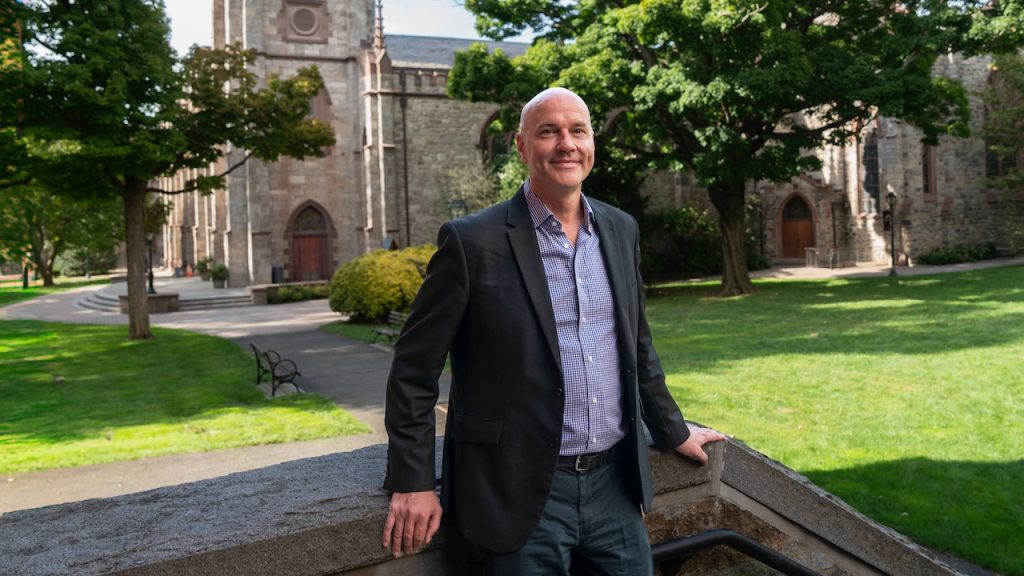
The study of philosophy has become an invaluable asset in the AI age. Major AI companies employ philosophers to safeguard and train the technology using their expertise in ethics, logic, consciousness, and epistemology. And here at Fordham, philosophy professor Stephen Grimm, PhD, is leaning into his scholarship of human understanding and the power of Ignatian discernment to reflect on our relationship with AI.
Inspired by a faith-based framework for thinking about AI at his alma mater, the University of Notre Dame, Grimm established Fordham’s Ignatian AI Initiative and planned its first Ignatian AI conference, to be held from Oct. 1 to 3, with a generous grant from the Lilly Endowment and the support of 15 other Jesuit universities.
“Jesuit universities are really the place where the church does its thinking,” said Grimm, who was recently appointed to two chairs: the Robert Southwell, SJ, Distinguished Professor in Philosophy and the Humanities at Fordham and the Dooyeweerd Chair at Vrije Universiteit Amsterdam. “The Jesuits go out to meet and discern the signs of the times and question what’s good here and what’s bad here. What’s leading us closer to God and to others, especially the poor and the marginalized, and what’s leading us away?”
The invitation-only Ignatian AI conference will convene roughly 220 Jesuits and Jesuit-educated scholars from Jesuit universities and high schools, industry experts, members of the Roman Curia, and educational leaders from more than a dozen countries. Together they will discern how to engage with AI in keeping with Jesuit principles.
Below Grimm discusses the upcoming event, the threats that AI poses, and the value of training our minds.
Our understanding of AI’s capabilities and potential harm to humanity has changed radically—even in the last few weeks. How can this conference help us navigate the uncertain future of AI?
What I hope will come out of this conference is a sense of the good and the bad—the things that will not just threaten our health and maybe human well-being, but degrade our humanity, outsource our thinking.
I think most people genuinely realize the value of training their mind. Going through the friction and struggle of thinking—that’s where our mind forms connections. But a recent MIT report on AI and education found that students who encounter some difficulty often default to asking AI, ‘Can you do it for me?’ We have to teach our students to embrace the struggle.
We also want to explore where to use AI judiciously, where we think it will help and not erode our humanity or de-skill us. And to learn where it is in terms of helping, of walking with the poor and the marginalized. Could it possibly bring us closer to God? And what is it about human connection that we really need to preserve and hold on to?
Discerning means taking a step back, seeing what we really value, seeing what preserves our freedom or agency, seeing what helps us to love one another better, trust one another better, care for one another more. That’s the work of this conference.
Who are some of the participants you’re excited to meet and learn from?
One thing that I’m proud of is bringing together Jesuit high schools with universities. Sometimes universities talk about being the front lines in thinking about Ignatian values and how to apply them to AI. But the high schools are the front lines and they’re doing extremely creative things. Jesuit high schools have developed a framework of the skills that they hope their grads will have upon graduation called “The Grad at Grad.” Now, a Jesuit high school in Phoenix, Brophy College Preparatory, for instance, is asking, who do we want our AI grad to be?
The event closes with a group discernment with all 220 or so participants. How will that work?
People are going to reflect on what they experienced in these two and a quarter days. At the end, there will be an hour-and-a-half Conversation in the Spirit led by Vanessa Rotondo, Fordham’s mission strategy officer. After careful guided reflection by trained facilitators, the microphone will be passed around and groups will discuss what they found particularly moving and important from the conference. This will then feed into subsequent meetings with participants who will write a white paper or framework for thinking about AI in Jesuit institutions. I think it’s really going to be powerful.
Given the pace of AI development, how has your thinking about AI evolved since you began planning the conference over a year ago?
I’m just more and more blown away by the capability of these models. The things that I thought it lacked, the next week it seems to have. It’s evolving at such a rapid rate that I wonder where the limits are. Can it attain free will or agency or responsibility or consciousness? I do not think so, but the impressiveness of the models forces us to think more carefully about what’s mysterious and special about us as human beings.
This interview has been condensed and edited for clarity.
