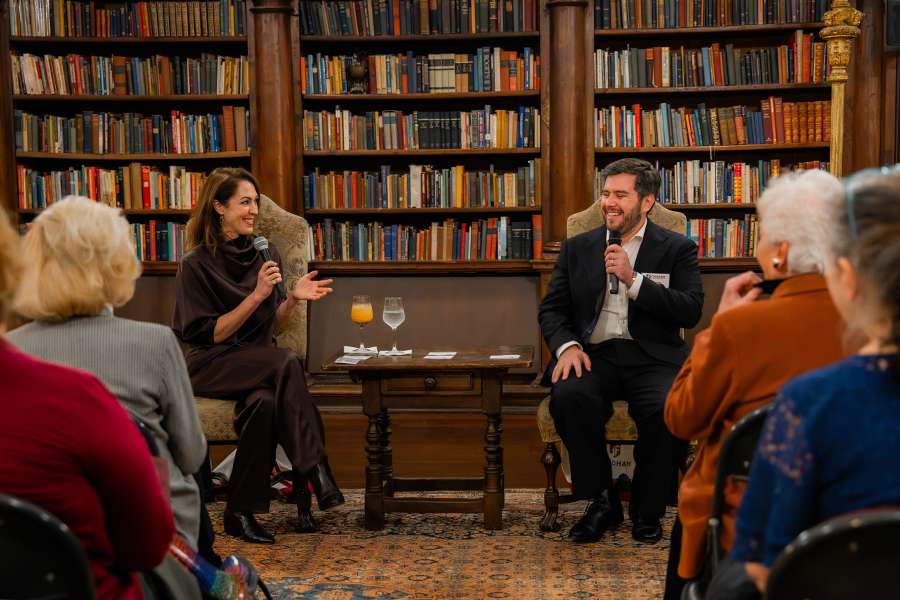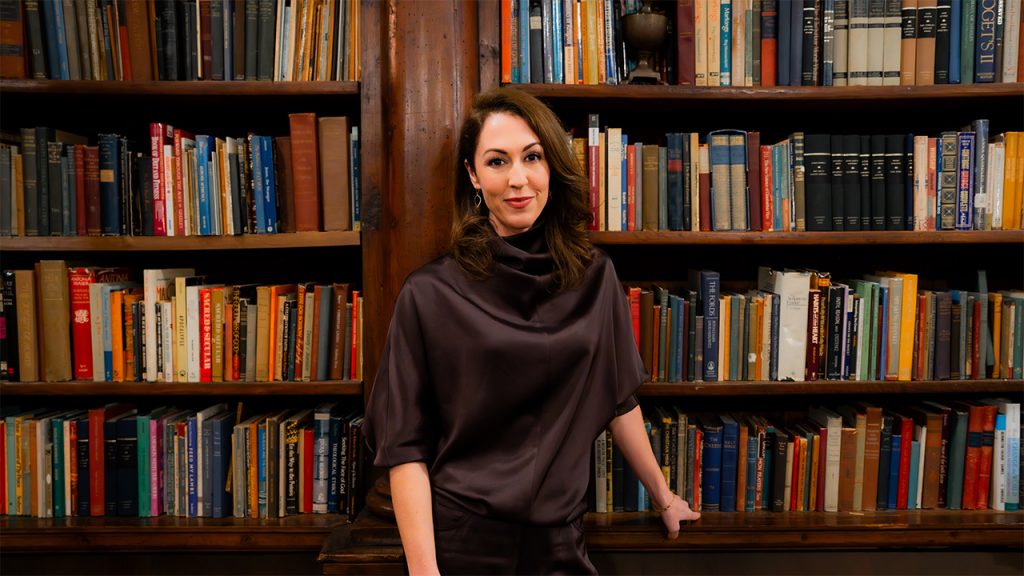
Fordham Theatre grad and Gilded Age star Kelley Curran discussed the show’s historical accuracy and Enid Van Rhijn’s Season 4 rise at a sold-out Fordham alumni event with historian Tommy Silk.
Kelley Curran wanted to make one thing absolutely clear: “There are no zippers on set.”
The Gilded Age star and 2006 Fordham Theatre graduate gave this forceful assurance about the show’s historically accurate costumes to a packed room of alumni, friends, and family—including Curran’s mother—who turned up to the Upper East Side’s House of the Redeemer on a recent November evening.
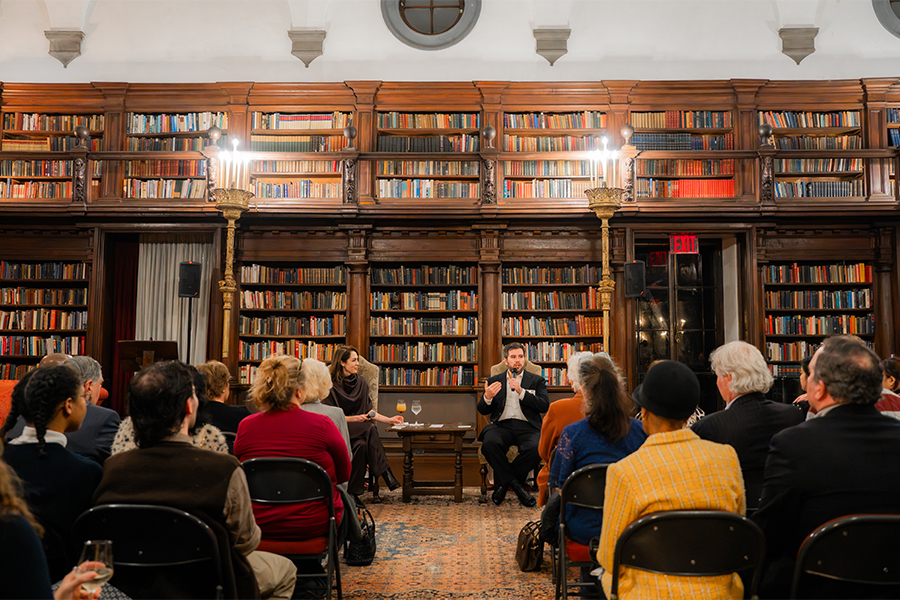
Inside a Real Gilded Age Mansion
Attendees trudged through rain and wind to get to the former Gilded Age mansion that now serves as an Episcopal church and retreat house. They were there to hear a talk between Curran and author and historian Tommy Silk ’12, the second event in the Office of Alumni Relations’ Learning on Tap series.

The pairing and setting for the conversation couldn’t have been better scripted. Silk, a licensed tour guide, author of the book Hidden Landmarks of New York, and creator of @landmarksofny on Instagram and TikTok, is currently working on a book about New York’s buildings from the Gilded Age, which he loosely defined as the American period after the Civil War into the early 20th century.
And when Rachel Kartiganer, Fordham’s senior associate director of young alumni and student engagement, first toured the House of the Redeemer’s historic library, she knew it would be perfect.
“We wanted to go a little bit upscale for this edition,” she said.
The combination of Curran’s star power and the chance to see an authentic 19th-century setting drew a packed house of Fordham grads.
“I’m really into the show, so I was like, ‘I need to go to that,’” said Madeleine McLaughlin ’25 MS. “I’ve never been here before and I was really excited.”
Despite having not watched the show yet, Mayarita Castillo ’16 wasn’t about to miss the opportunity to dive deep into New York City’s past.
“As a non-native New Yorker who’s lived in the city for more than a decade, I like to take every opportunity I can get to learn more about the history of the city,” said Castillo, who lives in Harlem’s Sugar Hill neighborhood. “I see them filming [there] sometimes.”
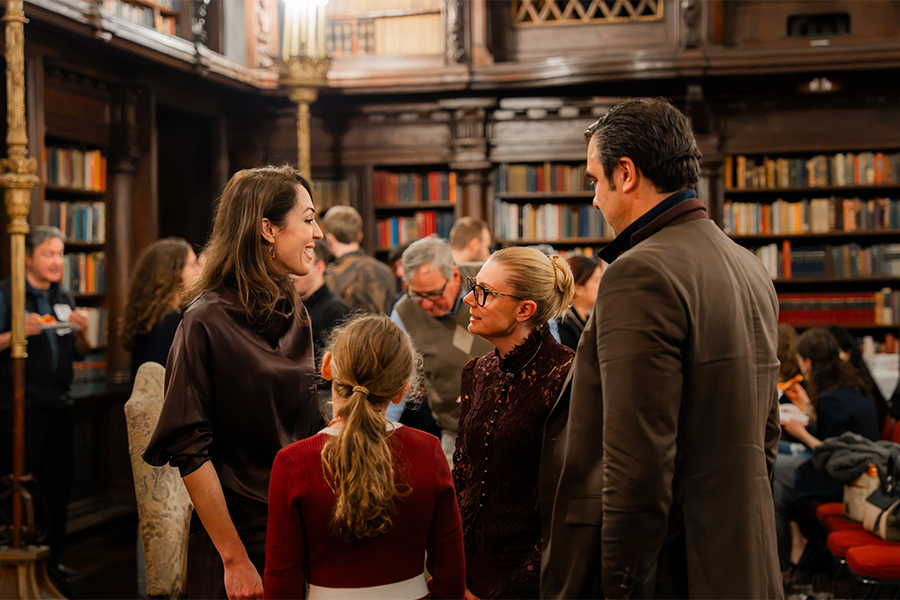
And for Kevin Smith ’68 and his wife, Joanne, who recently moved back to the city from New Jersey, the evening was complimentary—a benefit for President’s Club members in the Victory Bell Circle and above. It was also part of their broader return to the city’s cultural life, which has included other Fordham alumni events. “We went to Fordham Night at Yankee Stadium,” said Smith, a former Fordham baseball player, “and it was only 13 minutes on the subway!”
Kelley Curran on Enid van Rhijn and The Gilded Age, Season 4
For Curran’s part, spending time in Gilded Age mansions has become part of her job in her role as Enid van Rhijn (formerly known both as Enid Turner and Enid Winterton), the one-time lady’s maid who has figured out how to climb into New York’s most exclusive social circles. But while walking the halls of filming locations like Newport’s Breakers and Westchester’s Lyndhurst Mansion is nothing new to her, she said she never tires of it.
“It’s really been one of the extraordinary privileges of being on The Gilded Age,” Curran said while taking in the two-story library, which was removed piece by piece from a ducal palace in Italy and shipped to the United States during World War II—on two ships, to halve the damage should one of them get destroyed.
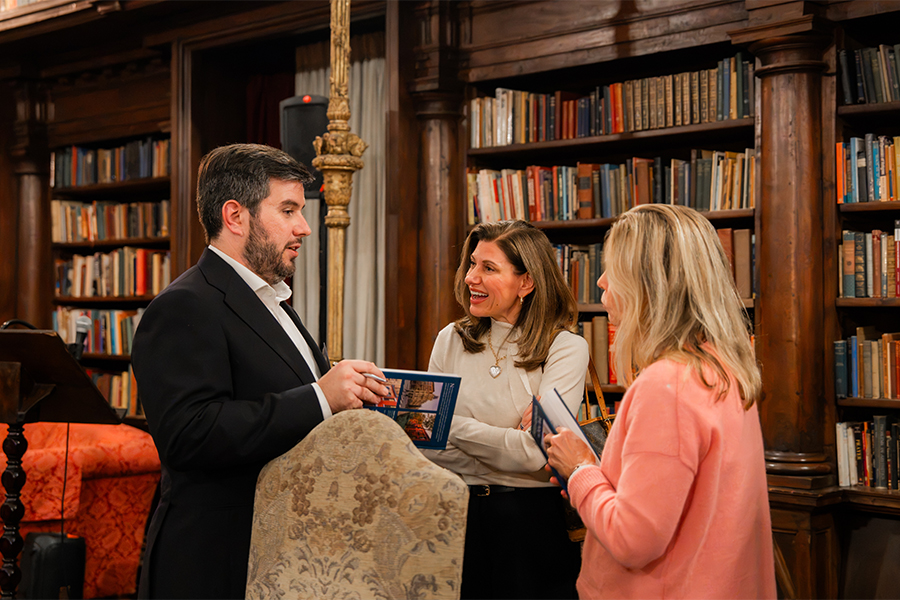
It’s the kind of space a viewer could imagine playing host to the sort of artists’ salons Enid and new husband, Oscar van Rhijn, have begun planning in The Gilded Age Season 4, a plot point that Curran is thrilled about.
“I just love that she’s so excited about the idea of creating a salon for artists and musicians,” Curran said. “Ultimately, she’s an aesthete. She has vision.”
In response to an audience question about the show’s faithfulness to the period, Silk backed up Curran’s claim that, while taking artistic liberties, The Gilded Age does an impressive job of grounding events in real history.
“There hasn’t been a storyline where I couldn’t think of what the real-world working story was for it,” Silk told the sold-out crowd.
He did have one bone to pick with the show’s depiction of 1880s New York, though.
“I do think there needs to be more horse poop.”