

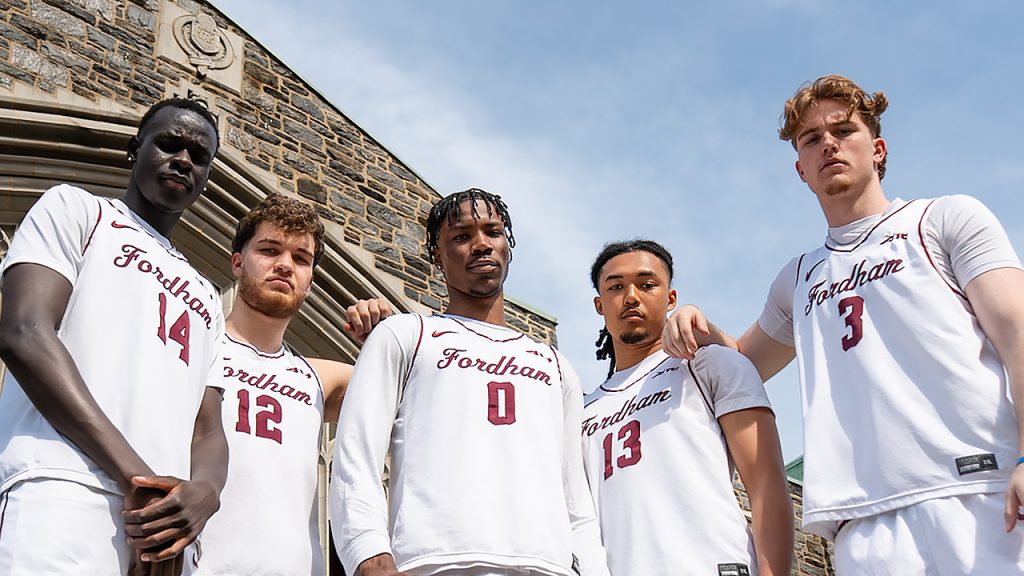
The men’s basketball Rams closed out a winning season in March, and then came a follow-up victory: five high-scoring team members who have played in the starting lineup opted to return next year, rather than join the flurry of college basketball players from around the country who are transferring schools.
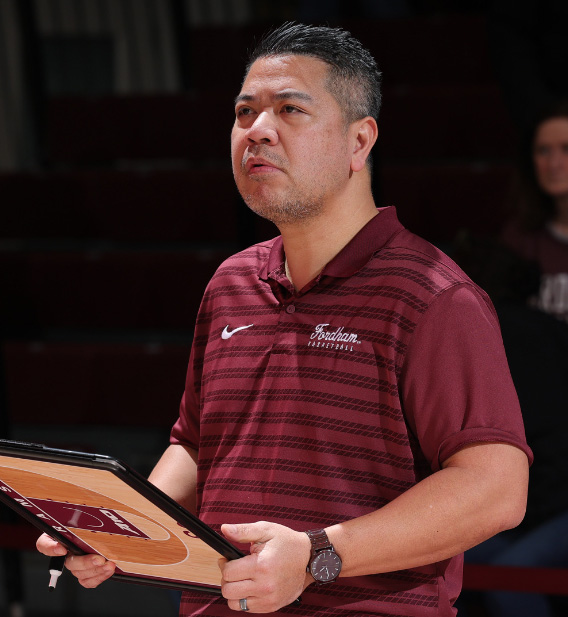
These days, when a team retains just three players, “you think, ‘wow, they’ve got great retention,’” said Mike Magpayo, head men’s basketball coach at Fordham. The retention of the five players, he said, shows the appeal of the culture within Fordham athletics, a culture supported by coaches and staff as well as President Tania Tetlow and members of the Board of Trustees. Even as transferring schools has become easier and more lucrative for college players in the last few years, Fordham’s experience shows how a program’s culture can help keep them in place.
‘Transferring Is Currency’
“It’s almost like moving, transferring, is currency now,” Magpayo said. Student athletes can now attend as many as four colleges in four years, he said, after the NCAA scrapped its policies that limited them to transferring once and required them to sit out from athletics for a year after doing so.
And players now have incentives to switch to universities where they can earn more money by marketing their names, images, and likenesses (NIL), as made possible by a 2021 U.S. Supreme Court ruling.
Today, 60 to 65% of college basketball players enter their names in an NCAA online transfer portal that opens in April, letting member institutions know they’d like to switch schools, said Magpayo. For Fordham to retain five starting men’s basketball players in this kind of environment “says a lot about where the program’s headed,” said Magpayo, who joined Fordham last April.
A Culture Reinforced from the Top
He said the Fordham athletics culture is fed from multiple streams: Athletic Director Charles Guthrie models the program’s work ethic—“nobody’s hustling harder” to fundraise, build connections, and draw attention to athletics, Magpayo said. Trustees like Don Almeida ’73, Darlene Jordan ’89, and Darryl Emerson Brown ’75, ’81 MA have also shown great energy and enthusiasm for advancing men’s and women’s basketball, in addition to making gifts in support of the teams.
And Tetlow has provided “tremendous” leadership, he said, showing an innovative spirit and promoting the idea that “we’re trying to be excellent in our respective crafts, but we’re also trying to be great people and caring and kind.”
“You feel that when you’re here, just from even seeing the way students interact with each other, and so I’m really proud that these five guys found value in that,” Magpayo said.
‘Everyone’s Striving for Greatness’
The five returning players who have started games—all of them international students—are Jack Whitbourn, Rikus Schulte, Akira Jacobs, Abass Bodija, and Roor Akhuar. The five ranked among the top seven scorers on the 2025-26 squad and among the top six in retrieving rebounds, led by Schulte, who was second in the Atlantic 10 last season with 9.1 rebounds per game.
Magpayo said he’s also happy to be retaining two “walk-on” players who earned spots on the team by trying out. “We’re in great shape,” he said, to have “seven guys in the program who know exactly the kinds of attitudes that we have to have” and “the tempo of our practices.”
In interviews, Schulte and Jacobs described a culture of hard work and commitment led by supportive coaches and staff members.
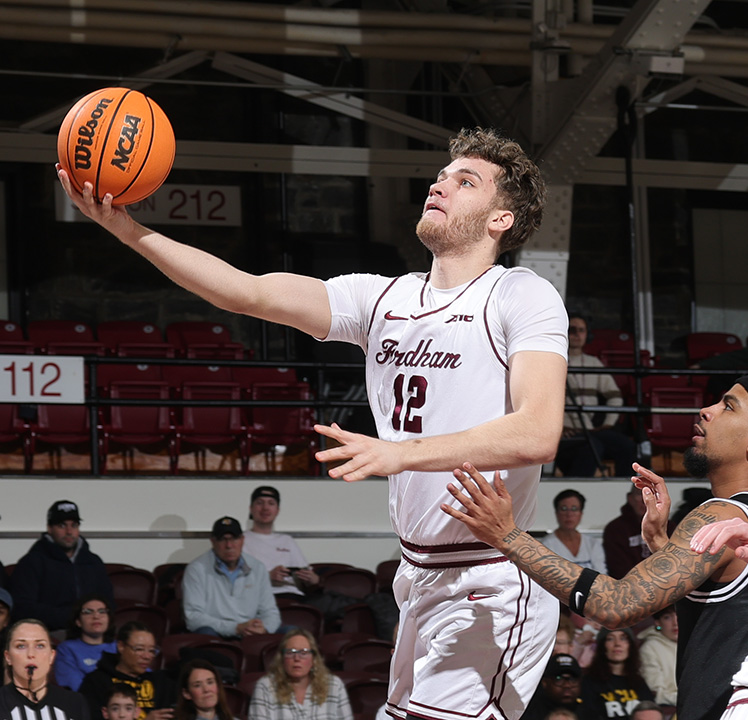
“The coaches are really player-friendly,” said Schulte, a rising senior and a forward on the team who hails from Münster, Germany. “They’re just trying to make us better. They’re not trying to be better than us; they’re trying to help us. I think it’s just like they’re part of the team.”
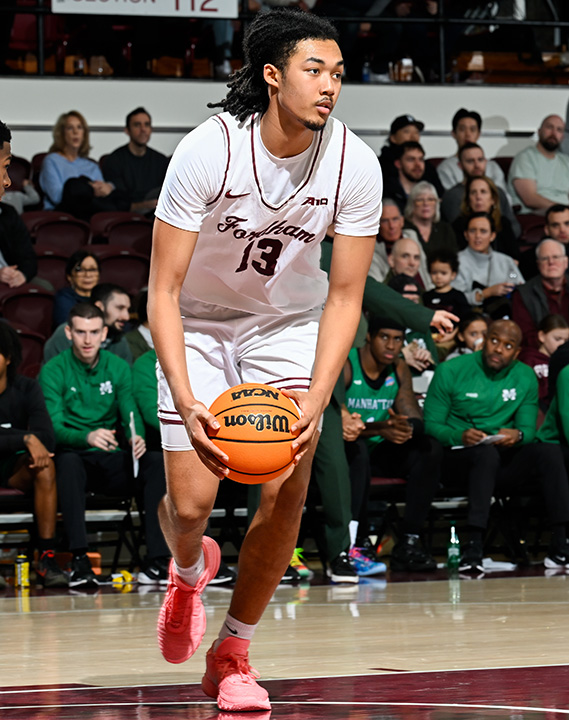
Jacobs, also a rising senior and team forward, came to Fordham because of “how much belief [Magpayo] had in me.” And Magpayo and other coaches are “always there” in their offices whenever he wants to stop by to talk about upping his game.
“They’re so invested in us that I believe in what we do every step of the way,” said Jacobs, who is from Yokohama, Japan.
They both noted how the players come together on their own to practice during the offseason. “Everyone here wants to get better,” Jacobs said. “Everyone wants to work. Everyone’s striving for greatness.”
Both Jacobs and Schulte earned CSC Academic All-District Honors from the College Sports Communicators last month; they noted that professors and academic advisors are committed to their success in the classroom.
Resilience and Perseverance
The team’s culture came into clear view during a low moment in the past season, after the team lost to Davidson in January and fell to a 1-6 record in the Atlantic 10 conference. “I told the guys, ‘Keep your heads up, stand tall around campus. You’re actually growing,’” Magpayo said.
“And over the next 24 hours, we were off, but I saw nine of the guys in the offices watching film with the coaches and whatnot, and that told me we still had a chance, that they still had a growth mindset and they were still fighting the fight.”
What happened next? “They flipped it and they went on a winning streak,” Magpayo said. The team came back to beat Davidson 63-59 in an electric game at the Rose Hill Gym.
After the Davidson loss, “we all got closer,” Jacobs said.
“We showed up earlier for practice, we put in extra work, because we still believed in what we were doing.”
