

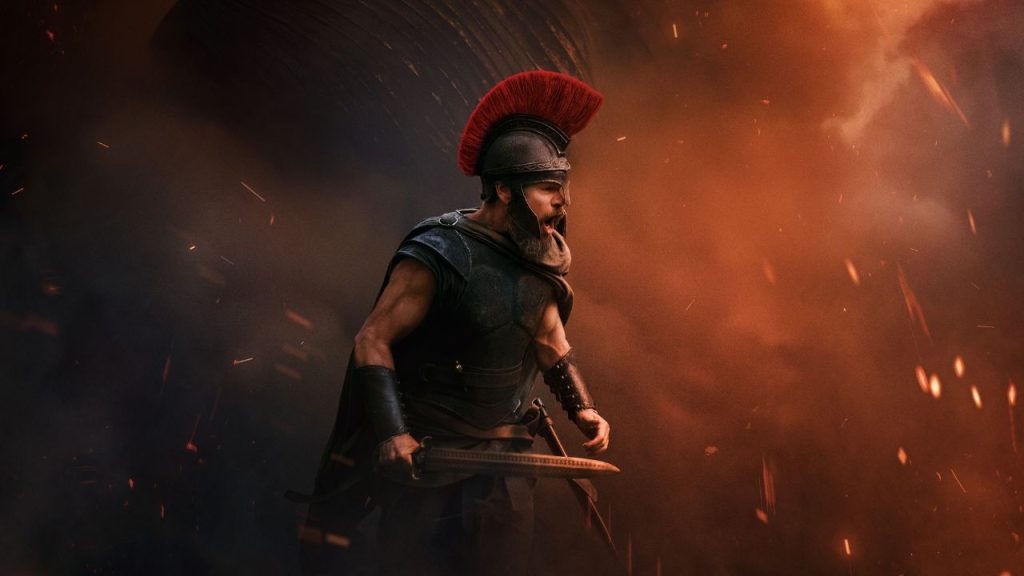
Nearly 3,000 years after Homer composed The Odyssey, audiences are still captivated by Odysseus’ long journey home. Christopher Nolan’s rendering of the epic tale is already a box office success, sparking renewed interest in the story and other ancient Greek myths that continue to shape our culture.
For Andrew Foster, PhD, associate professor of classics at Fordham, the story has endured because it asks timeless questions about what it means to be human.
“The basic questions The Odyssey raises are about identity and belonging,” said Foster. “These are questions any human being at some point in their lives can find resonance with.”
Odysseus on the Big Screen
Foster praised Nolan’s adaptation for its visual ambition and its realistic depiction of the ancient world. One detail that stood out, he said, was the sheer amount of physical labor required to accomplish even ordinary tasks in antiquity, from rowing massive ships to hauling enormous wooden structures like the Trojan Horse.
“I thought they did extremely well to convey how much strenuous manual effort was required to move anyone or anything,” he said.
At the same time, Foster felt the nearly three-hour film attempted to tackle too many themes at once, weaving together war trauma, the collapse of civilization, and the challenges of homecoming without fully developing any one of them.
“It was just too busy,” he said. “[Nolan] really should have picked a theme.”
A theme Foster would have liked to see the film hone in on was temptation, which in the poem is a clear obstacle keeping Odysseus from returning home. The siren song, the lotus leaves, and the sensual comforts offered by Circe and Calypso all represent temptations that threaten to delay the crew’s return to Ithaca.
“Really, that’s the side of The Odyssey that I tend to think receives too little emphasis—that the real impediments to your homecoming are allurements, are enticements,” said Foster. “He spends nine of his 10 years away wallowing in pleasure.”
Ancient Stories for the Modern Era
Nolan’s film is one example of how Greek mythology persists throughout our culture, but another example can be found in the language we use. Even people who have never read The Iliad or The Odyssey may use expressions rooted in these ancient myths and others.
A tennis player’s unreliable backhand might be described as an “Achilles’ heel.” Cybersecurity experts warn about “Trojan Horses,” or malicious software disguised as legitimate programs. New technologies like artificial intelligence prompt concerns about opening “Pandora’s Box,” unleashing consequences that are impossible to contain.
How Greek Myth Has Endured
Part of the reason these myths persist is that they function as cultural shorthand, quickly communicating complex ideas, even to people with little knowledge of their ancient origins. (We may even call a long and eventful journey “an odyssey.”) But why do we use Greek myths as our cultural touchstones, rather than, say, Russian folklore?
According to Foster, the survival of classical stories and art was not accidental but the result of centuries of deliberate preservation by scholars, educators, patrons, and other cultural elites.
“The preservation of the classical tradition was something of a top-down activity,” Foster said. “For the last 2,500 years, there’s been an active, heavily patronized, energetic effort to preserve, augment, and transmit these stories.”
The rise of Christianity also shaped which myths survived. Foster noted that many Greek narratives have parallels in the Bible. Pandora, for example, bears striking similarities to Eve: Both are first women whose curiosity brings suffering into the world. Myths that reflected biblical stories were more likely to resonate within Christian intellectual tradition and to be passed on, Foster said.
Ultimately, Foster said, these stories have endured because, like Odysseus’s long journey home, they continue to speak to human experiences that transcend time and place.
