


The Fordham Foundry has launched a program to help student entrepreneurs turn ambitious ideas into viable businesses, and the first venture it’s backing comes from a first-year student with a taste for caffeine.
The Early-Stage Venture Program, funded through a $1 million endowment from investor and philanthropist Mario Gabelli, invested $30,000 in Wide Eye—a caffeinated popcorn company founded by first-year Gabelli School of Business student John Russak. Going forward, the program will provide roughly $60,000 annually to support student-run startups and, eventually, Bronx-based entrepreneurial ventures.
The venture program officially began investing in November, shortly after the Gabelli endowment was established. An investment committee made up of Foundry staff, faculty members, and outside investors selected Wide Eye as the first recipient.
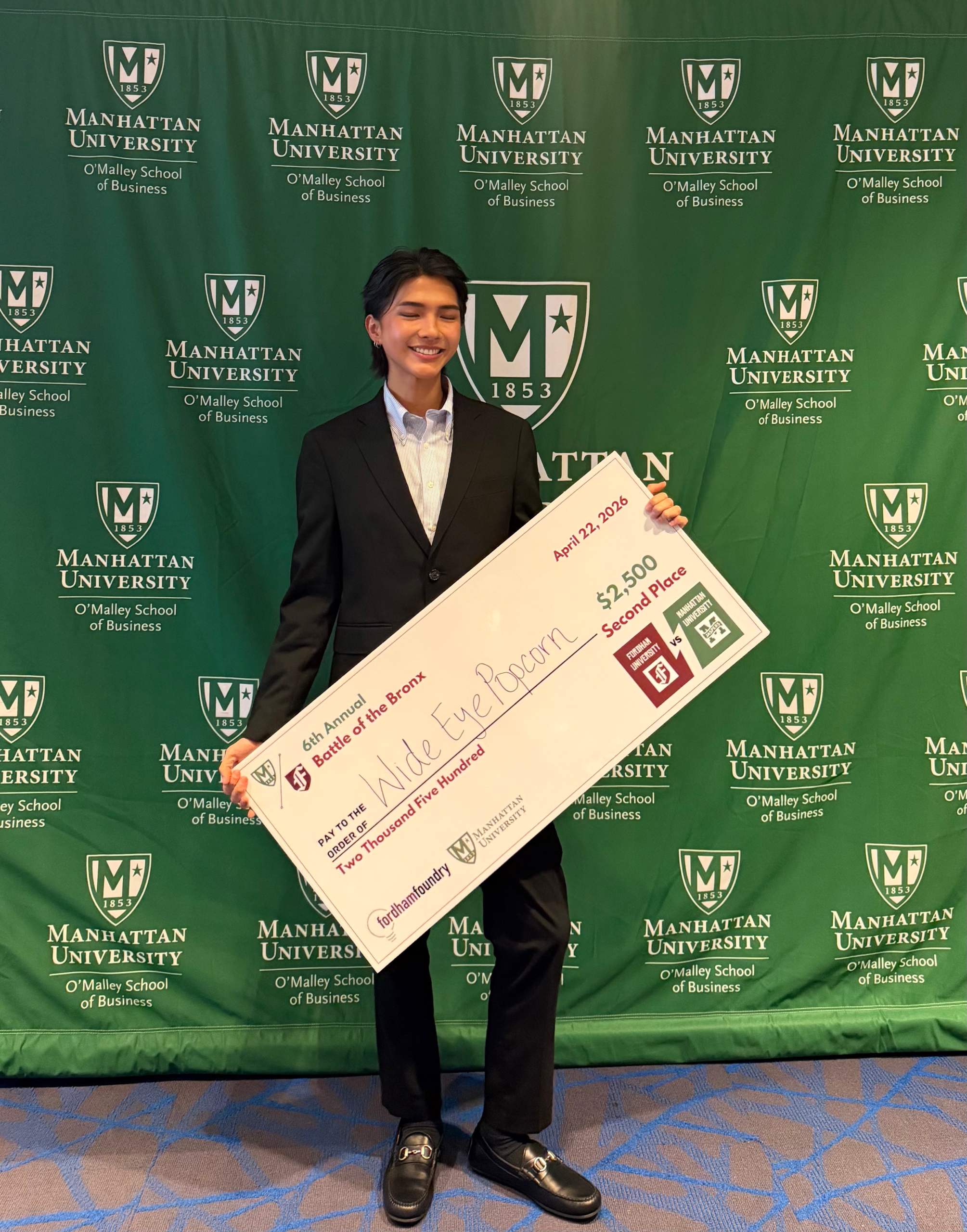
The company, which aims to offer a portable, health-conscious option for those who want a high-fiber snack as well as an energy boost, received an additional $2,500 prize from the Battle of the Bronx pitch competition hosted by Fordham and Manhattan University.
From Inspiration to Investment
“The idea came to me around a year ago,” Russak said. “I was really caffeine dependent throughout the end of high school and entering college, and I didn’t have a lot of time between classes, sports, and socializing to stop by Starbucks and spend $8. I wanted something that was both portable and filling.”
Wide Eye is a kettle-corn-like popcorn snack with a zero-sugar, caffeinated coating, in flavors like cold brew and matcha. Russak, a finance major, said the company is currently developing recipes and working with a food scientist to make a shelf-stable product.
Russak says his target demographic will be younger people who are in need of a pick-me-up. He plans to offer samples on college campuses once the recipes are developed and tested, where he believes they’ll be popular “especially during finals week when stress is high and caffeine usage is up as well,” he said.
Russak’s path to funding involved months of pitching and refinement through Foundry programming. He competed in several pitch competitions and workshops before appearing before the investment committee.
Ultimately, Foundry staff hope to expand the program beyond Fordham students, supporting Bronx entrepreneurs who participate in Fordham community workshops and entrepreneurship programming.
Jenny Mith, community director at the Fordham Foundry, said the program builds on an earlier Foundry initiative known as the Angel Fund, which gave students hands-on experience evaluating startups.
“The Angel Fund was designed to give students real venture capital experience—sourcing deals, conducting due diligence, and bringing companies to an investment committee,” Mith said. She said the Foundry redesigned the program with more structure and support, a shift that coincided with Mario Gabelli’s $1 million endowment for the fund.
“We took what worked—the investment committee, the student experience—and added more guidance and oversight,” she said.
Supporting Student Entrepreneurship
Dennis Hanno, PhD, a clinical professor at Fordham’s Gabelli School of Business who teaches classes in entrepreneurship, served on the investment committee that evaluated student proposals, including Russak’s. He said the program fills a gap for students with promising ideas but little access to funding or guidance.
“In the past students would say, ‘I have an idea but I don’t know what to do with it,’” said Hanno, the former president of Wheaton College. “The program is going to send a signal that those top ideas, even for a first-year student, are something that Fordham is willing to invest in.”
Luke Johnson, a 2015 Gabelli School graduate who also served on the program’s investment committee, said the program gives students an inside look at how startups are built—knowledge that can set them apart when pitching investors.
“I think it’s a really good way for students to understand not only how to start a business, but how to build one and raise capital for it,” said Johnson, co-founder and managing partner of Rose Street Capital, a tech-driven venture capital firm.
Johnson hopes the program will foster a spirit of entrepreneurship at the University.
“There’s no reason why Fordham students can’t build some of the next biggest companies in the world. I think that’s something we should try to support,” said Johnson.
