

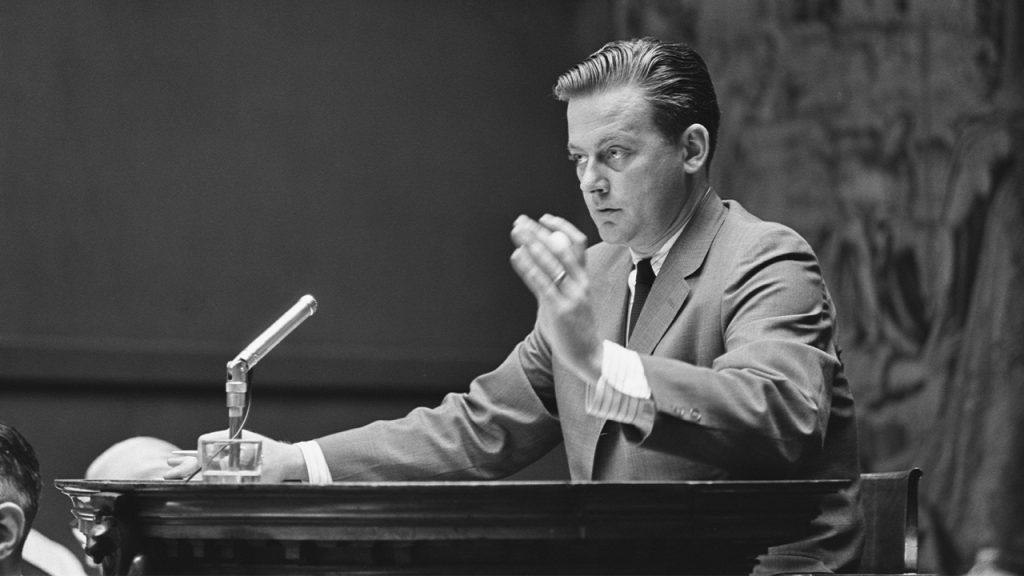
John L. Marion, a 1956 graduate and former trustee of Fordham University once described as “the god of auctioneers in America,” died on May 6 in San Diego. He was 92.
Marion was best known as the former president, chairman, and chief auctioneer at Sotheby’s, the renowned art auction house where he oversaw record sales of works like Pablo Picasso’s Yo, Picasso (1989, $47.9 million) and Vincent van Gogh’s Irises (1987, $53.9 million).
After retiring from Sotheby’s in 1994, Marion, along with his wife Anne Windfohr Marion, founded the Georgia O’Keeffe Museum in Santa Fe, New Mexico. Both individually and through Anne’s Burnett Foundation, Marion gave widely and generously. At Fordham, this included the establishment of the endowed John L. Marion Chair in Art History, Painting, and Sculpture, which has had a major impact on the department, according to former chair Jo Anna Isaak.
“I remember him talking about how lots of students would be the first in their families to be coming to university,” Isaak recalls. “He was very thoughtful about the economic needs of the students. I would frequently do a study abroad program where I took students to Rome, and he would always give [the department] funds if there were students who couldn’t afford it.”
From Sociology to the Navy to the Auction World
Marion was born on November 27, 1933, in Gardiner, New York, and grew up just about five miles north of the Rose Hill campus, in Mount Vernon. He majored in sociology at Fordham, where he was also business manager of The Maroon yearbook and sold cutlery door-to-door on the side.
“I didn’t have a career path,” he told Fordham Magazine in 1989. “All I knew was that I wanted something involving people, sales, and sales promotion.”
After earning a bachelor’s degree in 1956, he briefly pursued graduate studies in decorative arts at Columbia. He left to join the Navy’s officer candidate school in Newport, Rhode Island, and then served as a lieutenant in Guam.
He was recruited to the auction world by his father, Louis Marion, who was a founder and head auctioneer at the Parke-Bernet Galleries auction house. Parke-Bernet was bought by Sotheby’s in 1964.
When John joined Parke-Bernet in 1960, he started by searching for potential auction items and negotiating with labor unions. In 1961, he had his first turn as chief auctioneer, selling the Charles C. Auchincloss book collection for $78,377. In 1965, the same year his father retired, John conducted his first major Impressionist auction—an area of art for which he would take the gavel at Sotheby’s throughout his career.
Summoning Bids with the ‘Force of His Personality’
Marion became Sotheby’s president and chief auctioneer in 1972, and in 1975, he became chairman. As chair, he led high-profile auctions, trained and oversaw a staff of 25 auctioneers, brought in estate business, and served as media spokesperson.
During his time at the helm of Sotheby’s, Marion oversaw the shift of art auctions from quiet affairs for the wealthy to spectator-filled events marked by exponentially increasing prices.
“He was the god of auctioneers in America,” his successor as chief auctioneer, Tobias Meyer, told The New York Times. “He was beloved. He could make people bid by sheer force of his personality.”
Marion’s propensity for wringing high bids out of buyers was not merely a matter of playing emcee. As he told The Times in 1990, there were tricks of the trade.
“If a bidder looks like he’s getting to the end of his string,” he explained, “I’ll give him a break and look away and then—very quickly—look back and he’ll think, ‘Maybe I’d better bid again.’ I play little mind games.”
Despite his ability to lighten the mood of auctions with jokes, he took his job quite seriously.
“Everything culminates in that moment of the fine arts auction sale, so it must be done with class and style,” he told Fordham Magazine. “If the sale isn’t carried out properly, all the work beforehand—appraisals, sale promotion, property restoration—is wasted.”
Marion’s post-Sotheby’s life was largely focused on both art and philanthropy. In establishing the O’Keeffe Museum in Santa Fe, the Marions created a home for the largest collection of the artist’s work in the world. He also sat on the boards of the contemporary arts institution SITE Santa Fe, the Santa Fe Art Institute, and the executive committees of Performing Arts Fort Worth.
A Legacy of Giving to Help Students Access Culture
Among the recipients of Marion’s time and philanthropy was his alma mater. He joined the University’s Board of Trustees in 1988, telling Fordham Magazine a year later that he was proud to “assist Fordham’s administration in formulating important future policies.”
In addition to establishing the endowed chair, Marion made frequent donations to the Fordham Fund, the art history and music departments, and the Founder’s Undergraduate Scholarship Fund. The former business manager of the Maroon yearbook relished the opportunity to support students who might not otherwise be able to study at Fordham.
“He clearly appreciated his time at Fordham and saw what it was doing for other students,” Isaak says. “He was someone who actually understood what culture could do for a young person and how important it was to help them access it.”
Marion is survived by a son, John; two daughters, Deborah Murray and Michelle Marion; a stepdaughter, Windi Grimes; and eight grandchildren. His wife Anne and daughter Teri Marion both died in 2020.
