

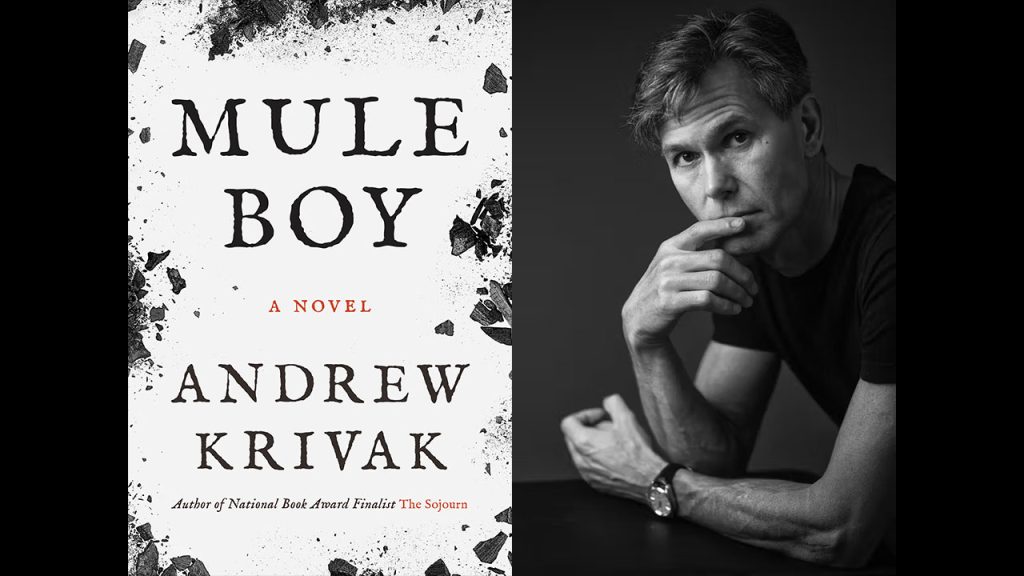
For author Andrew Krivak ’95 MA, the lines between oral storytelling, Catholic liturgy, and family history are fine.
In his latest novel, Mule Boy, Krivak—a former Jesuit and National Book Award finalist—explores the mysteries of sin, grace, and mercy through Ondro Prach, the 13-year-old lone survivor of a Pennsylvania coal-mining disaster that kills four men on New Year’s Day 1929. Decades later, the loved ones of the deceased seek Ondro out, and over the course of a single day—in a lyrical style that mimics the cadence and pull of oral storytelling—he relates the miners’ final moments and reflects on his own life, on what he has done and what he has failed to do.
Fordham Magazine caught up with Krivak to discuss the new novel, an NPR Book of the Day selection hailed by The Wall Street Journal as “a stunner.” We also spoke about his faith, his influences, and why The Bear, his acclaimed 2020 fable about Earth’s last two inhabitants, continues to resonate with audiences across the country.
So, for me, Mule Boy is as hauntingly beautiful as The Bear in its descriptions of the natural world and humans’ place in it. How would you describe Ondro’s connection to nature, from his time in the mines to his final workday as a fire lookout and park guard on Mount Monadnock in New Hampshire?
I wasn’t thinking about nature when I started writing Mule Boy. I’d always wanted to write about my grandfather’s death and his time in the mines. I grew up in the ’70s in Wilkes-Barre, Pennsylvania, and the mines—the slag heaps and the culm banks and the collieries and the trains—were all still in the area. My father’s father was killed in a cave-in, and my mother’s father died of silicosis, “black lung.” And so the novel starts with the early morning walk of the boy Ondro down to the mine. It’s the first day of the year, and he’s beginning his first day as mule boy after he’s been in the mines as a nipper and a spragger.
Ondro eventually exchanges the coal mountains that nearly kill him for mountains that could never be mined. For him, they’re a safe distance from the actual disaster. But everybody who was affected by that disaster comes to him to find out what happened. What did you do, and what did you fail to do? And the two mountain ranges are essentially side by side, and Ondro, he lives among them.
The novel is bracketed by the start and end of Ondro’s work life. How does your family history inform your own work as a writer?
We were taught to understand that work was hard, but work was also good. It was ora et labora, pray and work—as Catholics, this is what we understood; it’s liturgical.
My parents were really great about the fact that I loved books, and we had books all over the house. But when I decided that I really wanted to try this writing gig, I still carried that weight of approval with me. What would it look like in the eyes of my parents? So I think every time I sit down to write and I write about work, I am one part poet or maker and one part struggling with the approval of those who work. The biggest compliment my parents would say about somebody is, “Look at that, she’s a doer.” So that pushes me.
In A Long Retreat: In Search of a Religious Life, your memoir of your time as a Jesuit in formation, you described your dream job as laboring with words and ideas. Do you see storytelling as noble work that unites us across generations?
I wouldn’t be a writer if it wasn’t for the fact that my grandmothers just told stories all the time. There was something fascinating about the way they wove things together. Even when they were old, sitting in a chair near the stove—they weren’t doers anymore, but they were still storytellers. And I was really getting an education in the dialectic of physical labor and I’ll call it the spiritual labor of storytelling. Spiritual because prayer and storytelling are really intricately linked. And that kind of oral storytelling is what I was trying to get at with respect to the form of Mule Boy. No sentences, just clauses and commas—every clause a thought, every comma the inhale, the intake of a breath. If you break a story down, that’s what you get.
The Dardan Trilogy
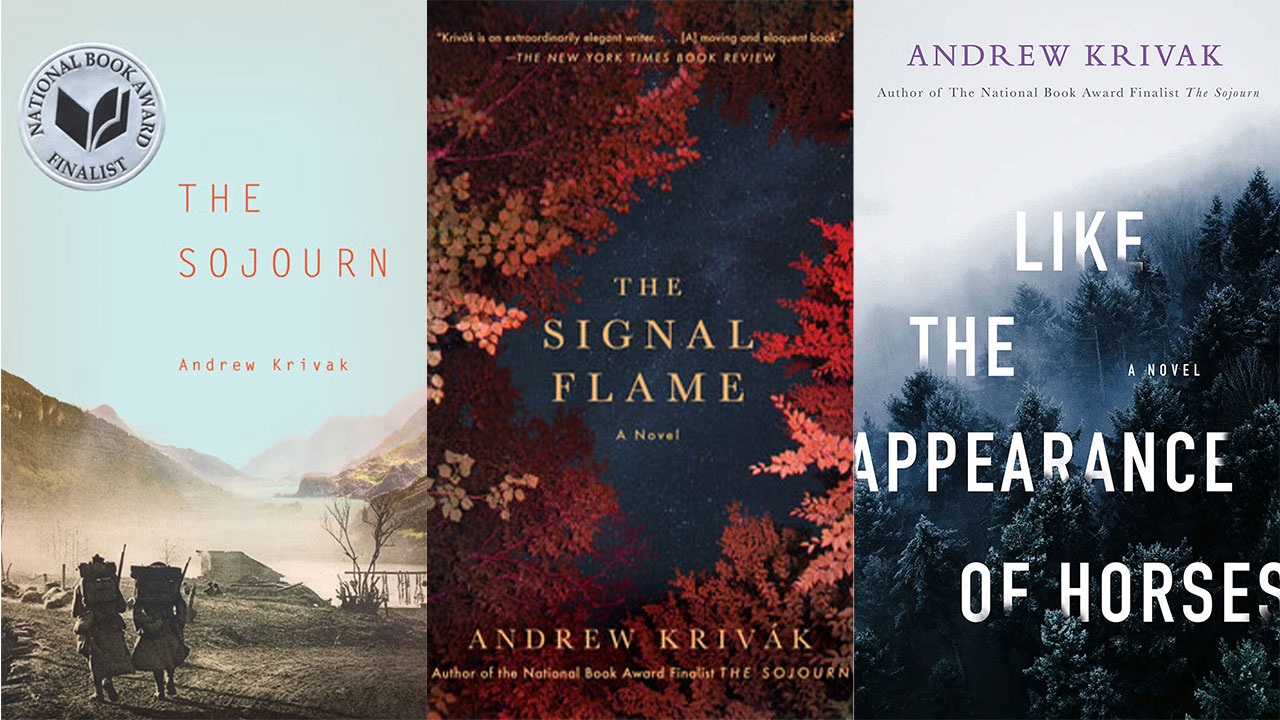
Krivak’s award-winning Dardan Trilogy began with his debut novel, The Sojourn (2011)—a National Book Award finalist—continued with The Signal Flame (2017), and concluded with Like the Appearance of Horses (2023). Set in the fictional town of Dardan, Pennsylvania, the trilogy chronicles the lives of two blended, war-haunted Slovakian-immigrant families across generations as they grapple with violence, love, loss, and the persistence of grace.
When Krivak received the 2012 Dayton Literary Peace Prize for fiction, which recognizes “the power of the written word to promote peace,” he dedicated the award to the people who shaped him, including his immigrant grandmother, whose stories about life in what is now Slovakia continue to inform his fiction.
“They’ve all done their work. They’ve all found their peace,” he said in an acceptance speech. “What remains is for us to keep telling of it as well as to keep praying for it, to keep insisting upon it as well as to keep hoping for it, and to keep listening so that we’ll know when to act, whether it’s out in the world … or at work on a sentence, alone in a room with words.”
Mule Boy strikes me as a very Catholic novel. The novelist Peter Quinn ’75 MA once said three things make up the Catholic imagination—sin, grace, and mercy. All are central to Mule Boy. Do you consider yourself a Catholic writer?
Well, writer first—a writer who has a deep Catholic imagination that was just given to me. I’ll take it; I feel lucky. I remember a passage from Thomas Merton in New Seeds of Contemplation where he says, if you’re going to be a writer and an apostle, make sure you’re a good writer first, because no one likes a bad apostle. That’s a paraphrase, but I think it’s true. And I always want to be a really good writer first, but I can’t ignore my Catholic imagination. I was raised in Pennsylvania, but I grew up in the Jesuits.
Tell me about the Book of Jonah and what role it plays in the novel. In Moby-Dick, Melville calls Jonah one of the “smallest strands in the mighty cable of the Scriptures.”
Exactly. It’s a tiny little book, right? Maybe it’s about four pages long.
What does Jonah, the disobedient, reluctant prophet, mean to Ondro?
So, Ondro is raised a Catholic, and he understands sin and redemption and the need for mercy. And there’s this really hard experience of sin and violence in the world. It’s not until he’s imprisoned with Jacobson, a Jewish man, that Jacobson is the vehicle for grace for Ondro. He gives him a gift of language. The two of them love to read, and if Jacobson is going to teach Ondro any Hebrew in their time together in prison, it’s going to be Jonah because it’s one of the shortest books in Hebrew scripture. And of course because Ondro himself has been in the mines—a kind of leviathan. And there’s a real question: Do the men want to go down in the mine or do they just understand that it’s their duty? So, when Ondro gets to New Hampshire and sits under the tree, people come to him to find out what happened. And he doesn’t want to relive any of it, but he’s called to do it.
Does studying Jonah somehow make Ondro a better storyteller?
I think it does, because if they had sought him out sooner, much like Jonah, he would’ve run away. He was running away most of his life. To college, alcohol, prison as a conscientious objector during World War II. So, yes, the act of reading Jonah makes him a better storyteller, and in the end, a better prophet.
Ondro is given many chances at life, including with Magda, the daughter of one of the miners, who becomes his wife. The chances drift away, but there is still the possibility of love and redemption in the end. Could you talk about what you had in mind with Ondro and Magda?
The two of them are orphans, in love out of their own loss. And this is where the motif of the rosary comes in. Ondro’s father, a Slovak immigrant, makes the rosary because he wants to keep in touch with the old country. The mother takes it out of the father’s pocket when he dies, and she gives it to her young son. It’s a wooden rosary, so it has this capacity to absorb the living oils and flesh of everyone who’s ever touched it. And so when Magda holds Ondro’s rosary and is like, “Oh, wow, did your dad give you this?” nothing could make him happier than seeing that now she’s touched me as well. Now I have her with me forever.
Much like that rosary, much like the liturgical cycle, death is the end of a particular storytelling person, but materially, what is touched does not just stop existing. The line from Scripture is, “Remember that you are dust, and to dust you shall return.” Well, dust is not nothing. And the dust itself is God-created, too.
“ … and on the first day of 1929 I went down into the mine not with a sprag in hand but with a carrot in my growler for Wicked the mule, and in the pocket of my overalls that day, as they are in my pocket still, I kept the rosary my mother had given me on my eighth birthday, my father’s rosary, and she told me he had made the beads himself when he was a boy and his father told him they were moving to America … ”
From Mule Boy by Andrew Krivak
Your 2020 novel The Bear was a National Endowment for the Arts Big Read title—a book meant to spark conversations in communities about the ways our physical environment can lead us to seek “hope, courage, and connection.” What inspired you to write that novel?
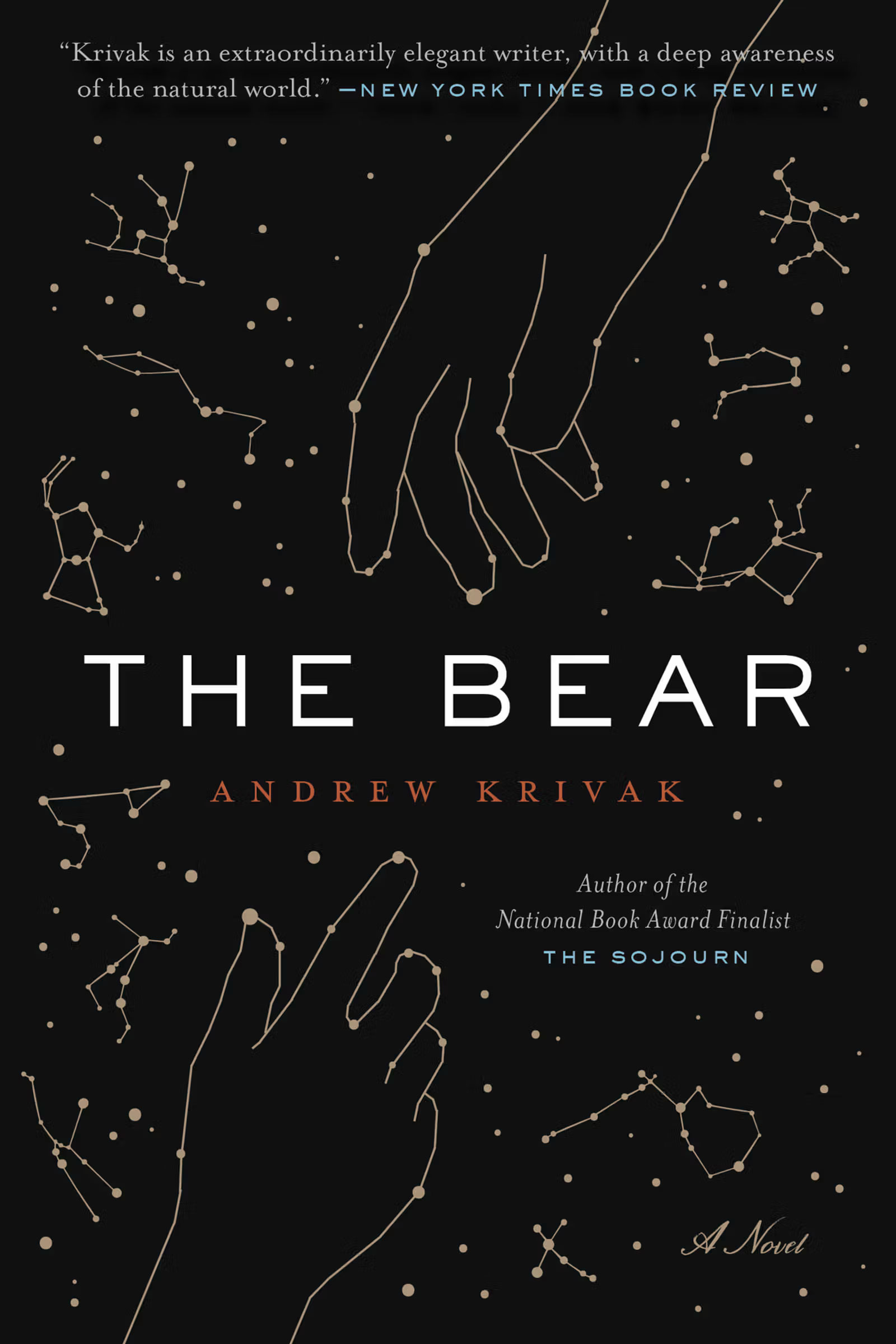
The Bear was not something I planned on writing. I was in the middle of the Dardan Trilogy and sort of just really down about stuff. My wife and I had bought a place on Mount Monadnock in New Hampshire, and I put a challenge to myself: Could I write a work in which nature was the protagonist? Not just some passive landscape through which people walk and wring their hands about what may or may not be happening to the environment, but what if nature were a protagonist?
I was out fishing on the lake one day, and I thought, wow, this place must’ve been really beautiful for the Indigenous who were living in the shadow of the Laurentide ice sheet as it retreated thousands and thousands of years ago. And then I thought, I wonder what it’s going to be like for the last ones. I rowed my boat to shore and I sat down and I wrote, “The last two were a girl and her father who lived along the old eastern range on the side of a mountain they called the mountain that stands alone.” I was not thinking about the extinction of the human race. This was just a story on the knife edge between survival and living in harmony with nature.
There’s a deep spirituality that comes through your writing about nature, even if it’s not always peaceful. Is that also a knife edge you navigate?
I think so. I’m no pantheist, but in The Bear I wanted to ask, what is the spirit of nature? What would it be like if you were the last person on Earth? To me, the great fact of belief is storytelling. I think storytelling will exist after humans go, because who’s to say that the Earth itself doesn’t understand the arc of its own narrative?
And who is going to listen to the Earth? That’s really my question. The ability to listen is what the girl in The Bear is given. With the last person on Earth, the veil lifts, and she understands that there is this constant communication among every living thing—even the living things that are about ready to check out.
This interview has been edited for length and clarity.
Read an excerpt from The Bear by Andrew Krivak
In 2020, Fordham Magazine published an excerpt from The Bear, a fable-within-the-fable the man tells his daughter about an affable old bear who comes to the aid of a village facing famine and oppression.
